Sharmistha Mukherjee Hails PM Modi as India’s Strongest Post-Independence Leader
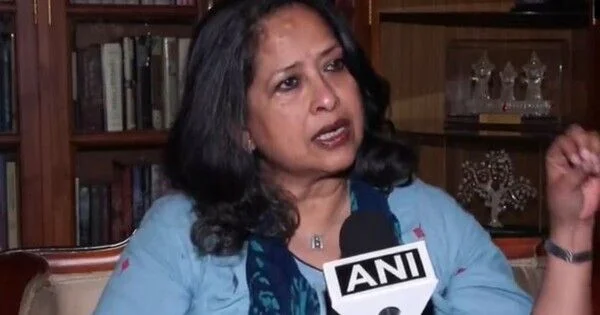
Sharmistha Mukherjee, daughter of former Indian President Pranab Mukherjee, stated that her recent publication regarding Prime Minister Narendra Modi stemmed from observations made by her late father following the 2014 Lok Sabha polls, noting the results reflected a distinct personal mandate for Modi.
Key Highlights
- Sharmistha Mukherjee highlighted that the 2014 election marked the first instance where a new political figure was projected as a prime ministerial candidate prior to the national voting.
- She observed that Prime Minister Modi entering Parliament as a first-time Lok Sabha member while simultaneously leading the nation’s executive branch was a unique historical milestone.
- Mukherjee described Modi as one of the most powerful prime ministers in the post-independence era, credited with establishing a resilient central administration.
- She underscored the necessity of strong leadership for India during current periods of heightened geopolitical volatility across the globe.
Sharmistha Mukherjee, daughter of former President Pranab Mukherjee, announced on Saturday that her latest editorial piece concerning Prime Minister Narendra Modi derived directly from an assessment made by her father following the 2014 Lok Sabha elections, framing the victory as a specific endorsement of Modi himself rather than just the wider party.
Reflecting on the written piece, Sharmistha Mukherjee explained that she authored an essay that achieved wide distribution across numerous Hindi and regional news outlets. In that text, she recounted specific political observations shared by her father concerning the historic 2014 general elections and Narendra Modi. That particular campaign marked a shift in national political strategies, representing the initial time in the history of Lok Sabha voting that an unestablished parliamentary figure was formally announced as the definitive prime ministerial contender ahead of the ballot.
She remarked that, in contrast to earlier electoral cycles where the eventual head of government generally materialized after the votes were counted or was already the sitting Prime Minister, the Bharatiya Janata Party strategically presented Narendra Modi as their singular candidate before the electorate went to the polls.
Otherwise, observing historical trends even within the Congress party, national voting typically concludes first, followed by a general assumption of leadership. This assumption remains particularly strong if the campaign is guided by an incumbent prime minister from the preceding administration, who is widely expected to retain the post. However, this specific situation involved an entirely fresh national face who was openly designated for the prime ministership. Consequently, it appeared as though the electorate intentionally selected not merely the political party, but chose Narendra Modi individually to guide the republic. This represented an entirely unprecedented dynamic, an observation originally articulated by her father.
Sharmistha Mukherjee further commented that Prime Minister Modi’s initial entry into the halls of Parliament as a first-term Lok Sabha member while concurrently occupying the highest executive office in the country stood as an exceptional event in Indian political history.
She pointed out the unprecedented nature of a first-term lawmaker achieving this trajectory, noting that while Narendra Modi had built a significant political reputation as the Chief Minister of Gujarat, creating a distinct political presence, the 2014 race was his inaugural Lok Sabha campaign. This made the arrival of a first-time member into Parliament directly as the Prime Minister an exceptional occurrence.
Evoking memories of the post-election dialogue between her father and Prime Minister Modi, she stated that the former president informed Modi during their initial meeting that the public mandate extended beyond organizational support, serving as a personal endorsement that carried a much heavier weight of governance responsibility.
Assessing the ongoing administrative leadership, Mukherjee stated that Modi succeeded in delivering a highly resilient and predictable administration, which she considers vital given the current environment of widespread global diplomatic instability. During these periods of international friction, India requires a decisive central authority, making Modi the appropriate figure to navigate these complex international realities.
She emphasized that every prime minister serving since independence contributed to the broader framework of state-building, arguing that executive tenures must be analyzed through an impartial historical lens rather than partisan comparisons.
Whether evaluating Jawaharlal Nehru, Narendra Modi, Indira Gandhi, P.V. Narasimha Rao, or Manmohan Singh, actions must be viewed from a historical distance. Every leader advanced the national cause, meaning structural comparisons are unhelpful since no administration achieves perfection. Each leader demonstrated genuine intent, elevating the nation significantly. While opposition criticism remains a necessary democratic function, objective conclusions require temporal distance. Nevertheless, she affirmed that Modi remains among the strongest leaders in post-independence history due to his capacity to maintain a highly stable governance structure.
Contrasting this with historical minority coalitions, Mukherjee noted that past joint administrations revealed the inherent vulnerabilities of shared governance. Smaller regional partners frequently applied political pressure, restricting the implementation of decisive policy shifts. Under the current administration, India has maintained a solid governance foundation, a critical asset given contemporary global strategic shifts, requiring firm national direction amidst international changes.
Historical Context
The shift toward presidential-style campaigning in India reached a definitive turning point during the 2014 general elections. Historically, Westminister-style democracies in India relied on coalitions or established post-election consensus to determine the prime minister. By naming a prime ministerial candidate prior to the election, the 2014 campaign altered voter dynamics, a trend that continues to influence modern Indian political structures and executive governance.
FAQs
What did Sharmistha Mukherjee say about the 2014 election mandate?
Sharmistha Mukherjee shared an insight from her father, former President Pranab Mukherjee, noting that the 2014 Lok Sabha election was a personal mandate for Narendra Modi rather than just a victory for his political party.
Why did Mukherjee describe PM Modi’s entry into Parliament as unprecedented?
She highlighted that it was highly unusual in Indian political history for a first-time Lok Sabha Member of Parliament to enter the legislative house directly as the nation’s Prime Minister.
How did Sharmistha Mukherjee evaluate PM Modi’s governance?
She described Prime Minister Modi as one of the strongest post-independence leaders in India, praising his ability to provide a highly stable and resilient central government during times of global geopolitical uncertainty.