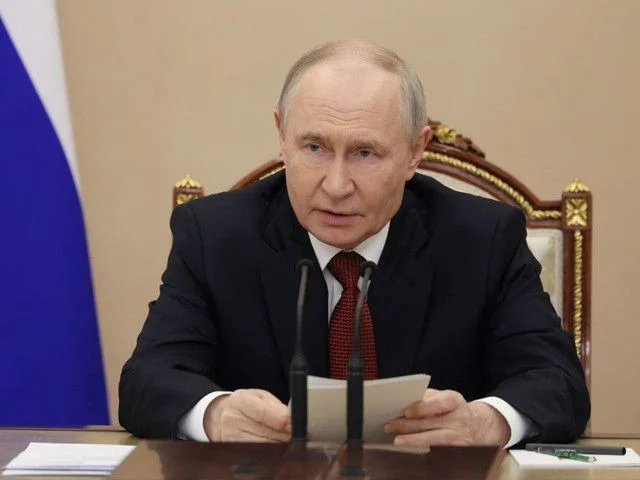
Putin Admits Russian Fuel Shortages Amid Ukrainian Drone Strikes
President Vladimir Putin conceded on Sunday that intense Ukrainian drone campaigns have triggered domestic fuel shortages and supply deficits across Russian regions. Moscow has activated a round-the-clock emergency task force to stabilize distribution and protect its vital agricultural sector while actively considering a sweeping ban on diesel exports.
Key Highlights
- President Putin acknowledged persistent lines at gas stations and regional supply deficits.
- Dual Ukrainian drone strikes disabled major refining facilities in Krasnodar and Yaroslavl.
- A federal task force is operating continuously to protect domestic fuel schedules.
- The Kremlin is weighing a complete ban on diesel exports to protect local industries.
President Vladimir Putin acknowledged on Sunday that fuel supply problems had created shortages in Russian regions and a task force was working on ensuring sufficient quantities were provided throughout the country.
Putin, addressing a meeting of senior officials on fuel supply and distribution, said Russia had to minimize the effects of Ukrainian drone strikes on oil installations linked to the shortages.
He called for measures to ensure supplies for the farm sector and said a ban on diesel exports was under consideration.
“You are well aware that problems for drivers and for businesses persist,” Putin told the meeting, according to accounts published by Russian news agencies. “Unfortunately, there are still queues at gas stations too.”
He added: “We have to reduce to a minimum the impact of terrorist attacks on our civilian targets and infrastructure.” Ukraine has stepped up medium and long-range attacks on industrial targets in Russia and Russian-controlled territories inside Ukraine, focusing mainly on the oil sector.
Putin said gasoline reserves were being used and now stood at 1.7 million metric tons and that July production levels should exceed those recorded in June. He said a ban on diesel exports, under discussion for some time, was being considered.
“The need to introduce a complete ban on the export of diesel fuel is being considered,” he told participants. Russian Deputy Prime Minister Alexander Novak had earlier said there was no need for Russia to ban diesel exports, Interfax news agency reported.
A task force on fuel supplies was working round the clock, Putin said, adding the situation required “systemic measures that match the scale of current challenges” to increase supply and keep prices at a reasonable level. Supplying agriculture, he said, was particularly important.
“We need to make every effort to ensure that all seasonal fuel supply schedules are maintained for agro-industrial enterprises, because the harvest depends on it,” Putin said.
Russia’s ruling party on Sunday announced it would run an injured Ukraine war veteran and a television war correspondent, alongside the country’s foreign minister and the mayor of Moscow, as lead candidates in a parliamentary election due in September.
Speaking at United Russia’s pre-election congress, party chairman and former president Dmitry Medvedev said that Ukraine war veteran Vladislav Golovin and state television war correspondent Yevgeny Poddubny would head the party’s candidate list. United Russia has won large majorities in every national Russian election it has contested, though polling shows it is significantly less popular than President Vladimir Putin.
Despite a difficult backdrop of an ongoing war and fuel shortages driven by Ukrainian drone strikes, United Russia is likely to secure a large majority, bolstered by Putin’s support and a tame parliamentary opposition that broadly supports the Kremlin’s line on Ukraine.
Putin himself won a fresh term as president in 2024, keeping him in office until at least 2030. Golovin, 29, rose to prominence in state media in 2022 as a naval infantry platoon commander in the battle for the Ukrainian port of Mariupol, during which he was wounded. Reporter Poddubny was also wounded in 2024, during fighting in Russia’s Kursk region.
Future Outlook
The Kremlin faces a balancing act between maintaining vital energy export revenues and pacifying domestic consumers as drone warfare expands. If regional fuel deficits disrupt the upcoming harvest, Moscow may be forced to halt international diesel shipments entirely. This strategy would tighten global energy markets while reallocating domestic air defense assets to safeguard surviving refineries from long-range infrastructure attacks.
FAQs
What caused the current fuel shortages in Russia?
Sustained long-range Ukrainian drone strikes targeting Russian energy infrastructure and processing plants have disrupted production, choked supply lines, and triggered local deficits.
Is Russia planning to halt its energy exports?
The Kremlin is actively reviewing fuel export agreements and considering a total ban on diesel exports to ensure domestic supply security, particularly for its agricultural sector.
Which Russian facilities were affected by the recent drone strikes?
Recent strikes set ablaze the Slavyansk refinery in the Krasnodar region and disrupted logistics near a major refining facility in the Yaroslavl region, located 700 kilometers from Ukraine.