Prime Minister Modi Urges Clay Idols, Marks Self-Reliance Milestones
Prime Minister Narendra Modi on June 28, 2026, championed environmental sustainability and national self-reliance, urging citizens to choose indigenous clay artifacts over toxic alternatives for upcoming celebrations while celebrating significant breakthroughs in domestic defense aviation and missile capabilities.
Key Highlights
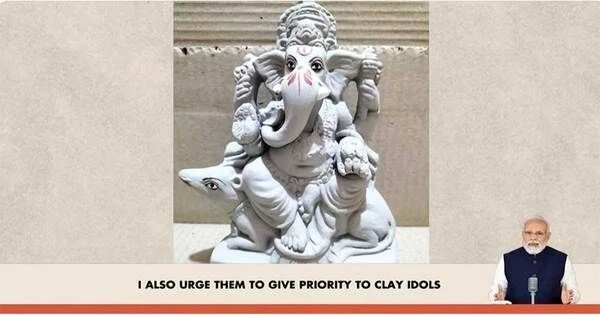
- Prime Minister Modi called for a complete boycott of Plaster of Paris (PoP) Ganesh idols in favor of traditional clay options.
- The broadcast highlighted the successful June 10, 2026, maiden flight of the domestically assembled C-295 transport aircraft.
- India’s defense capabilities expanded with the successful flight test of an indigenous Long-Range Land-Attack Cruise Missile.
- Community-led environmental successes, such as plastic recycling initiatives in Madhya Pradesh, received national recognition.
Prime Minister Narendra Modi strongly requested the nation to observe the upcoming Ganesh Utsav with deep environmental awareness. He emphasized buying clay representations created by neighborhood craftsmen while completely avoiding pieces constructed from Plaster of Paris (PoP).
Speaking during the 135th edition of his radio program, Mann Ki Baat, the Prime Minister pointed out that significant preparation time remains before the festival begins. He called upon creators to focus on organic clay and urged consumers to double-check production materials and origins.
He stated that families should ensure their home and community celebrations utilize figures shaped from local soil. He noted that supporting these items directly empowers neighborhood potters and traditional creators across local districts.
The Prime Minister mentioned that numerous citizens sent letters requesting a focus on Ganesh Utsav. The upcoming cultural festival is scheduled to take place in September 2026.
He reiterated his directive for manufacturing networks to focus entirely on earth-based alternatives. Furthermore, he tasked consumers with confirming the geographical origin and material composition of their purchases, insisting on a total halt to buying Plaster of Paris products.
Explaining the ecological advantages, Modi noted that earth-made designs disintegrate organically during immersion rituals. This natural breakdown prevents the severe degradation of public water networks, rivers, and regional lakes.
He stated that organic designs dissolve harmlessly when religious rituals conclude, protecting natural water systems. This practice balances spiritual traditions with ecological preservation. Buying from regional creators accelerates the national “Vocal for Local” economic initiative.
The Prime Minister also celebrated an inspirational localized campaign organized by women in Biaora, located within the Rajgarh district of Madhya Pradesh. These residents successfully gathered scattered plastic refuse and transformed the waste into functional eco-bricks.
He expressed great admiration for the female citizens of Biaora who cleared local neighborhoods of plastic garbage. Rather than waiting for external institutional interventions, the group collected discarded items and empty plastic containers throughout their municipality.
Modi explained that this initial cleaning drive steadily grew into a comprehensive public campaign. The collected waste was compressed into structurally sound eco-bricks to improve and upgrade various public parks and municipal zones.
He affirmed that these specific eco-bricks now enhance urban areas. The local campaign successfully processed hundreds of kilograms of plastic waste over recent months, converting systemic urban pollution into clean infrastructure.
The Prime Minister additionally focused on the critical necessity of water preservation, requesting wide public cooperation for the active ‘Catch the Rain’ ecological drive.
He emphasized that every drop of monsoon rainfall must be secured. He stated that the momentum of the water conservation program cannot be allowed to diminish under any circumstances.
New India Reflects Self-Reliance
Prime Minister Narendra Modi separately highlighted multiple critical industrial milestones that showcase the country’s accelerating transition toward complete self-reliance. He specifically lauded the inaugural flight of the domestic C-295 military transport vehicle and the successful evaluation of a long-range cruise missile.
During his June 2026 radio address, Modi observed that the domestic aviation ecosystem achieved an unprecedented industrial breakthrough early in the month.
He emphasized that the C-295 platform is being assembled domestically, noting that 40 of these units are under construction inside the country. This large-scale manufacturing program supplies critical opportunities to micro, small, and medium enterprises (MSMEs) alongside the broader aerospace industry.
This expanding industrial footprint will generate substantial new employment options across the manufacturing sector. The initial Indian-assembled C-295 military transport vehicle successfully completed its operational maiden flight on June 10, 2026.
The Indian Air Force is currently executing an order for 56 C-295 transport units valued at approximately Rs 21,935 crore. While initial units arrive directly, 40 individual aircraft will undergo full assembly by Tata Advanced Systems Limited in structural partnership with Airbus at a dedicated manufacturing hub in Vadodara. Modi stated that subsequent milestones achieved throughout the month bring immense pride to the populace.
He recalled his recent participation in a dedicated naval installation ceremony held in Kolkata. During the official event, INS Dunagiri, INS Shanshak, and INS Agrya formally joined the active Indian Navy fleet, featuring entirely domestic engineering and construction.
The Prime Minister stated that the Defence Research and Development Organisation (DRDO) executed a flawless trial of an indigenous Long-Range Land-Attack Cruise Missile (LRLACM). He remarked that these combined achievements ensure India grows increasingly protected and independent across both maritime and aerial fronts.
The specialized DRDO development team completed the flight test of the LRLACM on June 15, 2026, using a testing range located off the coastline of Odisha. The specialized cruise missile incorporates completely indigenous subsystems engineered by collaborative DRDO institutions and domestic industrial firms.
Throughout the broadcast, Modi expressed appreciation to the public for cooperating with his previous requests to temporarily moderate international travel and coordinate vehicle pooling amidst geopolitical tensions.
He noted his deep appreciation for the civilian population, emphasizing that communities have not only respected the economic guidance but are actively assisting with national stabilization efforts.
The Prime Minister additionally asked agricultural communities to transition toward completely chemical-free farming methodologies to protect long-term soil health through the implementation of organic fertilizers.
Highlighting an advanced educational framework designed to keep modern technical students connected to cultural foundations, he stated that the Central Sanskrit University in Delhi is introducing a new B.Tech program specializing in Artificial Intelligence and Data Science.
He defined this academic shift as a vital bridge connecting cutting-edge computer sciences with traditional knowledge systems. He added that national cultural arts are gaining prominent visibility globally, referencing a dedicated Spanish-speaking group in the Dominican Republic that established an organization titled ‘Brahmakamal Dominicana.’
The local group consists of roughly 100 individuals who study ancient Vedic texts and practice traditional chanting methods. Lacking formal academic training, the participants achieved accurate phonetic pronunciation solely by studying recorded audio master files.
The Prime Minister next addressed historical myths surrounding the regional Hargila bird in Assam, a species that performs a critical environmental cleaning role by clearing organic refuse.
He noted that the Hargila bird was previously viewed as an unfavorable omen in select districts of Assam, leading communities to destroy nesting trees. Biologist Purnima Devi Barman observed this ecological damage and committed to reversing the deep-rooted cultural misconceptions.
Barman engaged local women directly to explain the scientific realities of the species, pulling an expanding network of citizens into the preservation campaign. This scientific outreach completely transformed local perspectives, turning a feared creature into a proud regional symbol.
Modi reported that expanding numbers of young individuals are choosing professional athletics, highlighting the successful launch of the ‘Nagaland Baby League’ football program.
The regional athletic tournament accepts youth players between the ages of 5 and 12. The competitive league accelerates physical talent while providing young athletes with an early sporting identity.
Focusing on the living root bridges of Meghalaya, Modi stated that India has officially requested their formal induction into the prestigious UNESCO World Heritage Site Network.
He recognized that shifting global weather patterns present preservation difficulties, but praised the communities of Meghalaya for taking responsibility to safeguard their natural infrastructure.
Local populations currently manage and protect more than 120 distinct living root bridges. Dedicated assessment teams inspect the structural integrity of the bridges every year, while specialized nurseries cultivate young flora to fortify the surrounding river ecosystems.
Historical Context
The focus on ecological safety during mass festivals emerges after years of severe water pollution linked to synthetic materials. Plaster of Paris (PoP) idols are traditionally coated in heavy-metal paints containing lead and mercury. Unlike natural clay, which dissolves within hours, PoP structures can remain intact in riverbeds for decades, causing long-term damage to aquatic life.
Simultaneously, India’s push for industrial self-reliance stems from a multi-year defense modernization strategy. The Rs 21,935 crore C-295 aircraft deal signed with Airbus represents a shift from importing finished military hardware to establishing high-tech manufacturing ecosystems within India, bolstering the “Make in India” initiative.
FAQs
Why is Prime Minister Modi discouraging the use of Plaster of Paris idols?
Plaster of Paris does not dissolve naturally in water and contains chemical pigments that pollute rivers and ponds. Clay idols dissolve quickly without harming aquatic ecosystems.
What is the significance of the C-295 aircraft project?
The C-295 project introduces advanced aerospace manufacturing to India’s private sector. Tata Advanced Systems Limited will assemble 40 of the 56 ordered aircraft in Vadodara, boosting local supply chains.
When was the indigenous Long-Range Land-Attack Cruise Missile tested?
The Defence Research and Development Organisation successfully flight-tested the indigenous cruise missile off the coast of Odisha on June 15, 2026.
What are the eco-bricks mentioned in the broadcast?
Eco-bricks are structural blocks made by packing clean, dry plastic waste tightly inside empty plastic bottles. Women in Biaora used them to upgrade and beautify public spaces.