Opposition Backs CJP Protest Over Education Crisis
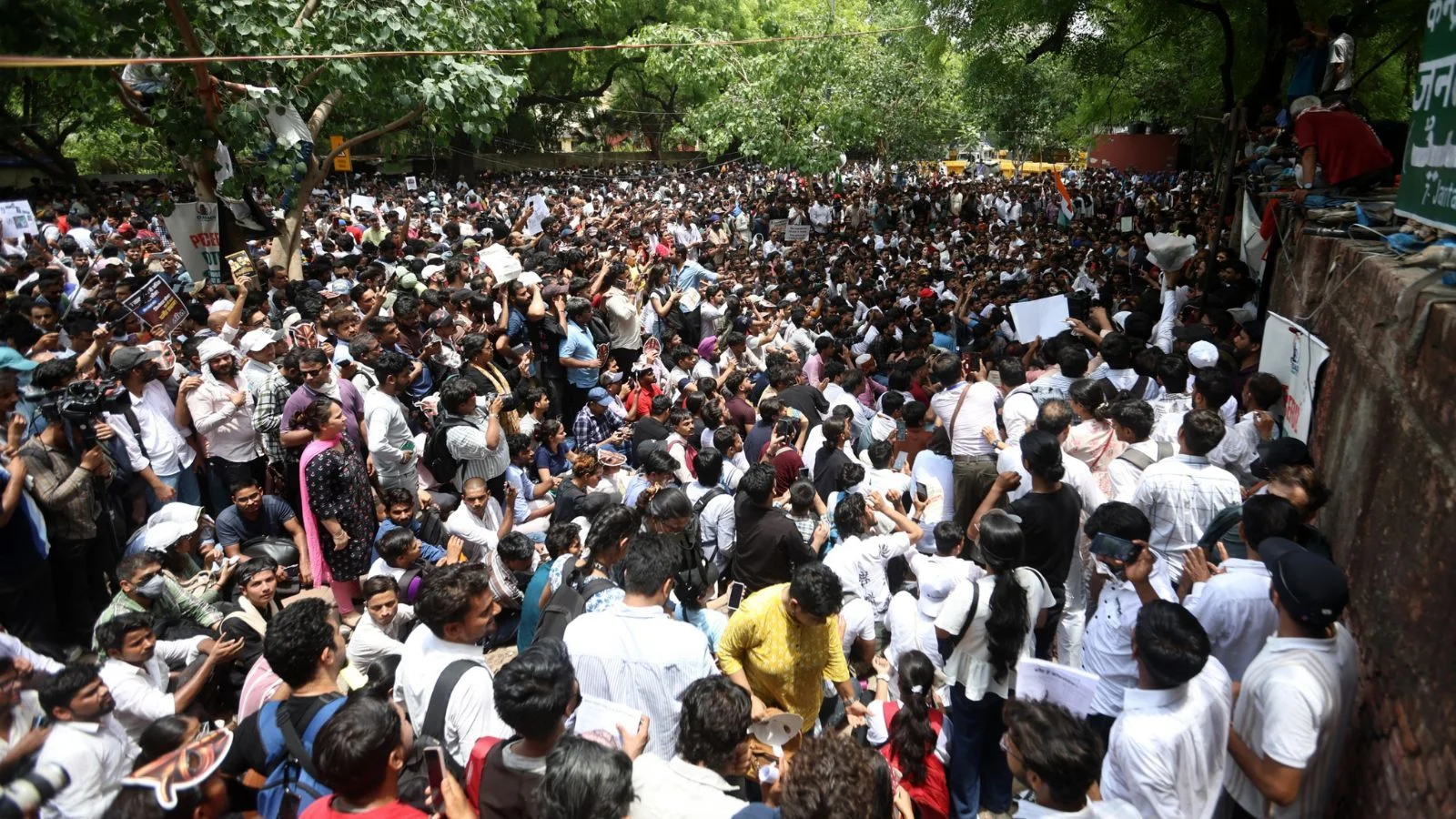
Cockroach Janta Party (CJP) founder Abhijeet Dipke spearheaded a major demonstration at Jantar Mantar in New Delhi on Saturday, June 6, 2026. The political mobilization has intensified scrutiny on the central government over ongoing examination national scandals, sparking varied reactions across India’s primary opposition factions.
Key Highlights
- CJP issued a strict seven-day ultimatum to the Center demanding the immediate removal of Union Education Minister Dharmendra Pradhan.
- Major opposition parties united in support of the youth-led agitation, labeling it a direct reflection of widespread student frustration.
- The Indian National Congress chose to maintain a tactical silence due to suspected links between the CJP and the Aam Aadmi Party (AAP).
As the CJP on Saturday issued a crucial ultimatum to the administration, giving them a seven-day deadline to dismiss Union Education Minister Dharmendra Pradhan, various political factions offered their alignment. The collective opposition, excluding the Congress, warmly embraced the protest at Jantar Mantar, declaring it a genuine manifestation of deep-seated anger among the nation’s youth.
Conversely, senior leaders within the Congress party deliberately preserved a measured silence on the development. Internal organizational insiders disclosed that the party highly suspects the CJP operates with covert backing from the AAP, prompting a strict “wait and watch” strategy.
Prominent Congress officials informed reporters that the establishment harbors deep suspicions regarding the CJP’s sudden, massive social media traction. Furthermore, questions were raised about the significant airtime granted to the group on mainstream television debates and the swift official permission secured for the capital city protest.
Addressing the situation via social media, Congress Social Media & Digital Platforms chairperson Supriya Shrinate published a statement on X. Without explicitly naming the CJP, she emphasized that her political organization stands completely aligned with the aspirations of Gen Z.
Shrinate asserted that the Congress party remains at the absolute forefront of championing causes vital to Gen Z. She noted their consistent efforts in amplifying youth voices, addressing critical systemic anxieties, and fighting persistently to safeguard their academic prospects.
To substantiate her claims, Shrinate highlighted that the NSUI and the Indian Youth Congress independently launched more than 50 protests across India. These demonstrations, organized over the span of just one month, targeted the NEET examination paper leak scandal and the CBSE evaluation discrepancies.
The digital head further compiled instances where Lok Sabha Leader of Opposition, Rahul Gandhi, faced state blockades. She noted he was repeatedly prevented from meeting tragedy victims or accessing sensitive areas to assess public grievances.
Given these recurrent restrictions, Shrinate argued that questions naturally arise when an organization is seamlessly permitted by the Delhi Police to assemble. Despite the skepticism from Congress, allied partners including the SP, TMC, Shiv Sena (UBT), RJD, CPI(ML), and CPIM openly validated the agitation.
Trinamool Congress deputy leader in the Rajya Sabha, Sagarika Ghose, affirmed that her party stands resolutely with the aggrieved student community. She characterized the mass gathering as a definitive reality check for the current ruling dispensation.
Ghose pointed out that unauthorized paper leaks have turned into an annual occurrence under the current administration. She lamented that numerous students have tragically ended their lives due to academic uncertainty, yet institutional accountability remains entirely absent.
Echoing similar sentiments, RJD spokesperson Mrityunjay Tiwari stated that his party and regional leader Tejashwi Yadav have consistently hit the streets against exam malpractice. Tiwari reminded the public that democratic systems inherently guarantee every citizen the fundamental right to peaceful protest.
Adding to the wave of criticism, Samajwadi Party Lok Sabha member Rajeev Rai termed the Jantar Mantar gathering a stern cautionary signal. Rai stated that the sudden outpouring of youth onto the streets must compel the union government to engage in deep introspection.
Rai drew historical parallels, comparing the present student unrest to the transformative JP movement witnessed during the 1970s. He urged the current administration to acknowledge and respect the visible public anger.
Shiv Sena chief Uddhav Thackeray issued an official statement noting that small, marginalized forces should not be underestimated in politics. He signaled that the intense agitation at Jantar Mantar serves as an explicit warning to the current leadership.
Thackeray remarked that thousands of young citizens, who represent the true destiny-makers of the nation, have been forced onto the streets. He noted they are enduring scorching summer heatwaves to voice deep anxieties regarding their compromised professional futures.
Former Delhi Chief Minister and AAP national convener Arvind Kejriwal described the agitation as an inevitable eruption of student anger. He advised the Modi administration to address core grievances directly rather than baselessly labeling protesting students as anti-national elements.
Kejriwal confirmed that AAP fully endorses the demands raised by the student community. The Delhi leader demanded that the Prime Minister step forward and sack the union education minister without further delay.
CPI(ML) Liberation general secretary Dipankar Bhattacharya personally arrived at the Jantar Mantar venue to join the agitation. Bhattacharya demanded that Dharmendra Pradhan resign immediately and accept formal responsibility for the ongoing national education crisis.
An unnamed CPI(M) Member of Parliament additionally noted that any genuine mass movement deserves a positive reception. The lawmaker emphasized that all pro-democracy political forces bear an absolute responsibility to support such spontaneous public uprisings.
Historical Context
The ongoing student unrest over national competitive examinations like NEET and CBSE marking patterns reflects a growing structural crisis within India’s centralized testing infrastructure. Massive street agitations over academic discrepancies frequently trace back to historic student-led movements, most notably the 1974 Bihar movement led by Jayaprakash Narayan.
Historically, systemic patterns of paper leaks and corruption within state-level recruitment boards have regularly triggered widespread urban protests. The scale of the 2026 demonstrations highlights a growing cross-party consensus among regional opposition groups, who view educational mismanagement as a primary vulnerability for the ruling federal coalition.
FAQs
Why are youth protesting at Jantar Mantar?
Students and political activists are protesting against recurring national paper leak scandals, specifically referencing the NEET examination issues and CBSE marking discrepancies that threaten their future careers.
What is the Cockroach Janta Party demanding?
The Cockroach Janta Party (CJP), led by founder Abhijeet Dipke, has given the central government a strict seven-day deadline to dismiss Union Education Minister Dharmendra Pradhan.
Why is the Congress party staying silent on the CJP protest?
The Congress party is maintaining a cautious “wait and watch” approach because party insiders suspect the CJP is covertly backed by the Aam Aadmi Party (AAP). They also questioned how easily the group received protest permissions.
Which political parties are supporting the student agitation?
The protest has gained broad support from various opposition parties, including the Trinamool Congress (TMC), Samajwadi Party (SP), Rashtriya Janata Dal (RJD), Shiv Sena (UBT), AAP, and left-wing factions like the CPI(M) and CPI(ML).