India’s Northeast Achieves Major Accessibility and Infrastructure Milestones
A series of groundbreaking infrastructure, accessibility, and developmental initiatives across Northeast India have achieved national recognition, signaling a major paradigm shift in regional growth and inclusive innovation. Led by pioneering educational tools and massive transit networks, the region is establishing new global benchmarks for sustainable development.
Key Highlights
- The 80-kilogram Hemkosh Braille Dictionary translates 90,000+ entries across more than 20 volumes for visually impaired learners.
- Assam is establishing a Rs 3,000–Rs 3,500 crore cancer care network featuring 17 specialized hospitals.
- The 13,000-foot Sela Tunnel guarantees all-weather military and civilian connectivity to Tawang in Arunachal Pradesh.
- Sikkim and Manipur have recorded global agricultural and engineering firsts through organic farming and ultra-tall bridge architecture.
Hemkosh, the pioneering effort linked with Assam’s legendary dictionary project and led by Jayanta Baruah, Editor of Asomiya Pratidin, aimed at ensuring that visually challenged learners are not left behind in their pursuit of education, has found national recognition as India marked 12 years of Prime Minister Narendra Modi’s leadership. The initiative was highlighted among the notable achievements emerging from Northeast India during this period, underscoring the region’s growing emphasis on inclusive innovation and accessibility-driven development in education.
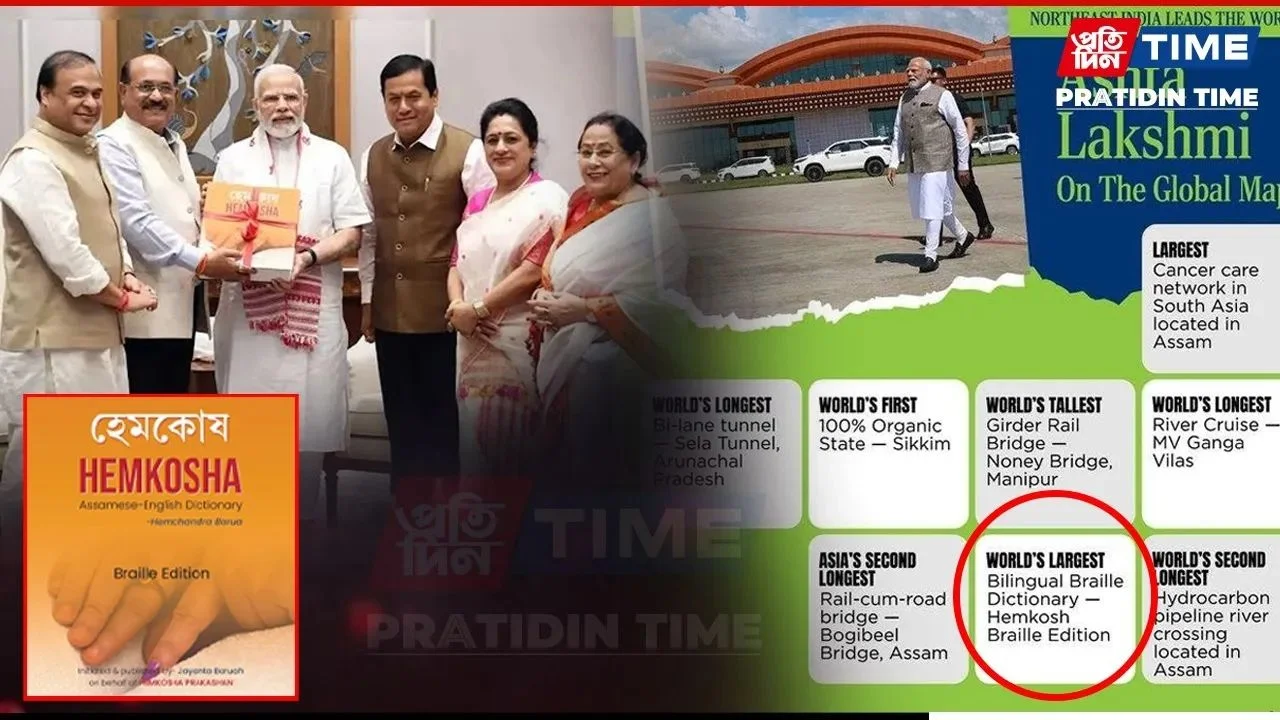
The project first came into wider national focus in September 2022, when Prime Minister Narendra Modi was presented with a Braille version of the Assamese dictionary Hemkosh, marking it as a symbolic milestone in accessibility-driven education in India.
Since then, the Hemkosh Braille Dictionary has continued to evolve as a long-term accessibility initiative, gradually expanding into a large-scale multi-volume reference system. In accessibility and education circles, it has been repeatedly cited as one of the most ambitious Braille adaptation projects undertaken for a regional Indian language, particularly due to its extensive vocabulary coverage and structured multi-volume format.
In 2023, the initiative further gained visibility in record and accessibility discussions for its scale as one of the most extensive bilingual Braille dictionary compilations, strengthening its position as a benchmark in inclusive publishing practices. Over time, it has also remained part of broader national conversations on disability-inclusive education and knowledge accessibility.
The Hemkosh Braille project continues to be recognised for transforming a historic Assamese lexicographic work into a fully accessible learning resource, enabling visually impaired students to engage with vocabulary, meanings, and language structure on an equal footing with sighted learners. It stands today as a significant example of how traditional literature can be reimagined through inclusive design and modern accessibility frameworks.
World’s largest: Hemkosh Braille Dictionary, Assam
The Hemkosh Braille Dictionary from Assam is regarded as one of the most significant achievements in accessible education and Braille publishing in India, transforming the historic Assamese dictionary ‘Hemkosh’, originally compiled by scholar Hemchandra Barua, into a fully accessible reference work for visually impaired learners.
The Braille edition is designed as a comprehensive multi-volume linguistic resource, containing approximately 90,000+ entries covering Assamese vocabulary in structured alphabetical order. These entries are spread across more than 20 volumes, making it one of the largest Braille dictionary compilations produced for any regional language in India.
Due to the nature of Braille printing, where each character requires expanded tactile space, the complete set becomes physically extensive, weighing around 80 kilograms when compiled in full form. This highlights not only the scale of the content but also the technical complexity involved in converting a traditional printed dictionary into Braille format without losing linguistic accuracy.
The project is rooted in the preservation of Assamese linguistic heritage, as Hemkosh itself is considered one of the foundational dictionaries of the Assamese language. By converting it into Braille, the initiative ensures that visually impaired students and readers can access the same depth of vocabulary, grammar usage, and word meanings as sighted learners.
One of the key strengths of this edition is its role in inclusive education infrastructure, particularly in a region where large-scale Braille reference materials in regional languages are limited. It enables students in schools, colleges, and special education institutions to engage with Assamese language studies in a more detailed and independent manner.
The compilation required coordinated efforts between linguists, Braille transcription experts, and educational institutions, ensuring that each entry was accurately adapted into tactile format while maintaining readability and consistency across volumes.
Beyond its size and structure, the Hemkosh Braille Dictionary is also seen as a milestone in disability-inclusive knowledge systems in India, reflecting how traditional literature can be reimagined through modern accessibility practices.
It has been widely acknowledged in educational and accessibility circles as a model for large-scale Braille publishing projects, especially in regional languages that often lack comprehensive reference tools for visually impaired users.
Overall, the Hemkosh Braille Dictionary stands not only as a record-holding publication but also as a powerful symbol of equal access to knowledge, linguistic preservation, and inclusive educational innovation.
South Asia’s Biggest Cancer Care Network (Assam)
Assam is developing a major cancer care network under the Assam Cancer Care Foundation(ACCF), a joint project of the state government and Tata Trusts. The plan includes 17 cancer hospitals across Assam, with 10+ already operational.
The project is estimated to cost around Rs 3,000–Rs 3,500 crore and follows a hub-and-spoke model to expand treatment access across districts.
Assam reports one of the highest cancer rates in India, especially oral, lung, and cervical cancers, making early detection and local treatment critical.
Each centre provides diagnosis, chemotherapy, and palliative care, helping reduce the need for patients to travel outside the Northeast for treatment.
World’s Longest: Sela Tunnel, Arunachal Pradesh
The Sela Tunnel in Arunachal Pradesh is a strategically important high-altitude infrastructure project built by the Border Roads Organisation (BRO) to ensure all-weather connectivity to Tawang, near the India–China border.
The tunnel is located at an altitude of around 13,000 feet (4,000 metres) in the Eastern Himalayas and forms part of the Balipara–Charduar–Tawang road network. The project consists of a main tunnel of about 1.5 km length along with a parallel escape tunnel, designed for safety and emergency access.
Before its construction, the Sela Pass route remained cut off for nearly 3–4 months every year due to heavy snowfall and extreme weather conditions, severely impacting civilian movement and military logistics.
The tunnel has significantly reduced travel time to Tawang and ensures year-round connectivity, which is crucial for both local residents and defence preparedness in the sensitive frontier region.
Built using advanced engineering techniques in extreme terrain, the Sela Tunnel is also considered a key infrastructure asset under India’s border development strategy, improving accessibility in one of the most challenging geographical zones in the country.
World’s First: Sikkim; A Fully Organic State
Sikkim became the world’s first fully organic state in 2016, completing a long-term agricultural transition that covered the entire state’s farmland.
The shift involved converting around 75,000 hectares of agricultural land into certified organic farming and training more than 66,000 farming families to adopt chemical-free cultivation practices.
As part of the policy, Sikkim completely banned the use of synthetic fertilisers and pesticides, making the state 100% organic across all agricultural production systems.
The transition was implemented in phases over more than a decade, supported by farmer training programmes, soil health improvement initiatives, and market linkage support for organic produce.
Sikkim’s achievement has been recognised globally, including by international organisations such as the Food and Agriculture Organization (FAO), which awarded it the Future Policy Gold Award for sustainable agricultural practices.
Today, the state is widely regarded as a global model for organic farming, ecological sustainability, and climate-resilient agriculture policies.
World’s Tallest: Noney Bridge, Manipur
The Noney Bridge, also known as the Ijao River Bridge, in Manipur is part of the strategic Jiribam–Imphal railway project and is widely recognised as the world’s tallest railway girder bridge.
The structure stands at a height of around 141 metres above the ground, making it taller than many globally known landmarks. It is being constructed over deep valleys in a highly difficult and seismic-prone Himalayan terrain, where landslides and unstable geology pose major engineering challenges.
The bridge forms a crucial segment of the 111-km Jiribam–Imphal railway line, which aims to connect Manipur’s capital Imphal with India’s national railway network for the first time.
Once operational, the project is expected to significantly improve passenger connectivity, freight movement, and economic integration of Manipur with the rest of the country. It will also play an important role in strengthening infrastructure in India’s eastern border region.
Engineered for extreme conditions, the bridge has been designed to withstand earthquakes, heavy rainfall, and difficult mountain terrain, making it one of the most technically complex railway structures in India.
World’s Longest: MV Ganga Vilas River Cruise
The MV Ganga Vilas is recognised as the world’s longest river cruise journey, operating across a network of rivers in India and Bangladesh.
The cruise covers a total distance of around 3,200 kilometres, with a journey duration of approximately 50 to 51 days, making it one of the most extensive inland waterway tourism routes in the world.
The route begins in Varanasi (Uttar Pradesh) and concludes in Dibrugarh (Assam), passing through multiple river systems including the Ganga, Hooghly, and Brahmaputra, along with transit through Bangladesh under international river protocols.
The cruise travels through over 50 major tourist and cultural sites, including heritage towns, river ports, and wildlife zones.
History of Northeast Indian Development Frameworks
Historically, the northeastern frontier of India faced severe geographical and logistical isolation due to the rugged Himalayan terrain and limited cross-regional connectivity. Over the last decade, a concerted policy shift toward inclusive educational design and heavy civil engineering has repositioned the region. Reimagining foundational assets, such as converting Hemchandra Barua’s historic 19th-century lexicographical text into a sprawling modern tactile network, highlights a transition from basic regional administration to state-of-the-art accessibility infrastructure and trans-border connectivity.
FAQs
What makes the Hemkosh Braille Dictionary historically significant?
The dictionary adapts the foundational 19th-century Assamese linguistic work compiled by scholar Hemchandra Barua. By converting its 90,000+ entries into a tactile format, it preserves regional linguistic heritage while providing visually impaired readers equal independent access to complex grammar and vocabulary.
How big is the physical compilation of the Hemkosh Braille Dictionary?
Due to the expanded spatial requirements of tactile Braille printing, the entire dictionary is spread across more than 20 volumes. In its complete physical compilation, the entire reference set weighs approximately 80 kilograms.
What is the scope of the Sela Tunnel project in Arunachal Pradesh?
Constructed by the Border Roads Organisation at an altitude of 13,000 feet, the project features a 1.5 km main tunnel and a parallel escape route. It bypasses the weather-vulnerable Sela Pass to provide all-weather, year-round civilian and military transit to Tawang.
When did Sikkim achieve its status as a fully organic state?
Sikkim completed its phased legislative and agricultural transition in 2016, transforming 75,000 hectares of land. The long-term initiative successfully brought more than 66,000 farming families into certified chemical-free cultivation practices.