2027 Nigerian Presidential Race Structures After Primaries
The concluded party primaries have positioned the 2027 Nigerian presidential election as a highly competitive race dominated by established political figures. Eleven candidates will appear on the ballot, but the contest is rapidly consolidating into a definitive three-way struggle for the nation’s highest political office.
Key Takeaways
- Incumbent President Bola Tinubu secures the APC nomination with 10.99 million votes, holding a significant structural advantage.
- Atiku Abubakar launches his sixth presidential campaign under the ADC platform following his exit from the PDP.
- Peter Obi anchors the NDC ticket alongside running mate Rabiu Kwankwaso to challenge the established major parties.
With party primaries concluded, the 2027 presidential race is taking shape as a contest dominated by familiar faces and familiar political battles.
The political landscape for the 2027 presidential election is formalizing rapidly as internal party selections finish and official campaigns prepare to launch in August.
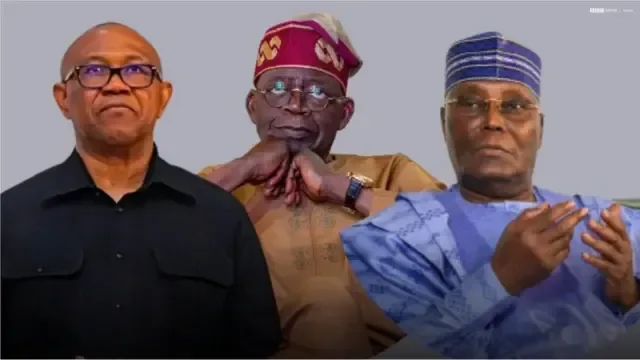
Although 11 contestants are slated to participate, veteran political observers state the competition is already a clear three-way race between President Bola Tinubu, Atiku Abubakar, and Peter Obi.
The ballot features Seyi Makinde representing the Allied Peoples Movement, Omoyele Sowore under the African Action Congress, and Donald Duke for the People’s Redemption Party. Aliyu Bin Abbas and Adekunle Omoaje are running under the Action Democratic Party and Action Alliance respectively.
Internal divisions persist as the Kabiru Turaki-led faction of the Peoples Democratic Party selected Goodluck Jonathan, while the rival Abdulrahman Mohammed faction nominated Prof Sandy Onor.
Tinubu’s incumbency advantage
Securing the ruling All Progressives Congress ticket with 10.99 million votes, Tinubu established a commanding position for the upcoming general election. His current political standing follows his 2023 victory against 17 opponents, where he secured 8,794,726 votes.
The sitting president commands the distinct benefits of incumbency, an asset that historically exerts immense influence over national electoral outcomes. His position grants him direct control over federal administrative structures and substantial state resources capable of maximizing campaign mobilization.
The ruling party has successfully leveraged its position to absorb more than 10 sitting governors from various opposition groups. Analysts view these high-profile defections as a deliberate consolidation of structural power prior to the 2027 vote.
Electoral experts emphasize that these strategic shifts alter grassroots dynamics and realign state-level voting apparatuses toward the ruling party. However, independent political analysts warn that elite defections do not automatically guarantee corresponding loyalty from ordinary voters.
Atiku makes sixth attempt at presidency
The 79-year-old former vice president is initiating his sixth campaign for the presidency in what represents his final political bid. This return confirms his position as a central figure within the opposition and one of Nigeria’s most enduring politicians.
He previously served as vice president from 1999 to 2007 under Olusegun Obasanjo before executing multiple presidential campaigns across different party lines. He ran under the Action Congress in 2007 and sought various tickets or ran in 2011, 2015, 2019, and 2023.
During the 2023 cycle, he finished second behind Tinubu after securing 6,984,520 votes. Subsequent internal conflict within the Peoples Democratic Party ultimately caused his departure, leading him to secure the African Democratic Congress nomination.
Loyalists assert that his extensive political history, widespread national networks, and deep institutional alliances make him uniquely qualified to challenge the incumbent administration. His electoral support remains deeply concentrated across crucial sectors of the North-East and North-West regions.
Conversely, detractors argue that his frequent candidacies have induced voter weariness, particularly among younger demographics demanding a transition to new leadership.
Peter Obi seeks second breakthrough
The former governor of Anambra State remains a disruptive force who fundamentally reordered the traditional dual-party dynamics of Nigerian elections. His initial presidential campaign transformed him into an influential national figure with a highly dedicated voter base.
During his 2023 debut, he won 12 states, including the Federal Capital Territory, accumulating a total of 6,101,533 votes.
He intends to expand this electoral foundation in 2027 by selecting former Kano State Governor Rabiu Kwankwaso as his vice-presidential running mate. Experts suggest this strategic alliance could broaden his appeal across southern states and unlock critical northern voting blocs.
Jonathan’s potential comeback
The prospect of the former head of state returning to active politics has triggered significant discussion across the country. While he has not officially declared his candidacy, his previous executive tenure gives him immediate nationwide recognition.
He retains measurable public goodwill from citizens who view his prior administration as a period of relative socioeconomic stability. Nevertheless, seasoned political analysts caution him against running, citing a vastly transformed electoral terrain since his 2015 exit.
Candidates’ geopolitical standings
Geopolitical dynamics and regional math are dictating party blueprints, as campaigns align their strategies with historic regional voting tendencies and ethnic rotations.
The 2023 results showed Tinubu capturing the North-West, North-Central, and South-West, while Obi secured the South-South and South-East, and Abubakar won the North-East.
Tinubu demonstrated nationwide competitive depth by placing either first or second across all six geopolitical zones during the previous cycle. He maintains an ironclad political foundation in the South-West, which serves as a highly dependable bastion for the ruling party.
The ruling APC is simultaneously moving to solidify its reach in northern territories through recent political defections and targeted cross-regional alliances.
Abubakar maintains his primary strongholds in the North-East and segments of the North-West but faces difficulties generating significant traction across southern states.
Obi retains clear dominance throughout the South-East, South-South, and major urban centers where his previous performance permanently altered traditional voting patterns. His base remains anchored by young professionals, though ultimate victory requires expanding his reach into core northern demographics.
Factors that may shape election
Economic performance, shifting party coalitions, and voter turnout dynamics will serve as the primary determinants of the final 2027 outcome. The ability of the opposition to form a unified front against the incumbent administration will dictate the ultimate competitiveness of the race.
Future Outlook
The road to the 2027 election will test the resilience of Nigeria’s democratic institutions and the adaptability of its political class. With campaigns launching in August, the electorate faces a choice between the continuity of the ruling APC, the veteran experience of Abubakar, and the disruptive reform agenda of Obi. The ultimate outcome will hinge on which coalition can successfully navigate the country’s complex geopolitical landscape and address pressing socioeconomic anxieties.
FAQs
Who are the main candidates in the 2027 Nigerian presidential election?
The election is shaping up as a three-way contest between incumbent President Bola Tinubu of the All Progressives Congress, Atiku Abubakar of the African Democratic Congress, and Peter Obi of the Nigeria Democratic Congress.
When do the official campaigns begin for the 2027 election?
Official political campaigns for the presidential election are scheduled to begin in August.
Which running mate did Peter Obi select for the 2027 race?
Peter Obi has chosen former Kano State Governor Rabiu Kwankwaso as his vice-presidential running mate to strengthen his campaign’s appeal in northern Nigeria.
How many candidates are expected to be on the presidential ballot?
There are 11 candidates expected on the ballot for the 2027 presidential election, though analysts view the race as primarily a three-way contest.