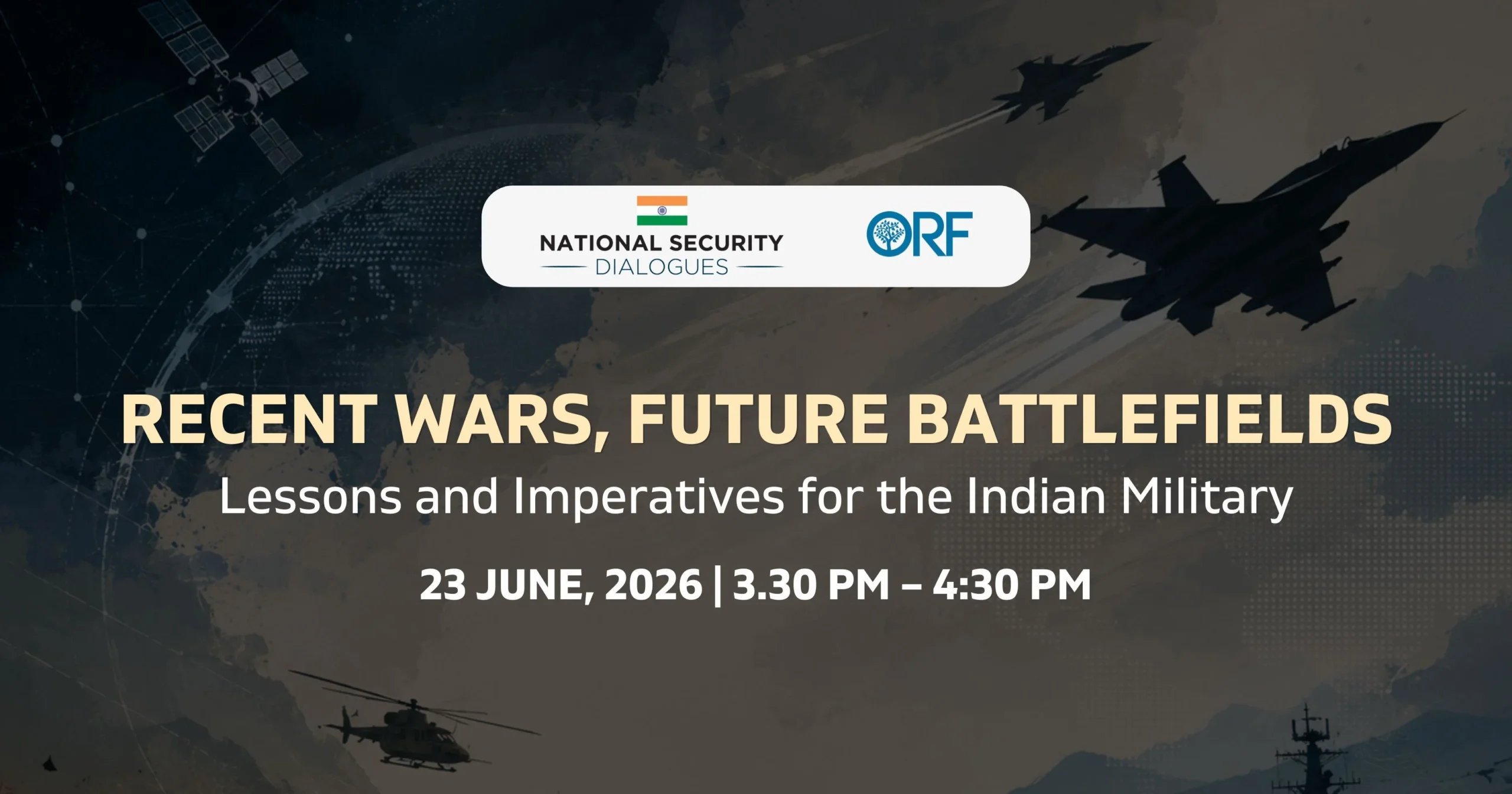
New Delhi Security Dialogue to Assess Evolving Warfare Dynamics
Recent international and domestic conflicts are transforming global combat and India’s strategic defense posture. Confrontations in Ukraine, West Asia, and along India’s contested borders reveal a critical shift toward aerial and kinetic non-contact domains, necessitating advanced air defense and enhanced joint operational capabilities.
Key Highlights
- Domain Shift: Global conflicts show a clear transition from land battles toward aerial and kinetic non-contact warfare.
- Strategic Assessment: The National Security Dialogue in Delhi will evaluate India’s military capabilities and deterrence durability.
- Technological Challenges: Adversaries are increasingly adopting sophisticated Chinese and Turkish military innovations.
- Future Preparation: The Indian armed forces must adapt to electronic warfare, artificial intelligence, and unmanned systems.
Recent conflicts – from the war in Ukraine and the fighting in West Asia to India’s own military campaigns along its contested frontiers – are reshaping the character of warfare and India’s strategic posture.
These wars have shown a marked shift from primarily terrestrial confrontation toward the aerial domain, with engagements increasingly unfolding within the “kinetic non-contact domain.”
They have underscored the centrality of joint operations, the need for layered ground-based air defence systems, and the growing significance of offensive air operations and drone warfare.
They have also demonstrated the need for robust strategic communications, even as India’s adversaries deepen their reliance on Turkish and Chinese military technologies.
This month’s National Security Dialogue will assess what recent wars and India’s military campaigns reveal about the changing character of warfare, the strengths and limits of India’s military effectiveness, and the lessons that should – and should not – be extrapolated from short, calibrated conflicts.
It will also examine evolving doctrine, capability development, and the durability of deterrence in an increasingly drone- and missile-defined battlespace.
Looking ahead, the dialogue will consider how the Indian military must prepare for the future of warfare – one shaped by autonomous and unmanned systems, artificial intelligence, the contest for the electromagnetic spectrum, and the growing salience of the space and cyber domains.
Conference Room, ORF Delhi
Future Outlook
The Indian defense establishment faces an accelerating requirement to modernize its forces against evolving regional threats. As hostile neighbors integrate sophisticated unmanned aerial platforms and electronic counter-measures, India’s strategic success will depend on its capacity to rapidly develop indigenous alternative technologies, secure the electromagnetic spectrum, and build cohesive tri-service commands capable of executing multi-domain operations.
FAQs
What is the primary focus of the upcoming National Security Dialogue?
The dialogue focuses on analyzing how recent global and domestic conflicts are changing the nature of warfare, evaluating India’s military readiness, and identifying strategic lessons for future multi-domain operations.
Where is the security conference being held?
The event is scheduled to take place at the Conference Room of the Observer Research Foundation (ORF) in New Delhi.
Which emerging technologies are reshaping India’s defense strategy?
India’s future military preparedness is increasingly focused on autonomous and unmanned systems, artificial intelligence, electronic warfare, and threats emerging within the space and cyber domains.
How is the domain of modern warfare changing according to the text?
Modern combat is shifting away from traditional land-based confrontations and moving rapidly toward offensive air operations, drone warfare, and engagements within the kinetic non-contact domain.