Admiral Swaminathan Takes Command as Indian Navy Chief
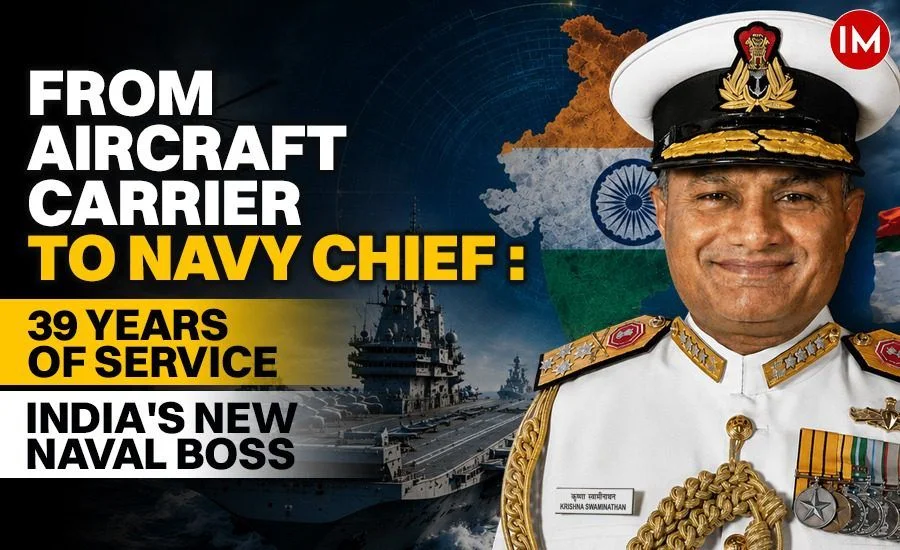
Admiral Krishna Swaminathan officially assumed command as the 27th Chief of the Naval Staff on 31 May 2026. His appointment comes at a critical juncture as India aggressively expands its maritime footprints, accelerates domestic defense production, and navigates evolving geopolitical challenges across the strategic Indian Ocean Region.
Key Highlights
- Admiral Krishna Swaminathan took charge as the 27th Chief of the Naval Staff on 31 May 2026.
- His distinguished career spans nearly 39 years, including command of the flagship aircraft carrier INS Vikramaditya.
- The new chief holds a PhD alongside multiple advanced degrees from prestigious global military institutions.
- His leadership focuses on technological transformation, artificial intelligence integration, and naval self-reliance.
On 31 May 2026, Admiral Krishna Swaminathan assumed control of the office of the Chief of the Naval Staff, bringing roughly four decades of extensive experience across frontline warships, aircraft carriers, and vital command structures.
His professional path showcases the trajectory of an officer who ascended the ranks through operational brilliance, strategic foresight, and unwavering dedication to defense.
Taking the helm as the 27th Chief of the Naval Staff, he assumes leadership while the maritime force scales up its operational boundaries, deepens domestic self-reliance, and readies for complex modern security environment shifts.
ROOTED IN DISCIPLINE, SHAPED BY LEARNING
Born in Bengaluru to educators D. Swaminathan and Shanta Swaminathan, the Admiral spent his formative years in an environment that prioritized scholastic excellence and structured living.
The family resided in the historic NR Colony within the Basavanagudi area, which remains one of the oldest residential sectors in Bengaluru.
Following his initial schooling at Bishop Cotton Boys’ School, he transitioned to Sainik School, Bijapur, establishing his definitive path toward military service.
He subsequently secured entry into the National Defence Academy, building the core foundation for a highly decorated career within the naval ranks.
His scholastic record matches his formidable operational history, featuring a BSc from Jawaharlal Nehru University and an MSc in Telecommunications from Cochin University of Science and Technology.
He also earned an MA in Defence Studies from King’s College London, alongside an MPhil and a PhD in International Studies from Mumbai University.
Furthermore, he completed advanced training at the Joint Services Command and Staff College in the United Kingdom, the College of Naval Warfare in India, and the United States Naval War College.
A CAREER BUILT AT SEA
Commissioned into service on 1 July 1987, the Admiral chose specialization in Communication and Electronic Warfare, fields that subsequently grew vital to modern fleet operations.
His initial naval chapters focused on mastering maritime operations firsthand and navigating the rigorous demands of sea deployment.
He eventually established a reputation as one of the most capable operational leaders within the maritime armed forces.
His early commands included the guided-missile combat vessels INS Vidyut and INS Vinash, followed by the guided-missile corvette INS Kulish.
As his profile elevated, he assumed leadership of the guided-missile destroyer INS Mysore, a premier frontline combatant asset of the fleet.
His milestone deployments featured commanding India’s flagship aircraft carrier, INS Vikramaditya, serving as its second commanding officer during critical operational phases.
He steered the carrier through the landmark International Fleet Review in 2016, during which the vessel earned the title of Best Ship of the Western Fleet under his direction.
RISING THROUGH THE RANKS
His advancement into flag rank assignments blended tactical execution with institutional governance.
Upon attaining the rank of Rear Admiral, he took over as Chief Staff Officer (Training) at the Southern Naval Command located in Kochi.
In this capacity, he influenced institutional training frameworks and drove the formation of the Indian Navy Safety Team to standardize operational safety paradigms.
He later operated as Flag Officer Sea Training prior to taking operational command of the Western Fleet, the recognized offensive arm of the naval force.
This appointment placed him at the center of maritime maneuvers across the Arabian Sea and the broader oceanic territories.
His strategic portfolio grew further when he stepped into the role of Flag Officer Defence Advisory Group, advising the federal administration on offshore security frameworks and national energy infrastructure protection.
FROM STRATEGIC COMMANDS TO NAVAL HEADQUARTERS
Reaching the rank of Vice Admiral, he navigated multiple high-profile administrative seats influencing policy frameworks, human resource structures, and operational blueprints.
He functioned as Chief of Staff of the Western Naval Command, later transitioning to Controller of Personnel Services and Chief of Personnel at Integrated Headquarters.
These roles provided comprehensive visibility into organizational readiness and workforce logistics.
In May 2024, he secured elevation to the post of the 46th Vice Chief of Naval Staff.
Prior to his ultimate promotion, he directed operations as the Flag Officer Commanding-in-Chief of the Western Naval Command, safeguarding the western maritime theater and vital global shipping lanes.
A LEADER FOR A NEW ERA
The Admiral takes control at a juncture where maritime deterrence holds unprecedented weight for the South Asian nation.
Throughout his recent administrative stints, he emerged as a principal driver of technological modernization across the naval architecture.
He consistently champions the adoption of domestic technologies, artificial intelligence integration, automated electronic warfare systems, and modern warfare capabilities.
He maintained direct involvement in expanding local manufacturing initiatives, backing domestic shipbuilding projects, submarine assembly lines, and the overarching indigenous defense manufacturing push.
Operational combat readiness remains a core tenet of his command philosophy, having previously directed maritime security tasks, anti-piracy deployments, and regional stabilization initiatives.
DECORATED FOR DISTINGUISHED SERVICE
A military journey spanning almost 39 years generated substantial state commendations and formal awards.
The state honored his contributions with the Vishisht Seva Medal in 2017, followed by the Ati Vishisht Seva Medal in 2021.
He received the prestigious Param Vishisht Seva Medal in 2026 for exceptional service of the highest tier.
These military decorations underscore a lifetime of rigorous commitment to national defense architectures.
COMMANDING THE FUTURE
Beyond his institutional responsibilities, the officer focuses on his family life alongside his spouse, Mrs. Laila Swaminathan, and their two daughters.
As he steps into the office of the 27th Chief of the Naval Staff on 31 May 2026, he takes over a combat force that stands larger, more digitally integrated, and strategically vital than past eras.
His progression from a student in Bengaluru to managing aircraft carriers and theater commands underscores his preparation for this defense role.
Amid accelerating naval rivalries, technological overhauls, and volatile regional dynamics, the new chief brings a potent mix of sea experience and intellectual depth to the pinnacle of command.
Future Outlook
The Indian Navy under Admiral Swaminathan’s leadership is projected to quicken its transition toward a fully modernized force. Over the coming years, the maritime service will focus intensely on expanding its blue-water capabilities and cementing domain awareness across the Indian Ocean. Observers anticipate accelerated inductions of indigenously built stealth frigates, nuclear-powered submarines, and unmanned aerial platforms to counter rising regional competition.
FAQs
When did Admiral Krishna Swaminathan become the Chief of the Naval Staff?
He officially assumed command as the 27th Chief of the Naval Staff on 31 May 2026, succeeding to the highest office in the Indian Navy.
Which major Indian Navy warships did Admiral Swaminathan command during his career?
He commanded several frontline vessels, including the guided-missile vessels INS Vidyut and INS Vinash, the corvette INS Kulish, the destroyer INS Mysore, and India’s flagship aircraft carrier, INS Vikramaditya.
What are the main strategic priorities for the new Indian Navy Chief?
His primary focus areas center on technological transformation, integrating artificial intelligence platforms, upgrading electronic warfare systems, and driving self-reliance through domestic warship and submarine construction.
What academic qualifications does Admiral Swaminathan hold?
He possesses a highly distinguished academic background, including a BSc from Jawaharlal Nehru University, an MSc from Cochin University, an MA from King’s College London, and both an MPhil and a PhD in International Studies from Mumbai University.