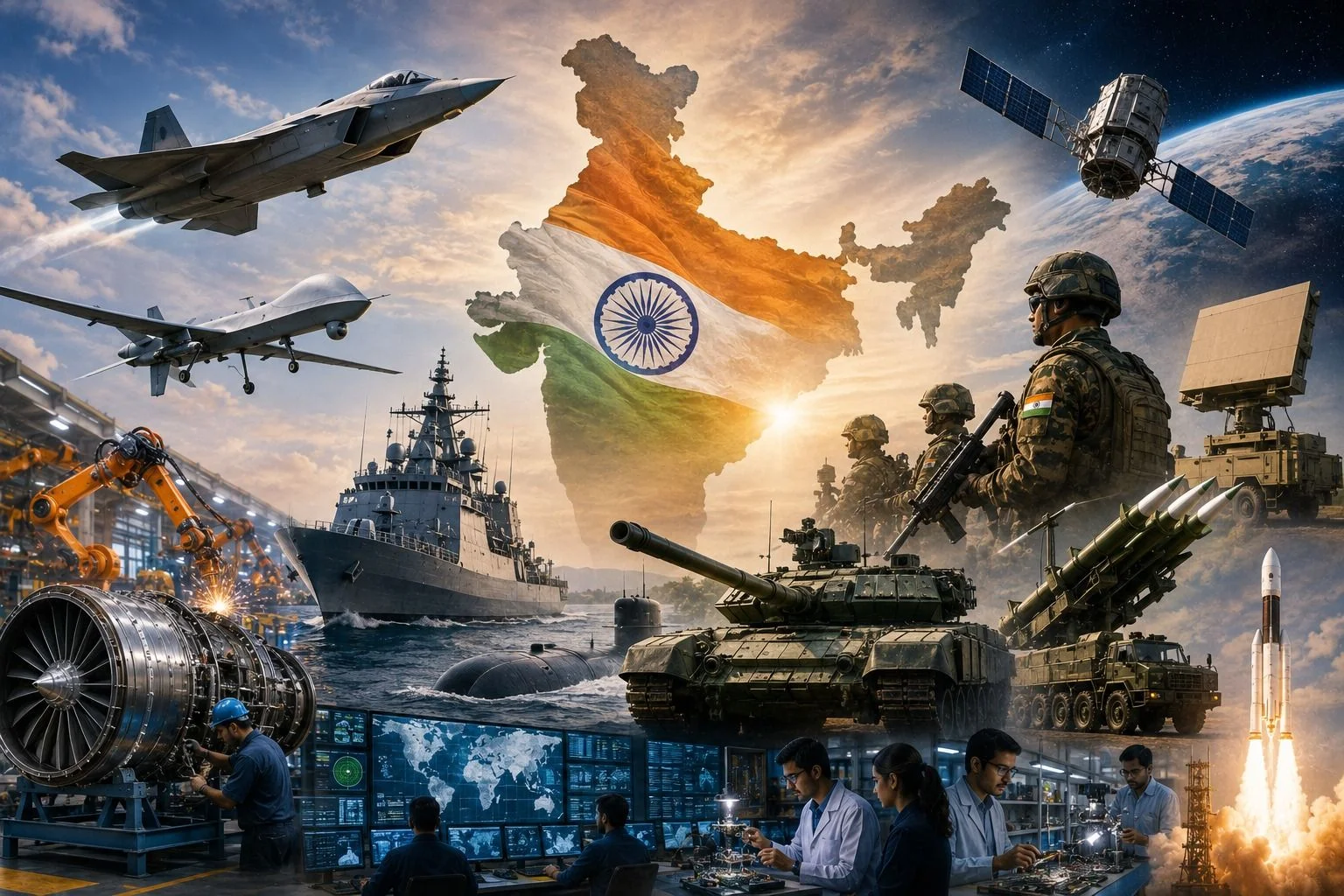
India’s Defence Revolution: Industrial Modernisation and Strategic Self-Reliance
India is rapidly restructuring its defence ecosystem, shifting from an import-dependent security model to a self-reliant powerhouse. Over the past twelve years, structural reforms and technology partnerships have transformed domestic production, turned defence into an economic engine, and propelled military exports to historic heights.
Key Highlights
- India is transitioning away from foreign suppliers toward the indigenous Atmanirbhar Bharat framework.
- Government initiatives have democratised innovation, allowing hundreds of start-ups and MSMEs into the defence sector.
- Newly established defence industrial corridors are aggregating manufacturing, testing, and research capabilities.
- Surging military export volumes reflect growing international confidence in India’s strategic engineering standards.
India’s global ascent is frequently quantified via gross domestic product growth, digital milestones, infrastructure rollouts, and geopolitical leverage. Yet a concurrent shift is occurring within the national security architecture. Over the last decade, New Delhi has executed an unprecedented military modernization campaign.
This strategic pivot is reforming the traditional security framework. What was once a heavily import-reliant system is converting into an autonomous, high-tech industrial enterprise.
The implications of this shift extend beyond battlefield readiness. Military capability remains inextricably linked to industrial competitiveness, technological breakthroughs, financial resilience, and sovereign authority. Advanced defence production hubs do not just manufacture hardware; they catalyze intellectual property and create highly skilled employment.
In a fractured global environment, defence autonomy serves as a core indicator of domestic durability.
Consequently, India’s defense evolution over the past twelve years represents more than expanded budgets or weapon acquisitions. It reflects a comprehensive national strategy to reinforce industrial capacity and eliminate vulnerabilities within critical supply networks.
From Import Dependence to Strategic Self-Reliance
For generations, India ranked as a leading international buyer of foreign military hardware. Although state institutions like the Defence Research and Development Organisation and Hindustan Aeronautics Limited built important capabilities, advanced combat platforms were consistently purchased from overseas vendors.
This operational reliance introduced deep vulnerabilities. External supply chains frequently triggered project delays, budget overruns, technology blockades, and logistical gridlocks during overseas conflicts. Every major procurement contract carried geopolitical weight, altering diplomatic balances and tying the nation to long-term foreign maintenance support.
To mitigate these pressures, state planners redirected national policy toward domestic production under the Atmanirbhar Bharat initiative. The defense ecosystem became the central testing ground for this self-reliance framework.
This systemic pivot required deep structural adjustments. Policymakers deployed regulatory overhauls, financial incentives, and cultural changes to integrate private corporations, academic centers, and research groups. The goal went beyond replacing foreign items to building a self-sustaining engineering base.
These sustained efforts are yielding measurable outcomes. Domestic military manufacturing has grown substantially, defense exports have broken past records, and Indian enterprises are actively integrating into global aerospace supply chains. Continuous challenges remain, but the systemic trajectory is clear.
Defence as an Engine of Industrial Development
A vital benefit of this military overhaul is its direct stimulative effect on broader industrial manufacturing.
Modern security platforms require the integration of multiple advanced technologies. Aerospace systems, artificial intelligence, robotics, computing networks, advanced metallurgy, and semiconductors all converge in modern defense manufacturing. Consequently, capital injected into military research yields dual-use breakthroughs for civilian commercial markets.
Historically, foundational civilian infrastructure grew directly out of military development pipelines. The internet, satellite navigation networks, microchips, and jet propulsion systems originated inside defense projects before transforming global commerce.
Indian planners are leveraging this technological linkage. Expanding public research grants and building tighter bridges between state laboratories and private firms shows an understanding that technological sovereignty cannot be purchased off the shelf.
Frameworks like Innovations for Defence Excellence and the Technology Development Fund have lowered entry barriers for private capital. Hundreds of early-stage firms and small businesses now execute advanced defense projects that were closed to them a decade ago.
This structural opening represents a major shift in national industrial policy. It marks a transition from a closed, state-monopolized model to a decentralized network leveraging competitive private enterprise.
The Rise of a Defence Innovation Ecosystem
Accelerating technological cycles are redefining modern combat. Emerging capabilities across autonomous platforms, artificial intelligence, hypersonic flight, quantum computation, and orbital systems are rewriting the rules of global strategic competition.
New Delhi has responded by funding distributed innovation networks alongside heavy hardware platforms.
The policy focus on incubators, corporate challenges, and university partnerships underscores a reality of modern tech: defense breakthroughs can emerge from agile startup teams just as easily as legacy state laboratories.
The iDEX framework illustrates this decentralized approach. By offering non-dilutive funding, technical mentorship, and streamlined procurement lanes, it allows non-traditional defense entities to scale new concepts rapidly. Broad commercial participation proves the commercial viability of defense technology.
Concurrently, the state has opened dedicated defense testing infrastructure to private enterprises. Access to specialized testing ranges was previously a massive capital barrier for private firms. Removing these restrictions establishes a more level playing field.
The long-term economic outcomes are significant. A thriving defense research network secures the frontlines while accelerating advanced manufacturing capabilities across the entire domestic economy.
Building Indigenous Manufacturing Capacity
Sovereign autonomy depends entirely on industrial factory capacity. Conceptual designs hold value, but national defense requires the physical capacity to manufacture complex weapon systems at scale.
India’s heavy industrial footprint has grown over the past decade. While state-owned defense corporations remain central, private sector capital expenditure has scaled up significantly. Rising industrial manufacturing licenses and deep supply chain integration show a changing industrial base.
The deployment of specialized defense corridors in Uttar Pradesh and Tamil Nadu concentrates production assets. These regional hubs co-locate manufacturing plants, testing sites, logistics networks, and design labs to optimize production efficiencies and train skilled labor.
Furthermore, the corporatization of the legacy Ordnance Factory Board into separate state corporate entities marks a major administrative shift. While long-term performance tracking continues, the restructuring directly targets manufacturing output, commercial accountability, and cost competitiveness.
These overhauls demonstrate that military security rests on an industrial foundation capable of maintaining steady production outputs during prolonged geopolitical friction.
Exports and International Credibility
The rapid acceleration of outbound military shipments highlights India’s evolving position in the global defense order.
Foreign defense sales function as a primary indicator of diplomatic trust and industrial maturity. Buying states purchase complex systems based on a manufacturer’s technological depth, quality control, and long-term geopolitical stability.
The expanding footprint of Indian military exports across diverse global markets confirms growing international trust in domestic engineering standards. While base export volumes are small compared to traditional legacy exporters, the upward vector is significant.
Sustained export growth creates clear industrial advantages. Larger production runs lower per-unit manufacturing costs, accelerate engineering iterations, and generate corporate revenue to fund next-generation product design.
For New Delhi, transitioning into an international defense exporter reinforces its objective to scale up as a global industrial hub and independent power.
The Geopolitical Dimension
This domestic defense overhaul remains bound to shifting international security dynamics.
The global geopolitical landscape is increasingly volatile. Great power competition, regional theater conflicts, maritime supply line disputes, and systemic cyber warfare are forcing nations to secure their supply chains and reinvest heavily in defense.
India occupies a distinct position within this landscape. The nation maintains deep diplomatic engagements with multiple global blocs while protecting its strategic autonomy. Navigating this environment requires an independent domestic defense base.
Future Outlook
The trajectory of India’s defense sector points toward deeper private-sector integration and an increased share of global defense supply chains. As the defense industrial corridors mature, domestic production is projected to shift from component manufacturing to the assembly of complete, complex weapon systems. Maintaining this momentum will depend on sustaining research funding, further streamlining defense procurement trials, and navigating international export regulations.
FAQs
What is the Atmanirbhar Bharat initiative in the defence sector?
It is a national policy framework designed to reduce India’s reliance on foreign military imports by incentivizing domestic research, development, and manufacturing within the defense industry.
How do programmes like iDEX support defence start-ups?
The iDEX program provides financial grants, technical mentorship, and access to state-controlled testing infrastructure, creating clear procurement pathways for small-to-medium enterprises and tech start-ups.
Where are India’s primary defence industrial corridors located?
India has established two major defense industrial corridors, which are located in the states of Uttar Pradesh and Tamil Nadu to create concentrated hubs for military manufacturing and research.
Why are defence exports considered a measure of international credibility?
Securing international defense sales demonstrates that foreign governments trust a nation’s manufacturing quality, technological sophistication, and long-term political reliability to support critical security platforms.