India China Review Border Stability at BRICS Security Summit
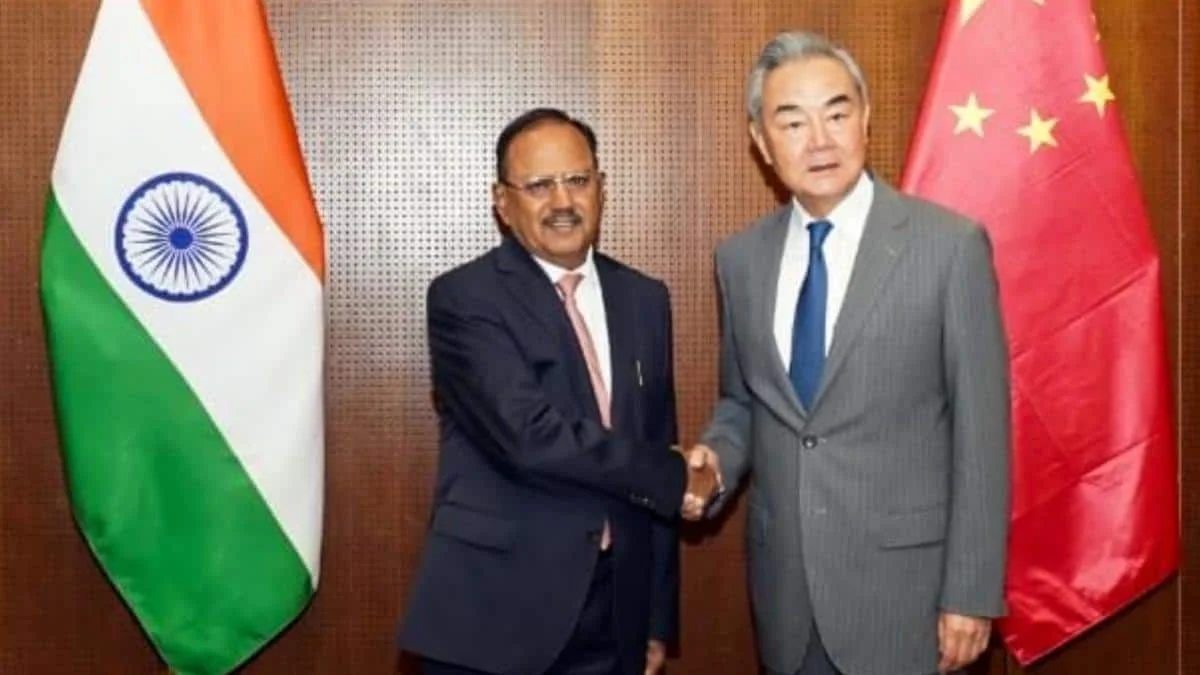
Indian National Security Adviser Ajit Doval and Chinese Foreign Minister Wang Yi held high-level talks in New Delhi to advance bilateral normalisation and secure regional border stability. The strategic dialogue took place on the sidelines of the 2026 BRICS National Security Advisers’ meeting hosted by India.
Key Highlights
- New Delhi Dialogue: NSA Ajit Doval and Chinese Foreign Minister Wang Yi engaged in structured, forward-looking talks to recalibrate strained bilateral ties.
- Border Focus: Both nations emphasized that maintaining peace along the Line of Actual Control is foundational for broader diplomatic progress.
- BRICS Agenda: The meeting anchors a broader security framework involving 11 member nations addressing non-traditional threats and regional counter-terrorism.
- Global Energy Interlinks: The security summit coincided with parallel West Asian developments, including a 60-day US Treasury license easing Iranian oil transactions.
NSA Ajit Doval and Chinese Foreign Minister Wang Yi held “constructive” talks in New Delhi, reviewing progress in India-China ties and reaffirming efforts towards normalisation and border stability.
NEW DELHI: Indian National Security Adviser Ajit Doval met with Chinese Foreign Minister Wang Yi on Monday. NSA Ajit Doval and Chinese Foreign Minister Wang Yi held “constructive” talks in New Delhi. The diplomatic session occurred during the high-level BRICS National Security Advisers’ forum.
The Ministry of External Affairs termed the exchange as highly productive and geared toward future cooperation. This strategic interaction marks a deliberate effort to reconstruct bilateral channels between the two major Asian powers.
Official statements released on X by MEA spokesperson Randhir Jaiswal confirmed that both diplomats evaluated recent diplomatic shifts. They explicitly noted positive trends moving toward a systematic normalisation of state relations.
The Indian delegation stressed that establishing stable, consistent, and positive ties remains vital for generating mutual confidence. According to Jaiswal, the intensive consultations remained thoroughly constructive and forward-looking throughout the session.
The high-level Indian delegation featured prominent state officials including Foreign Secretary Vikram Misri. Ambassador Vikram Doraiswami and Lt Gen Rajiv Ghai also participated actively in the bilateral security discussions.
This critical diplomatic interaction arrives as India executes its responsibilities as the 2026 chair of the BRICS bloc. The capital city is currently hosting the two-day assembly of top-tier international security officials.
The bilateral meeting underscores a shared intent by New Delhi and Beijing to stabilize continental relations. Ties had experienced severe strain following intense military friction along the Line of Actual Control starting in 2020.
The diplomatic landscape began showing distinct signs of recovery during 2024. Both governments initiated phased military de-escalation protocols alongside renewed high-level political engagements.
The current dialogue between Doval and Wang Yi mirrors this calculated, evolving framework. Both states are channeling resources into institutionalized dialogue mechanisms and concrete confidence-building measures.
Wang Yi previously traveled to New Delhi during the 2025 diplomatic calendar. He conducted extensive border-focused talks with Doval during the 24th Meeting of the Special Representatives held in August.
MEA records indicate that both representatives acknowledged the preservation of peace across border zones since their 23rd formal assembly. They reaffirmed that maintaining frontier stability is an absolute prerequisite for advancing wider bilateral ties.
The current diplomatic momentum builds directly upon recent state-level interactions between Prime Minister Narendra Modi and Chinese President Xi Jinping. The two leaders engaged during major international summits, including the recent SCO Summit in Tianjin.
During those prior deliberations, both heads of state welcomed the revitalized trajectory of bilateral interactions. The positive momentum has expanded steadily since their foundational meeting in Kazan in October 2024.
The leadership reaffirmed that India and China operate fundamentally as development partners rather than structural adversaries. They committed to a framework ensuring that bilateral differences are managed carefully to prevent them from escalating into active disputes.
The MEA reiterated that steady cooperation benefiting 2.8 billion people requires absolute adherence to mutual respect, shared interests, and sensitivity. Such a relationship remains critical for nurturing a balanced, multipolar Asian landscape aligned with contemporary global trends.
West Asian Security and Global Energy Impact
The broader BRICS security architecture brought together top officials from Brazil, Russia, India, China, and South Africa. Representatives from expanded member states including Egypt, Ethiopia, Indonesia, Iran, Saudi Arabia, and the UAE also joined.
Doval utilized the multilateral forum to manage parallel diplomatic priorities, holding distinct talks with Iran’s Deputy NSA Ghadir Nezamipour. These security consultations occurred alongside ongoing US-Iran diplomatic negotiations in Switzerland.
The security agenda prioritized non-traditional security challenges, counter-terrorism frameworks, and information communication technology safety. These meetings serve to finalize security priorities ahead of the formal BRICS Leaders’ Summit scheduled for September 2026.
Concurrently, global energy markets reacted to the US Treasury issuing a 60-day license permitting Iranian oil transactions until August 21, 2026. This economic shift directly impacts Indian market sentiments by lowering maritime shipping risks and stabilizing crude import costs.
Future Outlook
The strategic interaction between India and China sets a definitive baseline for stabilizing the Asian geopolitical theater throughout 2026. By centering ties on predictable diplomacy and frontier tranquility, both nuclear-armed neighbors are establishing a framework to insulate economic growth from localized border friction.
The upcoming BRICS Leaders’ Summit in September 2026 will serve as the next major evaluation point for this normalisation track. Observers expect that continuous working-group iterations on counter-terrorism and boundary management will solidify the security guarantees outlined in New Delhi.
FAQs
What was the primary outcome of the Doval-Wang Yi meeting in 2026?
The meeting resulted in a mutual reaffirmation to pursue gradual normalisation of bilateral relations. Both sides emphasized that maintaining peace and predictability along the border is essential for building long-term diplomatic trust.
Which nations participated in the broader security meeting in New Delhi?
The high-level BRICS National Security Advisers’ meeting convened top security officials from India, China, Russia, Brazil, South Africa, Egypt, Ethiopia, Indonesia, Iran, Saudi Arabia, and the United Arab Emirates.
How do external West Asian diplomatic developments impact India’s security agenda?
Stabilizing security tracks, such as the US-Iran talks in Switzerland and the subsequent 60-day Iranian oil license, directly reduces maritime risks in critical energy corridors like the Strait of Hormuz. This helps stabilize energy import costs for major consumer nations like India.