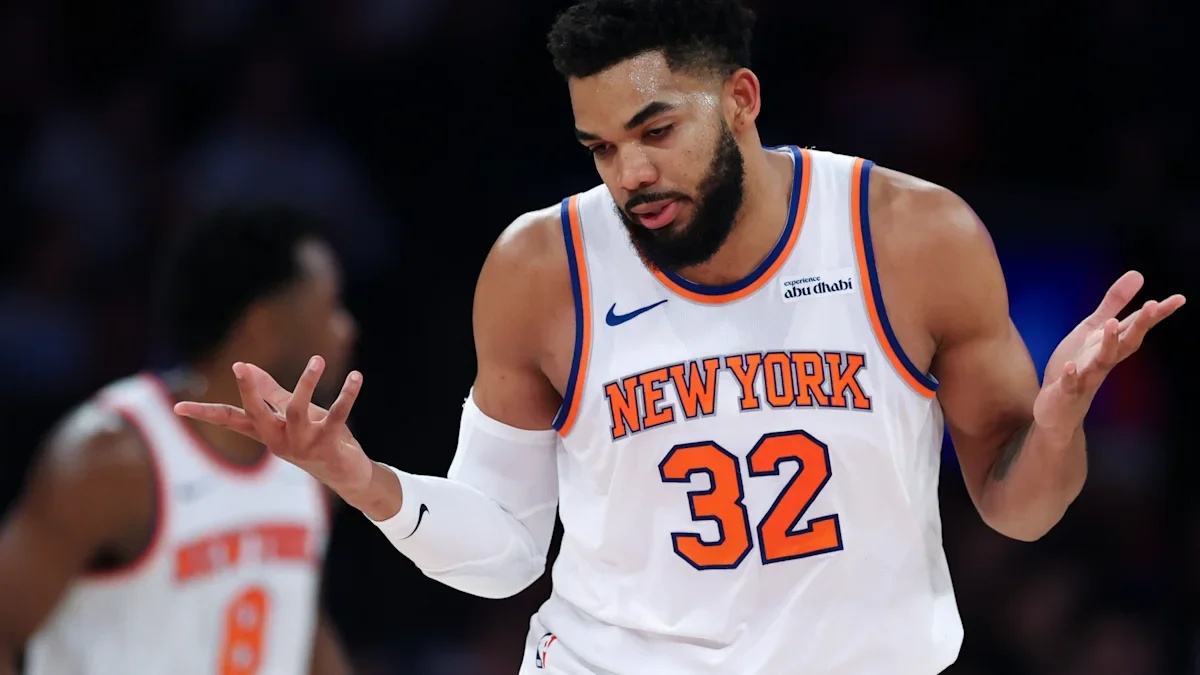
Knicks Acquired Karl-Anthony Towns in Three-Team Trade
The New York Knicks completed a three-team trade on October 2, 2024, acquiring four-time NBA All-Star Karl-Anthony Towns from the Minnesota Timberwolves in a transaction involving the Charlotte Hornets.
The deal also brought New York the draft rights to center James Nnaji.
The transaction reshaped New York’s frontcourt while sending several established players and future draft selections to Minnesota and Charlotte. It was completed as the Knicks prepared for the 2024-25 NBA season.
The official announcement confirms the acquisition and its terms. It does not establish a subsequent decision to trade Towns, an unresolved contract dispute or a timetable for another transaction involving the center.
Knicks Acquired Towns and Nnaji
New York received Towns from the Minnesota Timberwolves and the draft rights to James Nnaji from the Charlotte Hornets.
Towns was 28 at the time of the transaction and had already earned four NBA All-Star selections. His arrival represented a significant addition to the Knicks’ frontcourt entering training camp.
Nnaji, a 20-year-old center, was included through the Hornets’ participation. His draft rights formed a separate part of New York’s return rather than an additional established NBA player joining the active roster.
The transaction involved three franchises because the Knicks needed to assemble a package that accommodated both basketball considerations and salary-matching requirements.
Minnesota Received Players and Draft Compensation
The Knicks sent Julius Randle, Donte DiVincenzo and Keita Bates-Diop to Minnesota as part of the completed deal.
Randle had earned three NBA All-Star selections during his career. His departure was a substantial change to New York’s established roster, particularly because the Knicks were acquiring another high-profile frontcourt player in Towns.
DiVincenzo and Bates-Diop were also included in the outgoing package, expanding the transaction beyond a direct exchange of two prominent players.
Minnesota additionally received a top-13 protected 2025 first-round draft pick that originally came from the Detroit Pistons.
That selection represented a future asset rather than an immediate addition to Minnesota’s playing roster. Its protection was an important feature of the compensation package agreed upon when the transaction was completed.
Charlotte Facilitated Salary Matching
The Charlotte Hornets participated in the transaction to help accommodate the salary-matching arrangements required under the NBA’s collective bargaining restrictions.
New York sent guards Charlie Brown, DaQuan Jeffries and Duane Washington Jr. to Charlotte, along with two future second-round draft picks.
Charlotte also received draft assets from Minnesota as part of the three-team arrangement.
The Hornets’ involvement made the transaction more complex than a conventional two-team exchange. New York distributed outgoing players and selections between two organizations while receiving Towns and Nnaji’s draft rights.
The salary-matching component is relevant to understanding the completed acquisition, but it does not independently establish New York’s salary cap position in later seasons.
Trade Reshaped New York’s Frontcourt
Towns’ arrival gave the Knicks an established All-Star center while removing Randle from the roster.
The exchange changed the composition of New York’s frontcourt and required the organization to account for the departure of players who had previously occupied significant roles.
Acquiring Towns also represented a substantial investment in an individual player. New York committed multiple established players, a protected first-round selection and second-round draft compensation across the broader transaction.
Those outgoing assets provide historical context for any discussion of Towns’ future with the franchise. They do not, however, establish what New York could receive in a hypothetical subsequent trade.
Contract and Trade Questions Remain Separate
The October 2024 announcement documents the original acquisition but provides no verified figures for a proposed contract extension, a negotiating disagreement or the Knicks’ projected payroll in 2027.
It also does not establish Towns’ subsequent seasonal statistics, the applicable future luxury tax thresholds or any formal decision to explore another trade.
Consequently, the completed three-team transaction cannot be presented as evidence that New York has entered contract-related trade negotiations.
The confirmed development remains the Knicks’ acquisition of Towns and Nnaji’s draft rights in exchange for players and future draft assets. Any later transaction would be a separate development requiring its own confirmation.