Maharishi Sushruta Statue Unveiled at Royal College of Surgeons Edinburgh
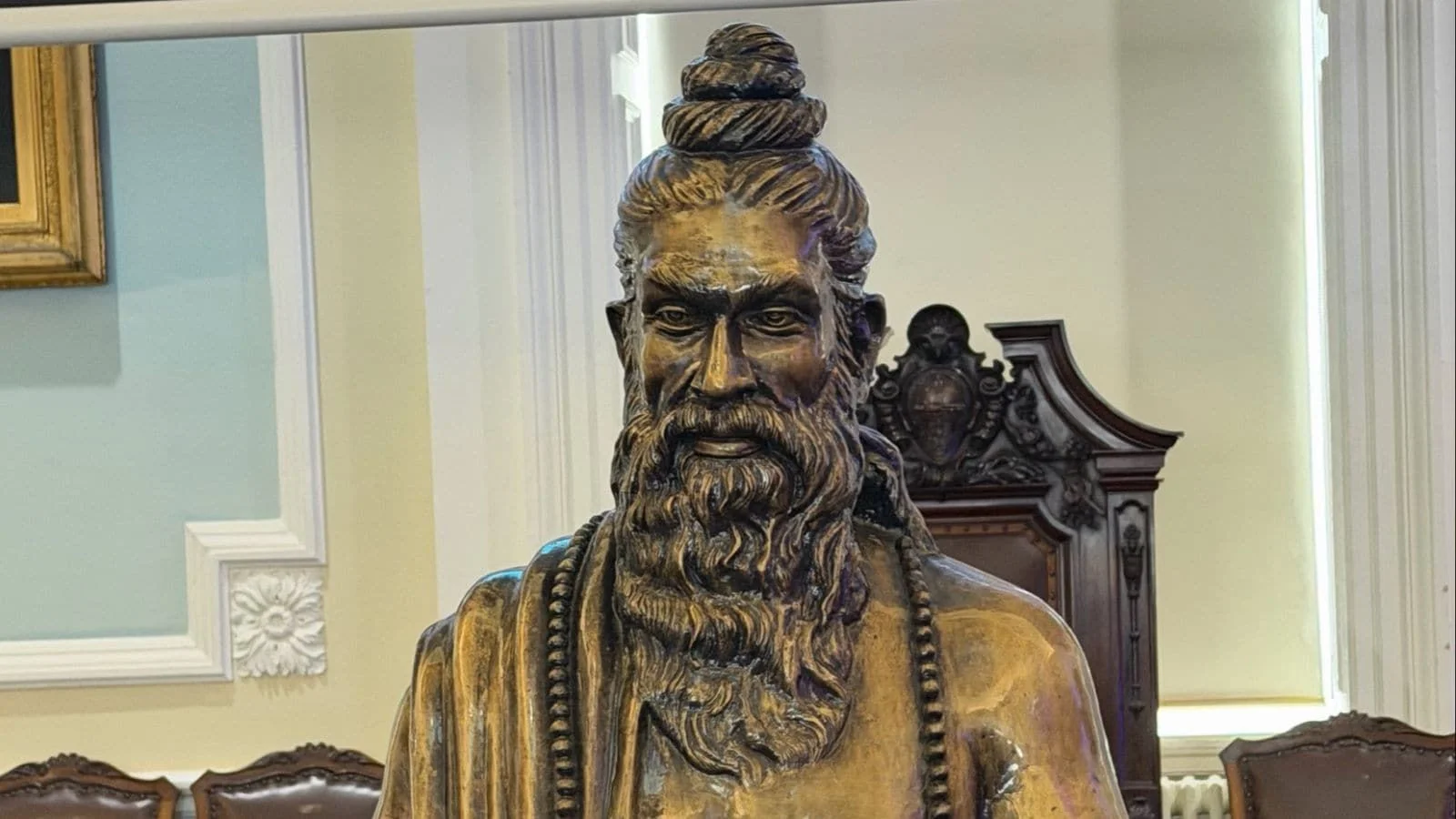
The Royal College of Surgeons of Edinburgh has unveiled a statue of the ancient Indian sage Maharishi Sushruta, celebrating India’s historical contributions to medicine. The installation marks a significant recognition of classical surgical heritage by the world’s oldest surgical corporation.
Key Highlights
- The world’s oldest surgical college in Edinburgh installed a statue of ancient Indian physician Maharishi Sushruta.
- The monument was donated by the Cheruvu Family Foundation and crafted by a traditional sculptor in Tamil Nadu.
- The initiative celebrates centuries of historical links in medical education and practice between India and Scotland.
- High-ranking diplomats and medical leaders from the UK, India, and the United States attended the ceremony.
Royal College of Surgeons of Edinburgh unveils Maharishi Sushruta statue, donated by the Cheruvu Family Foundation, highlighting India’s ancient medical heritage.
A statue honoring the ancient sage Maharishi Sushruta, widely acknowledged as a pioneer of surgical practice, has been inaugurated at the Royal College of Surgeons of Edinburgh, according to an announcement on X by India’s Consulate General in Scotland. The event commemorated the historical links binding India and Scotland together within the disciplines of medicine and surgery.
The installation within the prestigious Royal College was driven forward through the initiative of Professor Chandra Cheruvu, an expert in Laparoscopic and Upper Gastro-intestinal Surgery currently practicing at the University Hospital North Midlands.
Expressing gratitude to Dr. Cheruvu, the Consulate stated on X that the ceremony honored the ancient medical traditions of India, alongside the enduring medical ties between India and Scotland. It also noted the profound global impact of the Royal College in developing surgical training.
Dr. Cheruvu, who operates in the United Kingdom, maintains deep ancestral roots in India, having earned his medical degree in Andhra Pradesh.
Who Was Maharishi Sushruta?
The revered sage is widely recognized as one of the earliest pioneering physicians and surgeons in human history. He is celebrated for authoring the Sushruta Samhita, a foundational medical text detailing surgical operations and recording the earliest documented methodologies for plastic surgery.
Within his compiled texts, he detailed rudimentary techniques for nasal reconstruction alongside various complex operative procedures. The surgical instruments documented throughout his ancient treatise drew direct inspiration from the forms of animals and elements of nature.
While exact historical timelines remain a subject of debate, scholars estimate that he lived around 600 BCE. His historical work and teachings remain fundamentally linked to the ancient city of Varanasi.
About Royal College Of Surgeons, Edinburgh
The Royal College of Surgeons of Edinburgh holds the distinction of being the most historic surgical institution globally. Established originally in 1505, it received its formal royal charter the following year from King James IV, an monarch noted for his personal fascination with amateur surgical practice.
In the modern era, the institution stands as one of the premier global centers for advanced medical instruction. The college maintains an unbroken line of historical archives stretching back to 1581 AD.
The newly installed monument was presented to the institution by the Cheruvu Family Foundation, a philanthropic organization set up by Professor Cheruvu and his relatives. The piece itself was shaped by a skilled artisan based in Tiruvannamalai, Tamil Nadu.
The Cheruvu Family Foundation, set up by Professor Cheruvu alongside his family, provided the financial backing to donate the monument. Media documentation indicates that the physical sculpture was built by an expert craftsman operating out of Tiruvannamalai in Tamil Nadu.
The official gathering was attended by the Consul General of India to Scotland, Siddharth Malik, alongside the President of the Royal College, Professor Clare McNaught. They were joined by former President Professor Rowan Parks and Professor Marc Halpern, the founder of the California College of Ayurveda, amid a gathering of international dignitaries.
History of India-Scotland Medical Ties
The installation of the Maharishi Sushruta statue underscores a long-standing academic exchange between Scotland and the Indian subcontinent. During the 18th and 19th centuries, a significant number of medical officers serving in India were trained at Scottish universities, particularly in Edinburgh and Glasgow. This reciprocal relationship helped shape public health policies and medical education frameworks in both nations, bridging ancient eastern methodologies with western clinical advancements.
FAQs
Maharishi Sushruta was an ancient Indian physician and sage who lived around 600 BCE in Varanasi. He wrote the Sushruta Samhita, an ancient treatise considered one of the earliest texts covering surgical procedures and plastic surgery.
Where was the new Sushruta statue installed?
The statue was unveiled at the Royal College of Surgeons of Edinburgh in Scotland, which is recognized as the oldest independent surgical corporation in the world, founded in 1505.
Who funded and created the Maharishi Sushruta statue?
The statue was donated by the Cheruvu Family Foundation, which was established by UK-based laparoscopic surgeon Professor Chandra Cheruvu and his family. The physical monument was crafted by a traditional sculptor located in Tiruvannamalai, Tamil Nadu.
What is the historical significance of the Royal College of Surgeons of Edinburgh?
Founded in 1505 and receiving royal assent from King James IV in 1506, the institution holds an unbroken lineage of medical training records dating back to 1581 AD, making it a premier global hub for surgical education.