India Advances 100-Bed Fiji Super Specialty Hospital Project
New Delhi and Suva have accelerated bilateral healthcare operations, pushing a landmark bilateral medical infrastructure project into its final preparatory phase. The initiatives expand critical care access, bolster emergency medical logistics, and introduce sweeping regional legislative reforms designed to counter mounting public health challenges across the Pacific nation.
Key Highlights
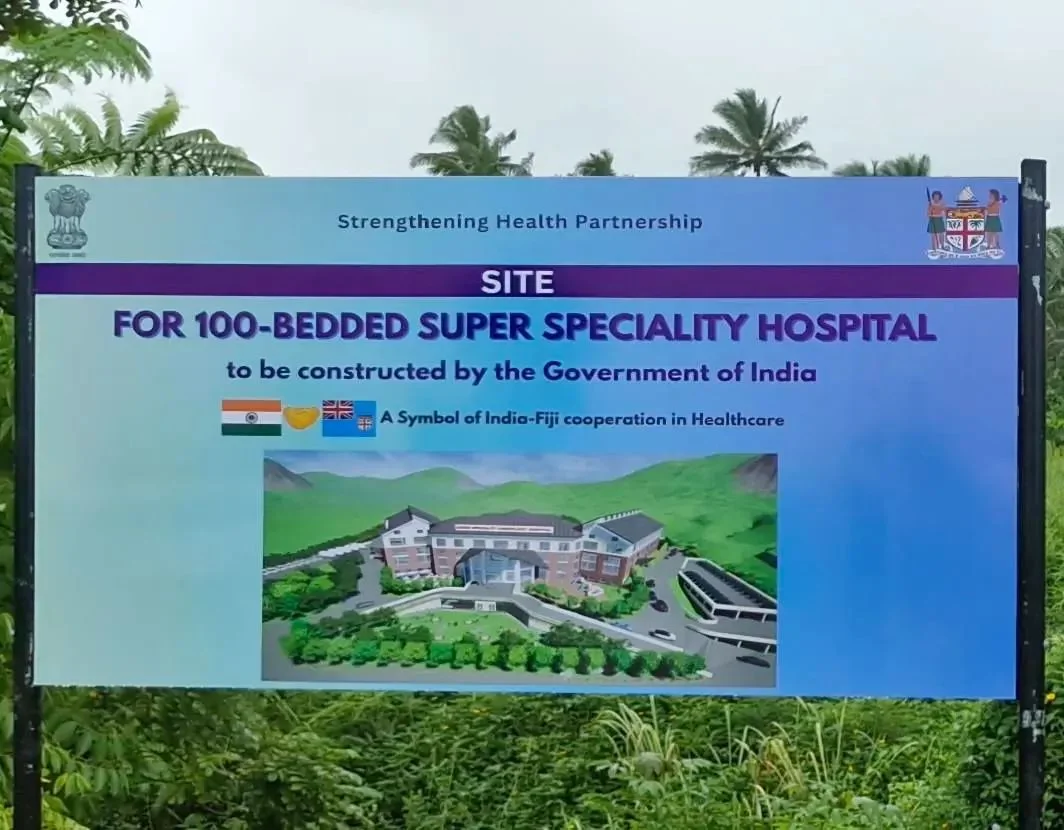
- Construction of Fiji’s first 100-bed Super Specialty Hospital in Nasinu has entered advanced tendering stages under Indian government procurement.
- New Delhi is expanding immediate grant assistance, deploying 10 ambulances, two dialysis units, and a specialized prosthetic camp by September 2026.
- India’s recent National Family Health Survey highlights socio-medical strategies that diplomatic officials say offer vital benchmarks for the Pacific.
- Fiji’s parliament is weighing the Public Health Amendment Bill 2026, introducing strict statutory penalties up to $10,000 for health non-compliance.
Fijian Health Minister Dr. Atonio Lalabalavu confirmed earlier this year that domestic administrative requirements were complete, transferring execution authority entirely to the Indian government.
The grant-financed 100-bed Super Specialty Hospital slated for Nasinu has advanced to critical tendering phases, with ground breaking scheduled immediately upon procurement finalization.
Diplomatic officials from the Indian High Commission in Suva confirmed that the infrastructure development—representing the largest single grant-in-aid deployment by India within the Pacific region—is progressing through state procurement channels in New Delhi.
Bibhash Lahiri, Under-Secretary for Technical Cooperation at India’s Ministry of External Affairs, stated that specialized engineering and construction teams will deploy to Fiji when current commercial evaluations conclude.
The procurement operations have reached a highly advanced stage, according to Mr. Lahiri.
Contractual finalization will trigger immediate mobilization to initiate physical construction on-site.
The upcoming medical center will occupy land adjacent to the Fiji National University in Nasinu, establishing the country’s premier specialized clinical facility.
The institution will function as a comprehensive multi-ward center, distributing clinical beds across multiple medical specialties, though final architectural distributions remain under assessment.
Concurrently, two distinct dialysis systems gifted by India are scheduled to arrive within three to four months, operating as an independent bilateral assistance track separate from the primary hospital construction.
State planners have yet to finalize whether the complex will operate under a public or private framework, noting the operational model will align with strategic directives from the Fijian government.
Initial clinical staffing configurations will utilize Indian medical specialists while structured human capital programs systematically train Fijian practitioners to transition long-term operational control to local personnel.
Furthermore, bilateral supply chain integrations now allow Fiji to import essential Indian pharmaceuticals at lower cost structures, with substantial volumes already entering domestic verification channels.
Strategic mobility expansions are underway as 10 specialized emergency vehicles transition through Indian procurement pipelines for direct delivery to the Ministry of Health and Medical Services.
The diplomatic mission confirmed the logistical deployment alongside plans to execute a secondary localized prosthetic camp scheduled for September 2026.
Indian external affairs officials verified the emergency vehicles are fully financed via state grants to optimize domestic rapid-response capabilities.
The asset mobilization follows the previous delivery of more than three tonnes of antiretroviral medications valued at $2.5 million in November 2025, marking India’s largest pharmaceutical donation to assist Fiji’s rising counter-HIV response.
The upcoming September 2026 medical deployment will provide free specialized prosthetic adjustments utilizing durable Indian-designed mobility limbs built for regional agricultural environments, succeeding an initial clinical camp executed in 2022.
Bilateral authorities flagged intensifying regional pressures from non-communicable diseases, observing that both populations face comparable risks from escalating obesity, diabetes, and hypertension linked to demographic shifts.
Technological and policy frameworks remain open to collaborative expansion, utilizing established joint working groups to systematically address mutual chronic health priorities.
Historical data confirms consistent medical aid flows, with India executing targeted pharmaceutical and supply donations across 2021, 2022, 2023, and 2025, alongside foundational prosthetic clinics.
Bilateral authorities indicate that targeted capital allocations toward public education and gender equality frameworks have generated measurable shifts in baseline family wellness indicators.
Data from India’s sixth National Family Health Survey points to structural shifts, noting a 50% reduction in underage marriages alongside normalized fertility measures and near-universal female participation in household economic choices.
The Ministry of External Affairs presented these multi-decade developments to regional stakeholders, outlining direct operational correlations to systemic issues currently faced by Fiji regarding chronic ailments and maternal care.
The comprehensive analytical study surveyed approximately 679,000 households through the International Institute for Population Sciences, capturing extensive developmental trajectories.
Monitored parameters show medicalized births rising from 38.7% in 2005 to 90.6%, while domestic vulnerability indicators dropped from 37% to 22.3%, alongside a contraction in early marriages from 47% to 20%.
Despite structural progress, administrative leads recognized sustained domestic hurdles, pointing out direct commonalities with contemporary public health patterns observed across the Pacific.
Both nations navigate substantial clinical pressures stemming from non-communicable illness profiles, with domestic female obesity tracking upward from 20% to 30% alongside climbing metabolic diagnoses.
The upward trajectory mirrors global public health shifts across developing economies.
Long-term analysis demonstrates that sustained macro-economic expansion yields optimal family wellness outcomes when structurally tied to digital inclusion, literacy, and gender parity.
Pacific healthcare architectures can leverage these long-term developmental metrics to optimize local intervention frameworks.
Strategic policy updates over the past 20 years provided the fiscal capacity to systematically advance baseline population wellness.
Concurrently, regional legislative bodies are reviewing statutory amendments that attach strict financial liabilities up to $10,000 for public non-compliance and health misinformation.
The statutory updates contained within the Public Health Amendment Bill 2026 aim to optimize state containment mandates, increase financial enforcement levels, and codify modern crisis preparedness protocols.
State executives seek expanded statutory powers to isolate and manage communicable pathogen vectors during active transmission events.
The legal framework establishes strict financial fines up to $10,000, mandatory quarantine tracking, and legal mechanisms to penalize the deliberate dissemination of fraudulent data during active crises.
The legislative updates within the pending bill seek to overhaul field inspection capabilities while modernizing response protocols against potential epidemic vectors.
Under the updated statutory terms, environmental health authorities receive broad entry and monitoring rights to gather biological samples, enforce isolation directives, and mandate decontamination protocols for structures or assets.
Significantly, administrative directors can mandate target populations to receive necessary immunizations or preventative medical interventions during verified outbreaks based on direct executive alignment.
The draft law, presented to legislative sessions in May 2026, serves to replace legacy healthcare frameworks with a highly agile emergency architecture.
The statutory text introduces specific misdemeanor categories for refusing lawful medical orders, interfering with authorized field personnel, or circulating false reporting designed to disrupt compliance.
Legacy financial penalties are adjusted upward, shifting historical baselines from $40 and $50 caps to a standard $1,000 threshold, while severe violations scale to $10,000.
The structural overhaul establishes decentralized Divisional and Sub-Divisional Outbreak Response Teams tasked with field coordination during active emergency situations.
Operational duties traditionally managed by specialized medical officers will distribute to certified medical practitioners and field environmental health officers under the modernized framework.
Finally, commercial compliance rules for lodging assets face stricter oversight, requiring operators to verify active tax status and corporate registration before local boards grant operational clearances.
The structural updates represent a comprehensive modernization of national emergency healthcare frameworks designed to maximize long-term systemic resilience.
Future Outlook
The completion of tender evaluations in New Delhi will clear the path for direct infrastructure deployment in Nasinu, marking a structural shift in Fiji’s specialized clinical capacity. This physical infrastructure, combined with the pending passage of the Public Health Amendment Bill 2026, signals a dual approach to national health security: importing specialized institutional expertise while centralizing legal and epidemiological controls to manage future outbreaks.
FAQs
What is the capacity of the new hospital in Nasinu?
The new Super Specialty Hospital will feature a 100-bed capacity. It is designed to function as a multi-ward facility distributing specialized clinical services across several newly introduced medical disciplines.
How is the new specialty hospital project being funded?
The construction and development of the facility are fully funded via a grant-in-aid initiative from the Government of India, representing its largest single grant development project in the Pacific region.
What penalties does the Public Health Amendment Bill 2026 introduce?
The proposed bill increases base penalties for non-compliance from historical levels of $40 or $50 up to $1,000 for standard infractions, while severe offenses—including the deliberate spread of public health misinformation—can incur fines up to $10,000.