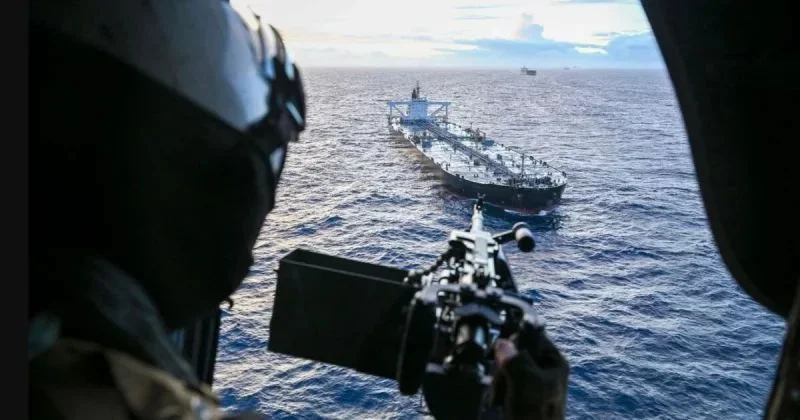
US Troops Board Sanctioned Iranian Tanker
American military units executed a night operation to board a sanctioned vessel containing Iranian petroleum in the Indian Ocean on June 5, 2026. This maritime action intensifies efforts by United States authorities to restrict the energy export revenues generated by Tehran.
Key Highlights
- US military units boarded the stateless supertanker MT Davina in the Indian Ocean on June 5, 2026.
- The vessel can transport 2 million barrels of petroleum and was sanctioned in October 2024.
- The operation follows Treasury Department actions blacklisting major Iranian digital currency exchanges.
- Tehran previously announced plans to accept cryptocurrency for vital maritime transit tariffs.
What happened with the Davina
The United States Indo-Pacific Command validated the high-seas boarding, classifying the deployment as an initiative to degrade the Iranian shadow fleet and its covert shipping systems. Officials confirmed the mission concluded without any tactical resistance.
The commercial vessel, tracking under the names Davina and Lenore, operates as a stateless entity. This specific legal classification means no sovereign nation officially registers the ship, nullifying standard protections under international law and permitting maritime interdictions.
Naval transponders last positioned the supertanker near southern Sri Lanka prior to the military boarding. The coordinates place the vessel directly within established maritime corridors known for ship-to-ship fuel transfers, a strategy utilized to bypass global trade embargoes.
The crypto connection is real
On June 2, 2026, federal regulators blacklisted the platform Nobitex along with secondary digital asset operations, declaring that the networks permitted evasion of economic blockades and yielded digital currency access for paramilitary organizations.
During April 2026, authorities in Tehran affirmed intentions to collect digital currency for maritime passage through critical chokepoints. This policy shift demonstrates the growing integration of alternative financial assets into high-stakes geopolitical conflicts.
Targeting Nobitex remains significant because the platform serves as a primary digital asset portal within the regional economy. By cutting off access points converting local currency to digital alternatives, regulators attempt to block parallel financial pathways.
What this means for crypto markets and oil
The implications for international energy sectors remain direct. Each blocked supertanker reduces the global volume of petroleum reaching international buyers, with this specific ship capable of moving 2 million barrels of crude.
For digital asset ecosystems, the blacklisting of regional platforms emphasizes claims that alternative currencies aid blocked governments. This development provides regulatory bodies in Western capitals with justification to enforce stricter compliance frameworks.
The regional decision to accept cryptocurrency for maritime transit fees introduces an unprecedented precedent of a sovereign state utilizing decentralized assets for vital infrastructure access, validating alternative settlement systems outside traditional banking networks.
Financial entities failing to audit for restricted regional digital wallets face severe legal liabilities. These regulatory enforcement risks extend equally to maritime insurers, international commodity brokers, and logistical supply networks.
Historical context or future outlook
The intercept of the MT Davina occurs amid an expanding global effort to counter parallel shipping networks used to circumvent international trade barriers. Over recent years, the deployment of unidentified or falsely flagged vessels has accelerated, challenging traditional naval enforcement mechanisms.
Concurrently, the integration of digital assets into state-level trade finance represents a shifting frontier for international regulatory bodies. As conventional banking routes remain restricted, the reliance on digital settlement systems by restricted nations is projected to drive broader compliance mandates across global financial and maritime commerce sectors.
FAQs
Why did US forces board the MT Davina?
US military forces executed the boarding operation to disrupt trade networks that allow regional actors to bypass international energy embargoes and generate state revenue.
What does it mean when a ship is designated as stateless?
A stateless vessel lacks a validated registration with any sovereign nation, which removes standard legal protections under maritime law and permits international authorities to intercept it.
How are digital currencies connected to maritime oil sanctions?
State entities utilize digital asset platforms to transfer value and bypass traditional banking networks, prompting regulatory agencies to target both physical shipping fleets and digital currency exchanges simultaneously.