Ken Betwa Project Spark Protests from Indigenous Women
Hundreds of indigenous women in India have launched intense demonstrations against the massive Ken Betwa river linking project. Protesters occupied symbolic funeral pyres to express extreme anxiety over impending displacement, environmental destruction, and the permanent submersion of ancestral villages under newly planned water infrastructure.
Key Highlights
- Hundreds of indigenous women launched a chita andolan protest using symbolic funeral pyres in Madhya Pradesh.
- The controversial infrastructure initiative includes the construction of the massive Daudhan dam and a 221 km water canal.
- Government estimates indicate the project will supply water to 62 lakh people and irrigate 10 lakh hectares of land.
- Local tribal communities face imminent displacement, loss of farming land, and the destruction of ancestral village structures.
Indigenous Women Launch Funeral Pyre Protests Over Dam Submersion Fears
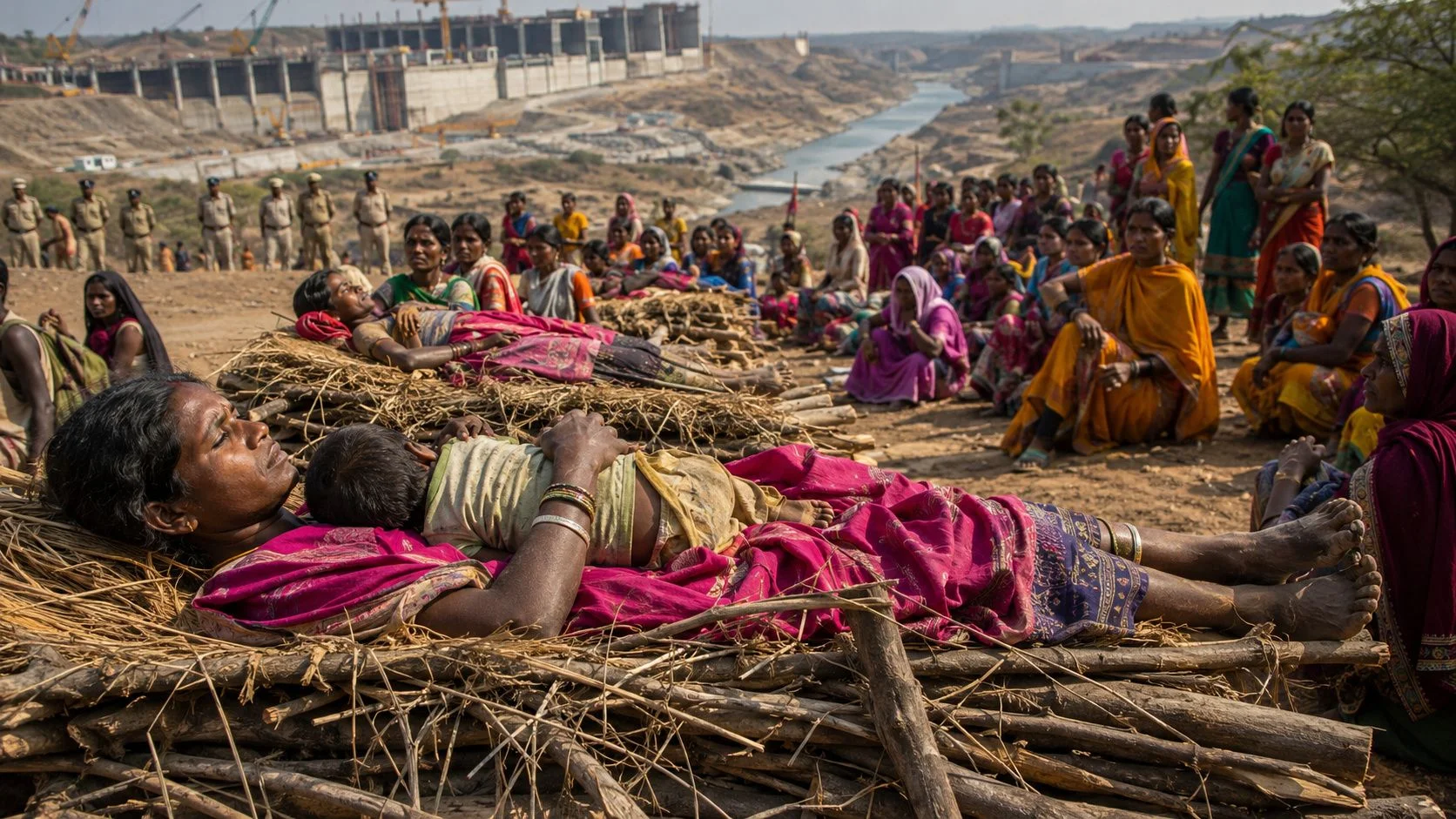
A massive gathering of indigenous women carrying children in arms staged an extreme demonstration against the multi-billion dollar Ken Betwa project in central India. The unique demonstration transformed deep-seated local anxieties over the loss of ancestral territories, homes, and agricultural farmlands into a stark, highly visible image of public resistance.
The widespread demonstrations were initially documented by the Times of India, a prominent national news outlet. The collective action erupted on April 9, 2026, within the Chhatarpur district of Madhya Pradesh, drawing hundreds of native agriculturalists who were predominantly tribal women.
At the center of the growing regional conflict is the planned Daudhan dam, a massive 221 km artificial water canal, and an expansive river-linking network engineered to transport water to arid zones. Local communities argue that the aggressive development of this infrastructure guarantees mass displacement, widespread land confiscation, and the absolute destruction of vulnerable rural settlements.
Tribal Demonstrators Deploy Symbolic Funeral Pyres to Highlight Existential Threat
The local community officially designated the demonstration as a chita andolan, a localized phrase representing a public protest conducted atop symbolic funeral pyres. Rather than brandishing traditional cardboard placards, the tribal women utilized their physical bodies to signal that losing geographic territory constitutes an absolute societal death.
The striking imagery generated intense national attention because numerous participating mothers held children in arms throughout the demonstration. This tactical presentation delivered an unmistakable, heavy message: the socio-economic future of entire generations remains severely jeopardized by state development plans.
The underlying slogan driving the rural mobilization translated directly into a demand for justice or death. This phrase captures the absolute desperation of vulnerable populations facing forced eviction from historic zones where they cultivate crops, raise families, and maintain deep communal bonds.
The severe visual gravity of the demonstration explains its rapid media propagation. The unfolding confrontation transcends standard disputes over national water-management infrastructure, representing a fundamental battle over vulnerable human settlements, cultural memories, ancestral territories, and basic survival.
Massive River-Linking Infrastructure Outlines Ambitious Water Divertment Grid
The primary objective of the Ken Betwa project centers on redirecting excess water volumes from the Ken river basin into the neighboring Betwa river basin system. State authorities designed this extensive transfer network to alleviate chronic drought conditions paralyzing multiple arid districts across Madhya Pradesh and Uttar Pradesh.
The engineering blueprint requires building the massive Daudhan dam, along with a sprawling distribution network consisting of secondary channels extending well over 200 km. This massive artificial distribution channel spans exactly 221 km, highlighting the immense physical scale of the state-sponsored ecological intervention.
In practical engineering terms, an infrastructure asset of this magnitude functions as a gargantuan artificial pathway for water resources. The network fundamentally alters natural hydrological circulation patterns across state boundaries to artificially irrigate highly marginalized regions lacking reliable access to natural water sources.
Conversely, when massive reservoir walls expand over historic, long-inhabited territories, adjacent farming populations experience immediate panic regarding widespread flooding, forced relocation, and the total destruction of acreage utilized for residential housing and daily economic survival.
Critical Daudhan Dam Becomes Principal Flashpoint for Threatened Tribal Settlements
The construction of the Daudhan dam has emerged as the most politically sensitive and volatile component of the broader infrastructure initiative. The massive concrete asset remains directly tied to generating an expansive reservoir grid designed for industrial-scale water retention and regional distribution.
Reports from the Times of India clarified that rural populations opposing the state intervention are explicitly raising alarms over land, forest rights, and displacement. These unresolved socio-legal friction points explain why organized resistance has amplified among disenfranchised indigenous farmers.
For the families inhabiting these threatened rural zones, the ongoing debate extends far beyond the physical height of the concrete dam. The immediate terror involves the forced abandonment of historic homesteads, the permanent loss of fertile agricultural zones, and absolute economic uncertainty following project completion.
This specific type of localized humanitarian disruption remains notoriously difficult to quantify through standard economic metrics alone. While residential structures can technically be rebuilt in designated relocation zones, organic community relationships, daily routines, river ecosystems, and historic family memories cannot be transferred.
State Officials Promise Major Irrigation Benefits as Communities Brance for Impact
State administrators continue to defend the infrastructure initiative, framing it as a vital public work capable of delivering reliable water security to chronically parched agricultural sectors. Official development pledges include expanded seasonal irrigation, stable municipal drinking supplies, and clean hydroelectric power generation.
According to published state metrics, the completed system is projected to service more than 10 lakh hectares of land while providing clean drinking water to approximately 62 lakh people. Regional authorities utilize the traditional Indian numerical term lakh to denote units of one hundred thousand.
These macro-economic figures illustrate why federal planners classify the river-linking initiative as a critical strategic asset. In highly marginalized, drought-prone agricultural belts, the arrival of managed water infrastructure can radically transform crop yields, regional food security, and family stability.
Nonetheless, affected rural populations view the massive development project through a radically different lens. For these communities, the projected economic benefits designated for external regions cannot justify the immediate, catastrophic risk of villages being submerged and ancestral lines displaced.
The ongoing public mobilization garnered intense domestic media scrutiny following a sharp outbreak of physical hostility between local demonstrators and state security forces. Women leading the frontline demonstration directly clashed with police units during an aggressive state attempt to clear the protest site.
Following the brief physical confrontation, law enforcement units retreated, allowing the indigenous communities to maintain their positions and reaffirm their commitment to the blockade. The direct clash significantly reinforced the national public image of a grassroots resistance movement spearheaded entirely by rural women.
Local organizers also detailed severe operational difficulties, reporting that state blockades restricted geographic circulation and choked off access to essential daily items. For the cornered residents, these logistical blockages served to amplify the overall sense of state pressure bearing down on the villages.
Despite the strict security cordons established near the primary protest camps, a faction of the demonstration successfully relocated their bodies into the middle of the flowing Ken River. This deliberate tactical maneuver reinforced the core symbolic message of the conflict: a direct fight over water, land, and the fundamental right to remain inside native territories.
Striking Visuals of Tribal Resistance Spark Widespread Digital Engagement
The profound digital reach of the protest images stems from an unusual confluence of raw, dramatic elements captured in a single geographic frame. The scene juxtaposes indigenous women and vulnerable children against symbolic funeral pyres, a massive dam site, an artificial river, and the total eradication of rural societies.
This stark visual combination allows external audiences to instantly comprehend the core humanitarian crisis without prior technical knowledge of the infrastructure scheme. The unmediated visual message remains entirely unambiguous: local farming families genuinely believe they will lose everything if the state project advances.
The ongoing protest also commands public attention because it forces ordinary, marginalized citizens into the absolute center of a highly technical macroeconomic discourse. Instead of limiting the conversation to concrete channels and political water Pledges, the scene highlights human beings residing directly in the path of destruction.
Consequently, the localized agrarian dispute has effectively transcended regional boundaries. The standoff illustrates how mega-infrastructure initiatives frequently represent a total economic solution for urban planners while presenting an existential, identity-destroying threat to traditional communities living on the land.
The unfolding conflict exposes the profound human costs that frequently accompany large-scale national water management projects. While the state presents the river network as a cure for systemic drought, the extreme measures taken by indigenous women prove that such projects can uproot entire civilizations.
The deployment of symbolic funeral pyres was not a mere theatrical display; it perfectly distilled a deep collective dread of displacement, land insecurity, and structural abandonment. The crisis forces an urgent global question regarding the moral limits of state-sponsored development at the expense of indigenous survival.
Future Outlook
The unresolved standoff at the Daudhan dam site indicates an escalating legal and political battle over land acquisition rights in central India. As tribal coalitions vow to maintain their encampments indefinitely, federal oversight committees will likely face mounting international human rights pressure to re-evaluate resettlement compensation packages. If independent environmental and social impact assessments are not fast-tracked to address the community’s fears of total cultural erasure, the confrontation risks stalling one of India’s most critical climate-adaptation initiatives for the foreseeable future.
FAQs
What is the primary purpose of the Ken Betwa project?
The project is a major state-sponsored infrastructure initiative designed to transfer excess water from the Ken river basin to the drought-prone Betwa river basin. It aims to provide critical irrigation to more than 10 lakh hectares of land and deliver reliable drinking water to approximately 62 lakh people across Madhya Pradesh and Uttar Pradesh.
Why are indigenous women protesting on symbolic funeral pyres?
The local women initiated the chita andolan protest to visually demonstrate that the forced loss of their ancestral lands and the submersion of their villages is equivalent to the death of their community. The extreme demonstration highlights their deep fears of displacement and the lack of clear guarantees regarding their housing, livelihoods, and land rights.
What specific infrastructure is causing the most local resistance?
The construction of the Daudhan dam is the main flashpoint of the protest. Local agriculturalists and tribal residents fear that the massive reservoir created by the dam will completely submerge their villages, destroy nearby forests, and permanently wipe out the farmlands they rely on for survival.
When and where did this specific protest take place?
The specific demonstration occurred on April 9, 2026, in the Chhatarpur district located within the state of Madhya Pradesh, India. It involved hundreds of indigenous farmers and residents from the threatened villages surrounding the project site.