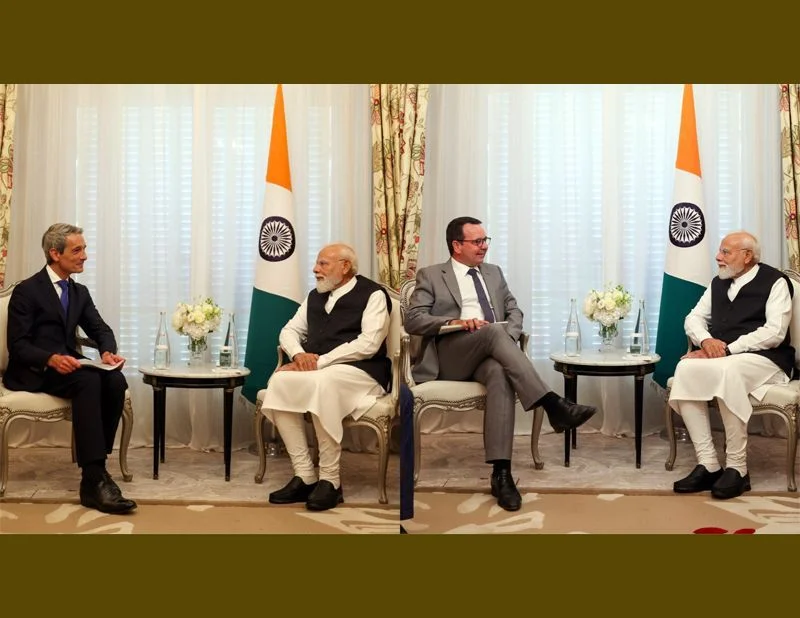
PM Narendra Modi Meets European Business Leaders in Paris
Prime Minister Narendra Modi engaged with top corporate executives in Paris on Thursday to discuss investment opportunities and expansion initiatives in India. The high-level dialogues focused on strategic collaborations spanning sustainable construction, modern mobility, and advanced artificial intelligence ecosystems.
Key Highlights
- Prime Minister Modi held targeted bilateral discussions with prominent French business leaders in Paris on June 18, 2026.
- Conversations with Saint-Gobain and Alstom focused on advancing sustainable infrastructure and modernizing India’s railway systems.
- Artificial intelligence took center stage during talks with Mistral AI to drive technology partnerships.
- The meetings followed Modi’s participation at the G7 Summit, where he also met world leaders.
Indian Prime Minister Narendra Modi convened with prominent corporate leaders in Paris on Thursday to evaluate investment prospects and expansion strategies within India.
The chief executives who participated in the deliberations represented diverse commercial segments, specifically sustainable infrastructure, transportation manufacturing, and artificial intelligence.
Modi is currently concluding a diplomatic visit to France, following his participation in the G7 Summit over the prior two days, where he also held bilateral talks with global figures including US President Donald Trump.
Modi conducted a bilateral meeting with Benoit Bazin, Chairman and Chief Executive Officer of Saint-Gobain, focusing on development avenues within the industrial materials and building sectors, prioritizing ecological sustainability, according to the Ministry of External Affairs (MEA).
The diplomatic briefing indicated that the prime minister acknowledged the substantial manufacturing footprint and capital commitments of Saint-Gobain in India, which generate significant employment for the domestic workforce.
Bazin outlined the multinational corporation’s strategic roadmap for escalating its capital deployment and operational footprint across Indian states, the MEA confirmed.
Modi additionally conferred with Alstom Chief Executive Officer Martin Sion to explore mutual opportunities in transport logistics and the modernization of transit rail networks.
The prime minister emphasized Alstom’s substantial financial investments and localized production operations, which actively bolster job creation and accelerate the domestic railway sector’s modernization.
Sion detailed the transport manufacturer’s impending deployment of incremental capital and operational scaling within the Indian market.
Modi also held talks with Arthur Mensch, the co-founder and chief executive of Mistral AI, drawing attention to commercial prospects within India’s accelerating technology architecture.
Mensch conveyed the technology firm’s intent to forge strategic alliances with Indian enterprises, aiming to co-develop innovative digital frameworks and enhance local computing capabilities.
Future Outlook
India’s proactive engagement with European industrial leaders signals an aggressive push to integrate global technology and sustainable practices into its domestic manufacturing framework. By securing investment intent from major players in AI and infrastructure, the administration aims to accelerate its digital transformation and transport modernization targets over the next decade.
FAQs
What was the purpose of PM Modi’s meeting with business leaders in Paris?
The meetings were aimed at exploring fresh foreign direct investments, discussing corporate expansion plans in India, and fostering technological partnerships in artificial intelligence, mobility, and sustainable construction.
Which companies participated in the high-level discussions?
Prime Minister Modi met with top executives from industrial materials manufacturer Saint-Gobain, rail transport major Alstom, and artificial intelligence startup Mistral AI.
How do these meetings benefit the Indian economy?
The discussions focused heavily on localized manufacturing, modernizing infrastructure, and expanding tech partnerships, which aim to drive domestic job creation and boost technological capabilities.