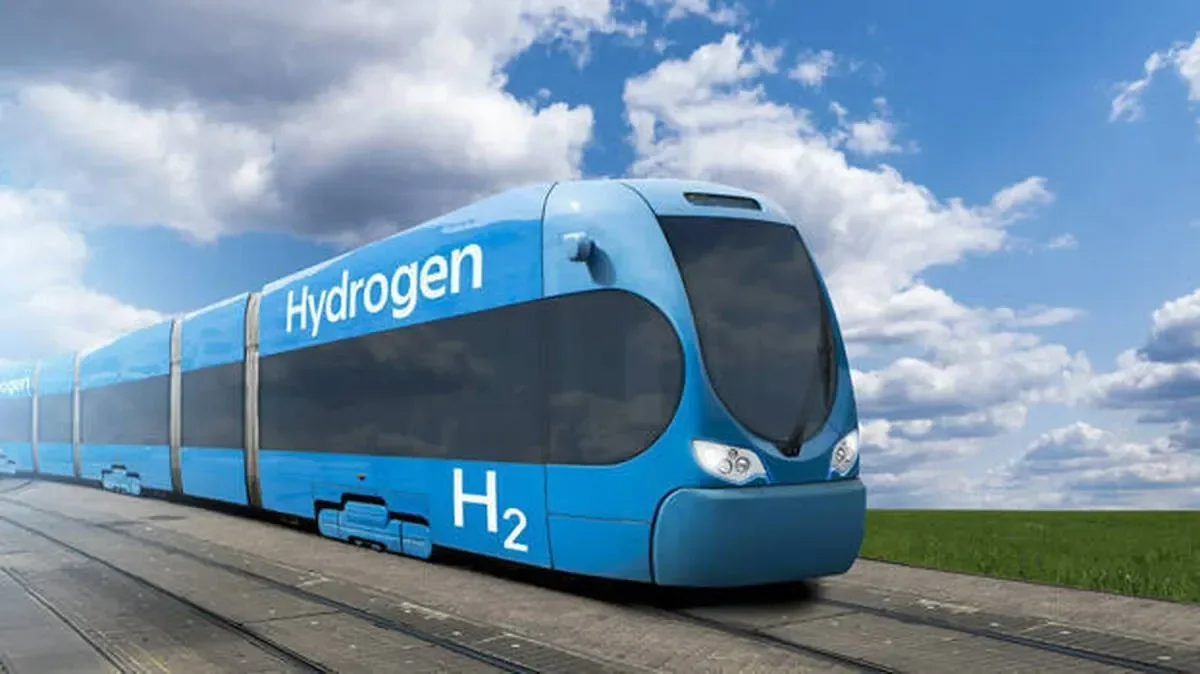
India Test-Runs First Indigenous Hydrogen Train at 120 Kmph
Indian Railways has successfully completed a high-speed trial of its first domestically developed hydrogen-powered train in Haryana. The eco-friendly convoy attained a top velocity of 120 km per hour during the operational test. The rolling stock is projected to commence public commercial services later this year.
Key Highlights
- The indigenous hydrogen train achieved a testing speed of 120 kmph on a dedicated domestic route.
- Named ‘Namo Green Rail,’ the zero-emission train emits only water vapor and operates silently.
- The system delivers a 1,000 km operational range powered by a high-capacity 1,200 kW engine.
- Production and maintenance infrastructure have been established across Chennai, Haryana, and Delhi.
New Delhi has achieved a major milestone by executing the high-speed trial of its homegrown hydrogen-powered passenger train. The vehicle successfully reached a velocity of 120 km per hour during the evaluation phase. Railway authorities indicated that the fleet, officially named ‘Namo Green Rail,’ could enter commercial deployment later this year following subsequent validation checks.
The high-speed evaluation occurred on a specially retrofitted 89-km railway corridor connecting Jind and Sonipat in Haryana. Government officials highlighted that this sector represents one of the longest dedicated tracks for hydrogen traction testing globally. Structurally, the innovative configuration integrates two specialized driving power cars alongside eight standard passenger coaches.
Global adoption of hydrogen-fueled passenger rail systems initiated in Germany in 2018. Comparable alternative-energy fleets are currently in service across several international territories, including the United Kingdom, the United States, China, Japan, and Taiwan.
1000 km on a single charge
The rolling stock relies entirely on onboard hydrogen fuel cells for propulsion. Electrical energy is generated through the chemical combination of hydrogen and oxygen, ensuring that water vapor remains the sole byproduct. Furthermore, the technology eliminates conventional operational noise pollution.
The passenger train delivers a maximum driving range of up to 1,000 km on one fueling cycle and can achieve a maximum velocity of 140 kmph. Engineering teams noted that the vehicle utilizes a 1,200 kW powertrain, which delivers twice the power output of comparable models deployed in Germany and China.
The configuration accommodates up to 2,600 passengers simultaneously. Onboard electrical systems, including air conditioning units, interior lighting, and ventilation fans, run exclusively on the generated clean energy.
Two trains ready
To sustain operations, a dedicated green hydrogen manufacturing facility has been constructed at the Jind railway hub in Haryana. The Integral Coach Factory in Chennai completed the assembly of the first two passenger trains, while ongoing technical maintenance will be managed at the Shakur Basti facility in Delhi.
Rs 500 per kilogram
The production cost for the clean fuel is pegged at approximately Rs 500 per kilogram. Internal assessments indicate that the acquisition and manufacturing costs for these hydrogen-powered propulsion systems run roughly 27% higher than standard diesel-powered locomotives.
Future Outlook
The deployment of the ‘Namo Green Rail’ underscores India’s broader environmental commitment to transition its extensive railway network toward net-zero carbon emissions. By establishing domestic production lines in Chennai and fuel generation plants in Haryana, the nation is positioning itself as a manufacturing hub for clean transport technology. Future phases are expected to expand hydrogen infrastructure across additional non-electrified passenger routes.
FAQs
What is the maximum speed of India’s hydrogen train?
The train successfully touched a speed of 120 kmph during its high-speed trial runs, though it is engineered to achieve a maximum operational speed of 140 kmph.
What is the driving range of the Namo Green Rail?
The hydrogen fuel cell system allows the train to cover a distance of up to 1,000 km on a single fuel cycle.
Where was the hydrogen train trial conducted?
The high-speed test was executed on an 89-km specialized testing track situated on the Jind–Sonipat route within the state of Haryana.