Coexistence of EV Battery Swapping and Fast-Charging in India
India’s electric vehicle sector will see the parallel growth of battery swapping and fast-charging networks, tailored to distinct commercial and consumer needs.
Key Highlights
- Commercial fleets prioritize battery swapping to maximize vehicle uptime and operational efficiency in last-mile logistics.
- Personal EV users are projected to lean toward fast-charging infrastructure, mirroring traditional fuel station experiences.
- Frugal engineering and localized manufacturing remain indispensable to withstand India’s harsh climate and demanding road conditions.
- Renewable integration will dictate the ultimate sustainability and cost-effectiveness of the nationwide clean mobility transition.
Que: Last-mile delivery has emerged as one of the strongest use cases for electric mobility. What makes EVs particularly suited for this segment?
Ans: Final-mile logistics has turned into a highly persuasive environment for electric transport because this specific operations architecture fits the core advantages of electric drivetrains. Commercial delivery units generally operate along predetermined metropolitan paths with predictable daily mileage, constant stop-and-go patterns, and intense duty cycles. Under these precise conditions, battery-powered platforms provide vastly superior thermal efficiency and reduced operational outlays when contrasted against standard internal combustion engines.
Transitioning to electric alternatives allows transport operators to trim energy expenditures, minimize upkeep bills, and optimize overall financial performance. Simultaneously, as metropolitan areas grapple with escalating pollution and demanding environmental standards, clean transport provides enterprises with a ecological, forward-looking shipping infrastructure. Driven by the swift acceleration of digital marketplaces and rapid-delivery commerce, the call for economical, dependable, and green delivery frameworks is fueling electric vehicle deployment across this entire category.
Que: For fleet operators and delivery partners, reliability and uptime are critical. How can EV manufacturers build platforms that address these operational needs better?
Ans: Product designs intended for commercial transport management must focus strictly on maximizing active hours rather than just basic transportation. Delivery vehicles log extensive operational periods through congested metropolitan sectors, requiring producers to engineering assets for extreme structural resilience, steady output, simplified servicing, and rapid turnaround cycles.
Achieving this requires assembling vehicles equipped with dependable energy storage packs, advanced thermal management architectures, real-time remote diagnostics, and support networks that compress maintenance delays. Options including quick battery replacement systems, rapid-powering infrastructure compatibility, integrated management consoles, and preventative maintenance alerts empower supervisors to monitor machinery status and execute corrections before mechanical failures happen.
For corporate transport networks, the true advantage extends far past the initial vehicle acquisition, relying instead on a dependable framework that preserves operational availability, curates lower logistical expenses, and provides logistics personnel the certainty required to expand clean transport operations.
Que: Battery swapping and fast-charging models are both being explored in India. How do you see these models evolving for commercial and personal mobility users?
Ans: Both energy replenishment frameworks will run parallel courses within the domestic market, though their specific utilization will depend heavily on target applications. Within the commercial logistics space, particularly for final-mile shipping and high-frequency corporate fleets, rapid battery replacement offers immense logistical and functional utility due to the paramount importance of continuous operation. Transport businesses cannot tolerate extended stationary energy replenishment windows, and modular replacement allows machinery to resume operations within mere moments while boosting capital asset optimization.
Conversely, individual transit consumers will likely adopt rapid-powering methods as the overarching standard over the coming years as public power networks expand and buyers seek familiar refueling routines. Individual operators also possess greater flexibility to replenish power supplies during overnight periods at residential locations or corporate offices, positioning rapid-charging as a supportive convenience rather than a rigid functional necessity.
Moving forward, the clean energy network will mature into a blended physical architecture where modular replacement feeds high-utilization commercial shipping, while rapid-powering scales alongside mass consumer adoption. The grander prospective lies in establishing standardized, dependable, and readily available power networks that eliminate range anxiety and ensure frictionless electric transition across all consumer classifications.
Que: How important is localised manufacturing and frugal engineering in building EVs for Indian road and usage conditions?
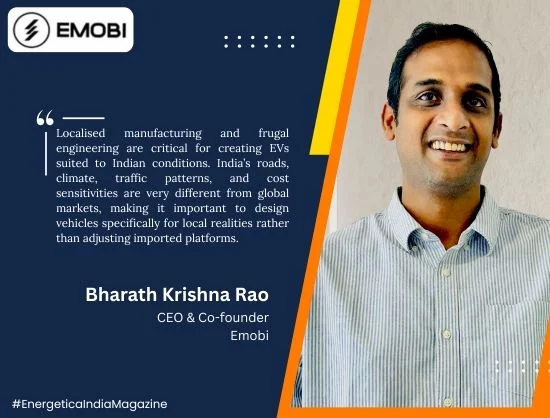
Ans: Domestic manufacturing pipelines and resourceful engineering methodologies are vital for crafting electric platforms optimized for regional environments. The subcontinent’s thoroughfares, weather patterns, traffic density, and price-sensitive consumer metrics differ vastly from Western markets, requiring engineers to craft platforms tailored to regional realities rather than modifying imported platforms. Resourceful engineering focuses not merely on cost reduction, but on forging rugged, optimized, and easily serviceable machinery capable of enduring high-utilization environments. Concurrently, regional manufacturing loops fortify industrial supply networks, accelerate development cycles, decrease import exposure, and foster scalable, durable clean transport networks explicitly engineered for domestic buyers and commercial enterprises.
Que: What role can technology, data, and AI play in improving vehicle performance, battery health, fleet efficiency, and user experience?
Ans: Advanced programming, digital telemetry, and automated intelligence will trigger a paradigm shift toward smarter, highly optimized, and predictable clean transport systems. From an entrepreneurial standpoint, networked telemetry and immediate information access enable supervisors to oversee machinery output, anticipate mechanical servicing, refine energy consumption, and elevate systemic operational hours. Automated intelligence can preserve cell integrity by governing smart power intake cycles, structural heat dissipation, and predictive analytical monitoring, ultimately stretching cell longevity and reducing overhead expenses.
For transport coordinators, data-led diagnostics allow for superior route optimization, lower power consumption, and enhanced asset utility, while individual owners gain an elevated ownership journey via intuitive controls, predictive maintenance alerts, and customized performance tuning. In time, electric vehicles will transform from isolated machinery into integrated intelligent mobility platforms driven by custom software, deep analytics, and iterative learning protocols.
Que: India’s clean mobility transition is also linked to renewable energy and energy storage. How do you see this larger ecosystem shaping the future of EV adoption?
Ans: The domestic shift toward ecological transport is intrinsically tied to the green power generation and stationary power storage matrix, given that the ecological validity of electric transit depends completely on the primary source of its electricity. From a corporate development perspective, every core piece including vehicles, containerized power storage, charging infrastructure, and green power generation must merge into a unified industrial ecosystem.
Expanding green power generation capacities directly ensures that vehicle power replenishment becomes progressively cleaner and more economical. Concurrently, advanced storage deployment improves utility grid equilibrium, power delivery, and holistic resource management. This synthesis creates cleaner charging networks, advanced resource oversight, and diminished fossil fuel reliance.
The nation’s capacity to deploy scalable, ecological, and tough integrated mobility and grid infrastructure will dictate the velocity of electric transport adoption alongside escalating market requirements.
Que: What is Emobi’s larger vision for making electric mobility more reliable, practical, and scalable for Indian users?
Ans: The foundational objective centers on making electric transportation sufficiently dependable to secure its place as the standard preference for daily commuting rather than functioning as an alternative niche. The core corporate target extends beyond merely generating unit sales, focusing instead on engineering machinery and holistic support structures that directly eliminate structural friction surrounding dependability, capital costs, uptime, and industrial scaling.
This strategy entails building variants engineered for regional pavement conditions and severe commercial utilization, while anchoring a highly localized industrial supply matrix to compress external vulnerabilities and build long-term operational strength. Emobi views computational technology, streamlined distribution, and nimble industrial manufacturing paradigms as the definitive drivers required to expand electric transport adoption across consumer and commercial markets alike.
Future Outlook
The landscape of Indian electric mobility is rapidly shifting toward a highly segmented infrastructure model. Over the next decade, multi-modal energy hubs combining solar arrays, localized battery banks, and high-speed dispensers are expected to anchor major transport corridors. As standardized cell designs gain policy traction, interoperable swapping stations will likely serve as virtual power plants, balancing the national grid during peak hours while ensuring commercial delivery fleets remain perpetually active.
FAQs
Why is battery swapping preferred over fast-charging for Indian last-mile delivery fleets?
Battery swapping allows commercial delivery vehicles to replace an exhausted battery with a fully charged one in a matter of minutes. This minimizes stationary downtime and maximizes vehicle utilization, which is essential for fleet operators who rely on continuous operations to maintain profitability.
Will personal electric vehicle buyers in India adopt battery swapping?
Personal vehicle owners generally favor fast-charging models. Individual drivers typically have the flexibility to charge their vehicles overnight at home or during work hours, making the traditional, stationary refueling behavior of fast-charging a more natural and convenient fit.
How does localized manufacturing impact the price and durability of Indian EVs?
Localized manufacturing allows companies to design vehicles from scratch for India’s unique terrain, high traffic density, and extreme weather. It also strengthens regional supply chains, lowers reliance on costly imports, and applies frugal engineering to build affordable, rugged components.
What role does artificial intelligence play in modern fleet management?
Artificial intelligence utilizes real-time data from connected vehicles to monitor battery health, optimize thermal performance, and schedule predictive maintenance. This prevents unexpected on-road breakdowns, refines route planning, and extends the overall operational life of the vehicle assets.