India Approves Seven New Bullet Train Corridors to Transform Travel
India is accelerating its high-speed rail network expansion with the official approval of seven new bullet train corridors. Announced by Union Railway Minister Ashwini Vaishnaw, these upcoming high-speed transit routes aim to dramatically compress travel times across major urban centers, fostering deep regional integration and robust economic growth.
Key Highlights
- Prime Minister Narendra Modi sanctioned 7 new high-speed rail routes across major domestic hubs.
- Transit times between critical urban centers like Mumbai and Pune will drop to just 48 minutes.
- The network expansion aims to create interconnected economic ecosystems across multiple states.
- Complementary regional rail services are expanding, with Bihar projected to receive over 200 new trains.
India’s high-speed rail ambitions received a big push after Union Railway Minister Ashwini Vaishnaw on Saturday said Prime Minister Narendra Modi had approved seven new bullet train corridors, while work continues to gather pace on the flagship Mumbai–Ahmedabad High Speed Rail project. He added that the programme was advancing steadily and that the proposed corridors were expected to reshape inter-city travel and strengthen economic connectivity across regions.
New bullet train routes to drastically reduce travel time
He added that the new bullet train routes are expected to drastically reduce travel times between major cities. The Mumbai–Pune corridor will cut travel times to around 48 minutes, while travel between Pune and Hyderabad could take just over two hours.
Vaishnaw also added that the expanding network would transform regional connectivity by creating integrated economic corridors. He said that the major cities including Mumbai, Pune, Ahmedabad, Surat and Hyderabad could become part of a closely linked economic ecosystem once the projects are completed.
How much travel time to be reducred in major cities?
Apart from the Mumbai–Ahmedabad route (1 hour 57 minutes), he also announced travel times of 48 minutes between Mumbai and Pune, 73 minutes between Bengaluru and Chennai, 2 hours 10 minutes between Bengaluru and Hyderabad, 2 hours 8 minutes between Pune and Hyderabad, 2 hours between Delhi and Lucknow, 3 hours 15 minutes between Delhi and Varanasi, and 6 hours between Delhi and Siliguri.
Full list of high speed rail corridors:
- Mumbai to Ahmedabad will take 1 hour 57 minutes.
- Mumbai to Pune will take 48 minutes.
- Bengaluru to Chennai will take 73 minutes.
- Bengaluru to Hyderabad will take 2 hours 10 minutes.
- Pune to Hyderabad will take 2 hours 8 minutes.
- Delhi to Lucknow will take 2 hours.
- Delhi to Varanasi will take 3 hours 15 minutes.
- Delhi to Siliguri will take 6 hours.
The announcement from the Centre comes as the government continues to step up its high speed railway expansion across the country. Earlier this week, Ashwini Vaishnaw and Bihar CM Samrat Choudhary inaugurated a new weekly train service between Chhapra Junction and Anand Vihar Terminal.
During the event, Vaishnaw also virtually flagged off two additional train services connecting Maul to Delhi and Zahirghat to Varanasi. Addressing the gathering, Vaishnaw said Bihar would receive more than 200 new trains over the next seven to eight years as part of a major railway expansion programme.
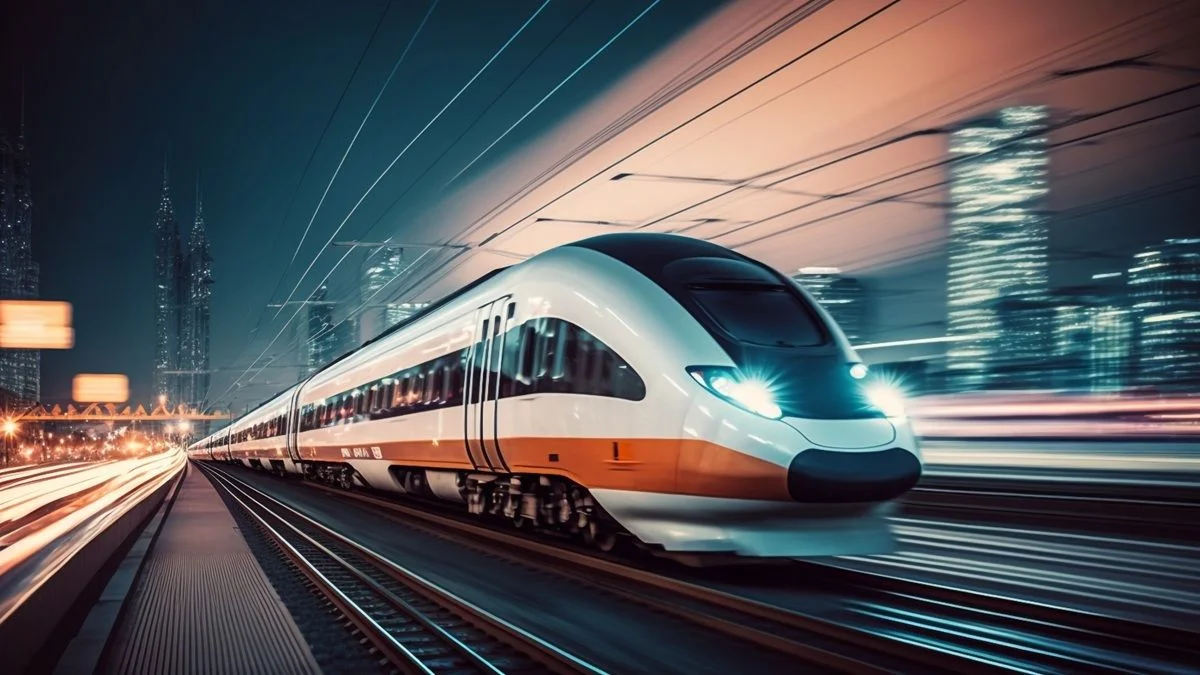
Bullet train image at Rail Bhawan only representational, clarifies Railway Board
Future Outlook
The rapid expansion of the high-speed rail grid signifies a structural shift in India’s transport infrastructure strategy. Over the next decade, these corridors will transition from standalone engineering projects into mega economic zones. By linking manufacturing units, tech hubs, and commercial capitals, the railway administration aims to unlock massive commercial synergies, accelerate industrialization, and significantly lower the nationwide logistics burden.
FAQs
What are the seven newly approved bullet train corridors in India?
The seven approved high-speed corridors include the Mumbai–Pune, Bengaluru–Chennai, Bengaluru–Hyderabad, Pune–Hyderabad, Delhi–Lucknow, Delhi–Varanasi, and Delhi–Siliguri lines.
How much will the travel time drop between Mumbai and Pune?
The proposed bullet train corridor will dramatically scale down transit time between Mumbai and Pune to approximately 48 minutes.
What is the projected travel time for the Delhi to Varanasi bullet train?
Once operational, the high-speed rail line connecting Delhi to Varanasi will complete the journey in 3 hours 15 minutes.
How many new conventional trains are planned for Bihar?
As part of the broader railway expansion framework, Bihar is scheduled to receive more than 200 new trains over the coming seven to eight years.