Iran Parliament Chief Likens World Cup Defense To US‑Israel Conflict Resiliency
Iranian parliament speaker Mohammad Bagher Ghalibaf praised the national football team’s defensive performance during the 2026 World Cup, linking their sporting resilience directly to the nation’s ongoing geopolitical defiance following recent military strikes by the United States and Israel.
Key Highlights
- Iran secured a 0‑0 draw against Belgium in Group G during the 2026 North American World Cup at Los Angeles Stadium.
- Goalkeeper Alireza Beiranband anchored the defensive effort by executing 7 crucial saves against Europe’s top players.
- Parliament Speaker Ghalibaf publicly framed the athletic performance as an analogy for national territorial defense.
- The sporting event coincided with a sudden suspension of high‑level bilateral diplomatic negotiations in Switzerland.
A post on X posted by Congress leader Mohammad Bagher Galibav, who headed Iran’s negotiations drew wide attention in connection with the recent conflict. Analysts say it is an attempt to show off Iran’s strong will even after the U.S. and Israeli airstrikes on Iran.
On the 21st local time, Chairman Galibaf posted a photo of the 2026 North American World Cup Group G match between Iran and Belgium on social networking service X. He explicitly stated that the footage mirrored how the nation protects its sovereign territory.
Iran drew 0‑0 against Belgium in the second Group G match of the 2026 North American World Cup at Los Angeles Stadium in California. With this draw, Iran and Belgium scored two draws side by side, turning their first chance to win into the final match.
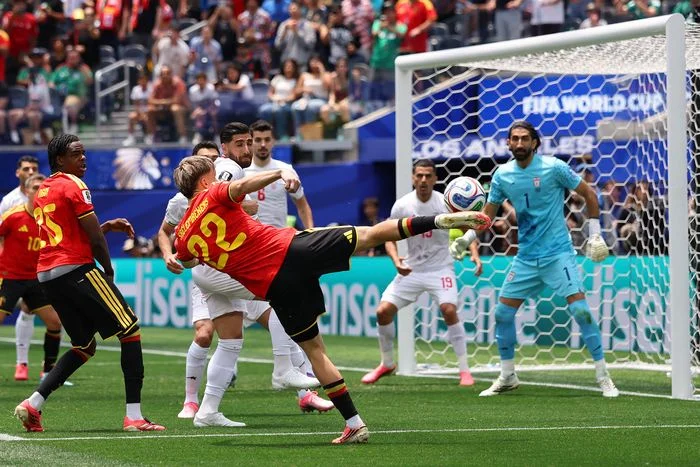
The scene came around the 58th minute of the game. Iran’s national soccer team goalkeeper Alireza Beiranband and Iranian defenders were seen struggling to block the ball from the goal line.
Belgium’s national team’s key midfielder Kevin De Bruyne penetrated the left side of the penalty area and poked a pass just in front of the goal by fellow player Maxim Doucawifer, but goalkeeper Beiranband reached out his left hand to block the ball while he collapsed. Immediately after the save, the Iranian players cheered, while the Belgian players wrapped their heads in disbelief.
The Athletic said, “Iran’s goalkeeper Alireza Beiranband blew himself toward the post and extended his left hand to show the best save in this World Cup,” adding, “As soon as the goalkeeper caught the ball, his teammates rushed to him and congratulated him.”
Belgium’s Alexis Salemakiers tries to shoot in the second Group G match of the 2026 North American World Cup between Iran and Belgium at Los Angeles Stadium in California on the 21st local time.
Iran goalkeeper Beiranband secured the Iranian goal with seven saves. It is evaluated that he has brought one point by blocking Belgium, which has star players from prestigious European clubs such as Real Madrid, Arsenal, AC Milan, and SSC Napoli.
Analysts say that Iran’s parliament speaker Galibaf’s mention of the scene is an attempt to show off Iran’s will to hold out after U.S.‑Israel airstrikes. Iran’s state‑run Press TV analyzed that it compared the Iranian people to the way they firmly defended their homeland during the war of aggression between the U.S. and Israel.
The message was posted minutes after the draw with Belgium and directly linked the Iranian national team’s defense to the recent war of aggression against Iran, Press TV noted.
Meanwhile, it is evaluated that the Iranian national soccer team is struggling despite various unfavorable factors. The U.S. is implementing restrictions on movement for the Iranian national team to allow entry to the U.S. only within 24 hours of the game and return to the training base camp in Tijuana, Mexico, immediately after the game. Many staff and officials have also been banned from entering the United States.
Mediators confirm progress despite suspension
The diplomatic fallout extended directly to parallel peace summits. Dialogue collapsed in Switzerland on Sunday after U.S. President Donald Trump issued public military threats, prompting the Iranian delegation to halt formal quadrilateral negotiations.
Despite the suspension of the quadrilateral format, Qatar and Pakistan issued a joint statement confirming that the first session of high‑level talks under the Islamabad MoU had concluded at the Bürgenstock resort in Switzerland.
The mediators announced encouraging signs regarding the release of frozen assets and oil export waivers. Political oversight will persist via a newly designated High‑Level Committee tasked with charting a comprehensive peace agreement.
The committee has agreed on a roadmap towards reaching a final deal within 60 days.
The mediators also announced the formation of a communication line to avoid incidents and ensure safe passage for commercial vessels through the Strait of Hormuz, as well as a de‑confliction cell involving Lebanon to ensure adherence to the termination of military operations in the country.
Talks conditional on Lebanon ceasefire
According to informed sources cited by Iran’s Tasnim news agency, the quadrilateral talks began at around 3:00 PM local time and were suspended after approximately 90 minutes for consultations.
However, following Trump’s threatening remarks, the Iranian delegation refused to return to the quadrilateral format.
Tasnim reported that Iran has made clear that no progress on other issues will be possible unless the first clause of the MoU, concerning the end of the war on all fronts, including Lebanon, is fully implemented.
The talks in Switzerland were the first high‑level negotiations under the 14‑point Islamabad Memorandum of Understanding, which was signed on June 18 after months of Pakistani‑mediated diplomacy.
The MoU commits both sides to an immediate and permanent termination of military operations on all fronts, including Lebanon.
It also provides for the lifting of the US naval blockade within 30 days, the unfreezing of billions of dollars in Iranian assets, and a $300 billion reconstruction fund for Iran.
A final deal is to be negotiated within 60 days, covering Iran’s nuclear program, the full removal of sanctions, and a permanent end to the war.
However, the path to implementation has been rocky. Despite the ceasefire commitment, Israeli forces have continued strikes in southern Lebanon, including deadly attacks on Beirut’s southern suburbs that killed dozens of civilians.
Iran responded on Saturday by announcing it had again closed the Strait of Hormuz, accusing Washington of failing to meet its commitment to halt fighting in Lebanon.
As the Swiss talks got underway on Sunday, Trump issued a series of threats on his social media platform and in a Fox News interview.
He threatened that if Tehran placed restrictions on the strait, “You won’t have a country”. He also suggested the US might take control of the waterway and impose its own tolls.
Iran’s lead negotiator, Parliament Speaker Ghalibaf, dismissed the threats, saying, “Don’t they think that if their threats had any effect, they wouldn’t be in this desperate situation today? No matter how much they talk, it is we who take action”.
He later warned US officials to “be careful” with their statements and said Iran’s armed forces were ready to respond. Vice President JD Vance had initiated the Swiss sessions alongside Steve Witkoff and Jared Kushner, attempting to establish fresh diplomatic parameters before verbal escalations disrupted the assembly.
Future Outlook
The implementation of the 14‑point Islamabad Memorandum of Understanding remains highly volatile over the next 60 days. While technical diplomatic groups continue to meet silently in Switzerland, any long‑term resolution hinges entirely on establishing a verifiable ceasefire in Lebanon and maintaining open commercial transit lines through the crucial Strait of Hormuz.
FAQs
What was the final score between Iran and Belgium in the 2026 World Cup?
The Group G match concluded in a 0‑0 draw at the Los Angeles Stadium in California, leaving both international squads with two points each heading into their final group stage matches.
Why did the Iranian diplomatic delegation suspend the quadrilateral talks in Switzerland?
The Iranian delegation, led by Parliament Speaker Mohammad Bagher Ghalibaf, exited the quadrilateral format after U.S. President Donald Trump published threatening statements online and on television regarding the control of the Strait of Hormuz.
What are the specific travel restrictions imposed on the Iranian football team?
The United States government restricted the Iranian athletic contingent’s transit visa terms, allowing them to remain on American soil for only 24 hours surrounding matches before forcing an immediate return to their base training camp in Tijuana, Mexico.
What financial and economic measures are outlined in the Islamabad MoU?
The framework stipulates the unfreezing of billions of dollars in blocked Iranian financial capital, grants critical waivers for oil and petrochemical exports, terminates the maritime blockade within 30 days, and sets up a $300 billion national reconstruction fund.