England Beats Scotland in Women’s T20 World Cup 2026
England sustained their undefeated streak in the 2026 ICC Women’s T20 World Cup by securing a comprehensive 38-run triumph over Scotland at Headingley. The victory relied on a commanding batting performance that resulted in a second successive 200-plus total, supplemented by clinical efficiency in the field.
Key Highlights
- Sophia Dunkley led the batting charge with 57 runs after being dropped three times by Scotland.
- Sophie Ecclestone became the second-fastest female bowler to reach 150 T20I wickets.
- Freya Kemp and Dani Gibson smashed an unbeaten 61-run partnership off just 21 deliveries.
- The victory cements England’s strong standing in the tournament group stage.
England outclass Scotland by 38 runs following another 200-plus team total. Sophia Dunkley capitalised on three dropped catches from Scotland before Sophie Ecclestone completed a dominant performance by claiming her 150th T20I wicket.
England extended their flawless momentum in the 2026 ICC Women’s T20 World Cup, dismantling Scotland by 38 runs through aggressive batting and precise bowling. Scotland fell well short of the demanding target after England registered their second score above 200 in the competition.
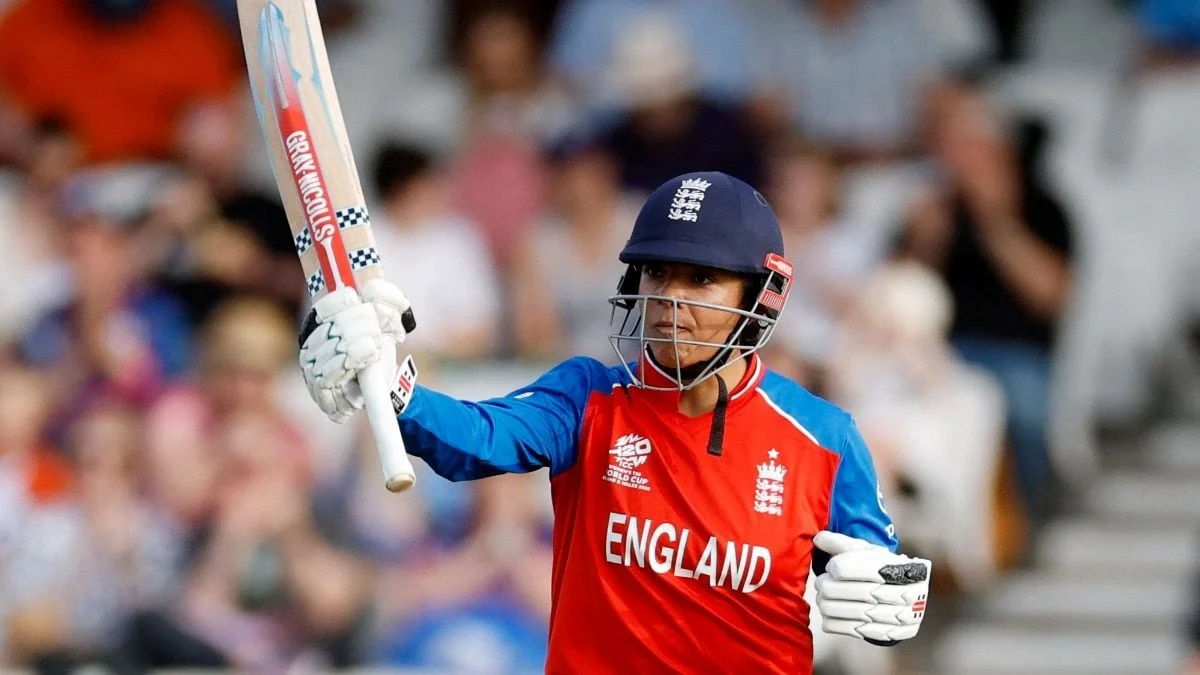
Sophia Dunkley anchored the top order with a vital 57, exploiting three missed fielding opportunities by the opposition. Later, Freya Kemp and Dani Gibson combined to unleash a destructive late-overs assault.
WOMEN’S T20 WORLD CUP 2026: FULL COVERAGE
During the second innings, frontline spinner Sophie Ecclestone secured her 150th T20I wicket, marking her status as the second-fastest female cricketer to reach this milestone.
DUNKLEY PUNISHES SCOTLAND
After electing to field first, Scotland suffered from erratic fielding that contrasted sharply with their disciplined display against the West Indies. The squad also managed two forced line-up changes, as Ailsa Lister and Rachel Slater were sidelined due to fitness issues.
Scotland initially enjoyed a dream start when Kirstie Gordon dismissed Amy Jones with the match’s first delivery, which flew straight to Megan McColl.
Sophia Dunkley, stepping in to lead the side for the injured captain Nat Sciver-Brunt, benefited from multiple defensive errors. Priyanaz Chatterji dropped a difficult diving opportunity when Dunkley was on 4, enabling the stand-in captain to anchor herself.
Dunkley quickly took control, clearing the boundary for the game’s initial six and accelerating to 43 runs by the conclusion of the powerplay. Danni Wyatt-Hodge fell immediately after the fielding restrictions eased, giving Gordon her second wicket, yet Scotland continued to gift Dunkley extra chances.
Katherine Fraser dropped the opener on 43, and McColl spilled another catching opportunity when the batter reached 45.
The top-order batter eventually secured her first-ever Women’s T20 World Cup half-century from 33 balls. Kathryn Bryce ended the innings at 57 runs when Hannah Rainey caught the ball deep in the outfield.
Rainey sustained the pressure by sending back Alice Capsey for a rapid 40, leaving England at 110 for four, while Chatterji dismissed Heather Knight for 25. Gordon’s final bowling statistics suffered after leaked boundaries cost her 21 runs in her ultimate over.
England concluded their innings aggressively with an explosive, unbeaten sixth-wicket stand. Dani Gibson struck an unbeaten 30 while Freya Kemp compiled a quickfire 39 not out, forging a 61-run partnership from a mere 21 balls to push England to 200 for five.
This resurgence highlights a major tactical shift for England. Experts like Charlotte Edwards previously noted that injuries to Kemp and Gibson derailed past campaigns, leaving England lacking lower-order boundaries.
Historically, England’s number six and seven batters operated at a 100 strike-rate across 17 innings in 2025, hitting fewer than 6% of balls to the rope. This season, their boundary percentage has surged to nearly 28%, boosting their combined strike-rate to a formidable 181.92.
Former players Alex Hartley and Ebony Rainford-Brent praised the duo for rectifying England’s historical finishing weaknesses, providing the exact late-innings firepower needed for knockout cricket.
ECCELSTONE REACHES LANDMARK
Scotland initiated their run chase with intent and aggression. Katherine Fraser capitalised on an early dropped catch to help guide her team to 32 runs without loss within the opening three overs.
Her high-risk approach backfired when Charlie Dean bowled her for 23 off 13 balls. Scotland narrowly surpassed England’s equivalent powerplay score by 1 run, but Ecclestone shifted the balance by removing Kathryn Bryce for 6 to claim her historic 150th T20I wicket.
Ecclestone struck again shortly after, trapping Darcey Carter for 29 as Scotland dropped well behind the required run rate.
England’s bowling attack continued taking consistent wickets. Gibson dismissed Megan McColl via a catch from Kemp, and Linsey Smith removed Sarah Bryce for 34 with assistance from Gibson near the boundary rope.
Kemp then took a sharp return catch to dismiss Chatterji, reducing Scotland to 155 for six.
Pippa Sproul and Gordon delivered late resistance via a 47-run partnership for the seventh wicket. Gordon completed her innings with 23, while Sproul logged 27 before a run-out on the final ball of the match capped Scotland’s innings well adrift of victory.
Future Outlook
England’s dominant group stage performance positions them as primary contenders as the tournament transitions toward the critical knockout phase. The explosive lower-order baseline established by Kemp and Gibson resolves a long-standing tactical vulnerability, giving the team a balanced edge against top-tier opponents. Fans await the return of captain Nat Sciver-Brunt from a calf injury to complete a fully fit line-up.
FAQs
Who scored the most runs for England in the match against Scotland?
Sophia Dunkley led England’s batting performance, scoring 57 runs from 33 deliveries to anchor the top order.
What milestone did Sophie Ecclestone achieve during the game?
Sophie Ecclestone claimed her 150th T20I wicket during the match, becoming the second-fastest woman in cricket history to reach this landmark.
How did Freya Kemp and Dani Gibson impact the final overs?
The pair constructed a rapid, unbeaten sixth-wicket partnership of 61 runs from just 21 balls, accelerating England to a total of 200 for five.
Why was Nat Sciver-Brunt missing from the England lineup?
The regular England captain missed the match due to a calf injury, with Sophia Dunkley stepping in as the stand-in captain for the fixture.