PM Modi Details India’s Advanced Defence and Aviation Successes
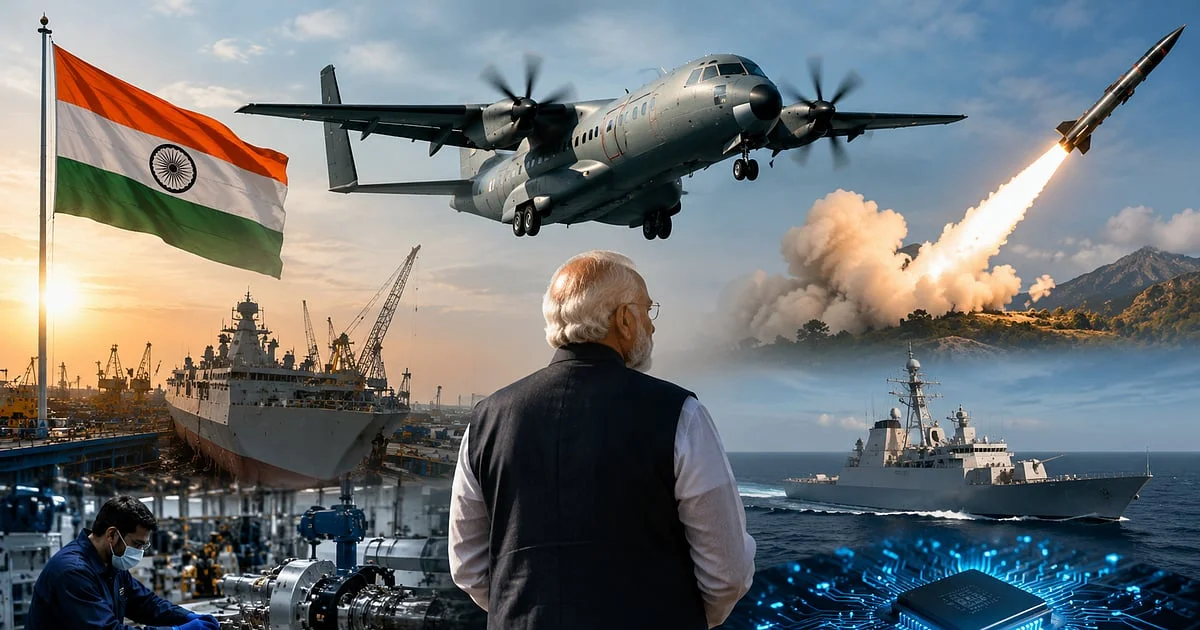
Prime Minister Narendra Modi announced significant advancements in India’s domestic defence, aerospace, and technology sectors, celebrating the maiden flight of the locally assembled C-295 military transport aircraft and successful testing of the Long-Range Land-Attack Cruise Missile as critical markers of national self-reliance.
Key Highlights
- India is assembling 40 out of 56 procured C-295 military transport aircraft domestically in Vadodara via a Tata-Airbus partnership.
- The Defence Research and Development Organisation successfully flight-tested the indigenous Long-Range Land-Attack Cruise Missile on June 15, 2026.
- The Indian Navy recently expanded its fleet by inducting three entirely indigenously designed and manufactured vessels in Kolkata.
- Academic and cultural shifts highlight modern integration, including an AI and Data Science B.Tech program taught at Central Sanskrit University.
Prime Minister Narendra Modi outlined India’s expanding self-reliance across the aerospace, technology, and defence sectors, pointing to the inaugural flight of the domestically built C-295 tactical transport aircraft and successful trials of the Long-Range Land-Attack Cruise Missile.
ANYTIME, ANYWHERE.
Experience a more refined e-paper today
Speaking during his monthly radio address, Mann Ki Baat, on June 28, 2026, Modi stated that the month of June brought monumental progress for the domestic aviation sector, mirroring the country’s relentless march toward technological independence.
Addressing the C-295 program, the Prime Minister stated that 40 of these specific aircraft are being manufactured directly within national borders, delivering vital industrial momentum to micro, small, and medium enterprises alongside the broader aerospace industry while generating substantial new employment pipelines.
The initial Indian-assembled C-295 transport aircraft completed its inaugural flight on June 10, 2026. The Indian Air Force is acquiring 56 units of the C-295 aircraft at a total calculated expenditure of Rs 21,935 crore, with Tata Advanced Systems Limited assembling 40 units alongside Airbus at a dedicated Vadodara facility.
Modi explained that the country unlocked multiple separate milestones during the month, providing a deep sense of pride to all citizens.
Recalling his attendance at a maritime event in Kolkata, he noted his recent participation in a naval induction ceremony where INS Dunagiri, INS Shanshak, and INS Agrya joined the fleet, emphasizing that every phase from design to final construction was executed indigenously.
He further drew attention to the Defence Research and Development Organisation’s successful launch of the entirely domestic Long-Range Land-Attack Cruise Missile earlier in June.
The Prime Minister observed that these developments ensure India is becoming far more secure and self-reliant across every domain, stretching from the seas to the skies.
The DRDO carried out the successful flight test of the cruise missile off the coast of Odisha on June 15, 2026. The system was created completely within India, featuring major subsystems engineered by internal DRDO laboratories and domestic industrial partners.
Modi additionally extended gratitude to citizens for positively answering his recent civic appeals amid geopolitical friction in West Asia, noting that individuals successfully curtailed non-essential gold acquisitions, deferred international vacations, and utilized carpooling frameworks.
He expressed immense appreciation for the population, stating that citizens did not simply endorse his public request but actively partnered with the government through every possible avenue.
The Prime Minister additionally renewed his call for the agricultural sector to prioritize chemical-free cultivation, protect arable soil health, and optimize the application of organic fertilizers.
Shifting to educational developments, Modi shared that the Central Sanskrit University in Delhi is introducing a specialized B.Tech degree focusing on Artificial Intelligence and Data Science to equip students for fast-evolving technological shifts while honoring traditional heritage.
He characterized the curriculum as a vital bridge connecting contemporary technological developments with the foundational traditional knowledge systems of India.
Illustrating the widening international footprint of Indian culture, Modi spoke of ‘Brahmakamal Dominicana,’ a group established by Spanish-speaking citizens in the Dominican Republic despite the nation hosting an exceptionally small resident Indian population of roughly 100 individuals.
He remarked that members gather to review Vedic literature and practice chanting traditional mantras without formal training, successfully mastering highly accurate pronunciation solely by studying recorded audio tracks.
The Prime Minister also lauded ecological conservation initiatives in Assam designed to safeguard the endangered Hargila stork, noting the bird was previously branded a terrible omen by historical local superstitions.
He recalled that communities once viewed the Hargila as highly inauspicious, going so far as to fell the specific trees holding active nests before systematic conservation efforts intervened.
Modi credited biologist Purnima Devi Barman for systematically dismantling those deep-seated misconceptions by presenting scientific evidence to local women, who gradually transformed the campaign into a movement that turned the bird into a proud village identity.
Transitioning to athletic achievements, the Prime Minister recognized that an increasing number of youths are choosing professional athletics, spotlighting Nagaland’s ‘Nagaland Baby League’ football program tailored specifically for children aged 5 to 12.
He noted the league successfully nurtures speed, unlocks latent athletic potential, and provides a structured platform to help young players forge their sports identities.
Turning to environmental marvels, Modi highlighted Meghalaya’s iconic living root bridges, confirming India has formally pursued their official inclusion within the UNESCO World Heritage Site Network while praising local clans for protecting them against climate impacts.
He noted that regional residents now maintain more than 120 distinct root bridges, utilizing dedicated annual inspection teams and community nurseries to fortify the surrounding river ecosystems.
He similarly commended women residing in Biaora within the Rajgarh district of Madhya Pradesh for taking immediate action to gather discarded plastics and manufacture eco-bricks without waiting for administrative assistance.
Modi concluded by noting that these recycled eco-bricks now enhance local public spaces, allowing hundreds of kilograms of waste plastic to be repurposed constructively, turning an environmental pollutant into a civic asset.
As the upcoming Ganesh Chaturthi festival nears in September, the Prime Minister requested that the public deliberately purchase earth-based idols crafted by local artisans.
He strongly encouraged families, neighborhoods, and local organizations to verify that their upcoming Ganpati celebratory idols are sculpted utilizing local soil by traditional community potters.
He further called upon idol manufacturers to exclusively focus on natural clay fabrications while reminding buyers to meticulously check manufacturing materials and the country of origin before making purchases.
Future Outlook
As India targets deeper industrial modernization by 2030, the twin successes of the C-295 aviation plant in Vadodara and the LRLACM missile platform lay the groundwork for major defense exports. The integration of public-private partnerships, such as the venture between Tata and Airbus, serves as a blueprint for future aerospace and heavy engineering projects, transitioning India from a primary equipment importer into a global defense manufacturing hub.
FAQs
When did the made-in-India C-295 aircraft complete its maiden flight?
The first indigenously assembled C-295 military transport aircraft successfully completed its inaugural flight on June 10, 2026.
What is the financial scope of the IAF C-295 aircraft acquisition?
The Indian Air Force is procuring 56 C-295 transport aircraft at a total estimated cost of Rs 21,935 crore, with 40 units built domestically by Tata Advanced Systems Limited and Airbus.
When and where was the Long-Range Land-Attack Cruise Missile tested?
The Defence Research and Development Organisation successfully conducted the flight test of the missile off the coast of Odisha on June 15, 2026.
Which Indian Navy ships were recently inducted into the fleet in Kolkata?
The Indian Navy officially inducted three entirely indigenous vessels into its operational fleet: INS Dunagiri, INS Shanshak, and INS Agrya.
What unique degree program is Central Sanskrit University launching?
The Central Sanskrit University in Delhi is launching a specialized B.Tech program in Artificial Intelligence and Data Science to combine modern technology with traditional knowledge.