National Party Slips to 29% in New Zealand Polls
A recent 1News Verian political poll reveals a sharp decline in support for New Zealand’s major political establishments. The data indicates that voters are shifting toward smaller political entities, putting significant pressure on the leading parties as the upcoming general election approaches.
Key Highlights
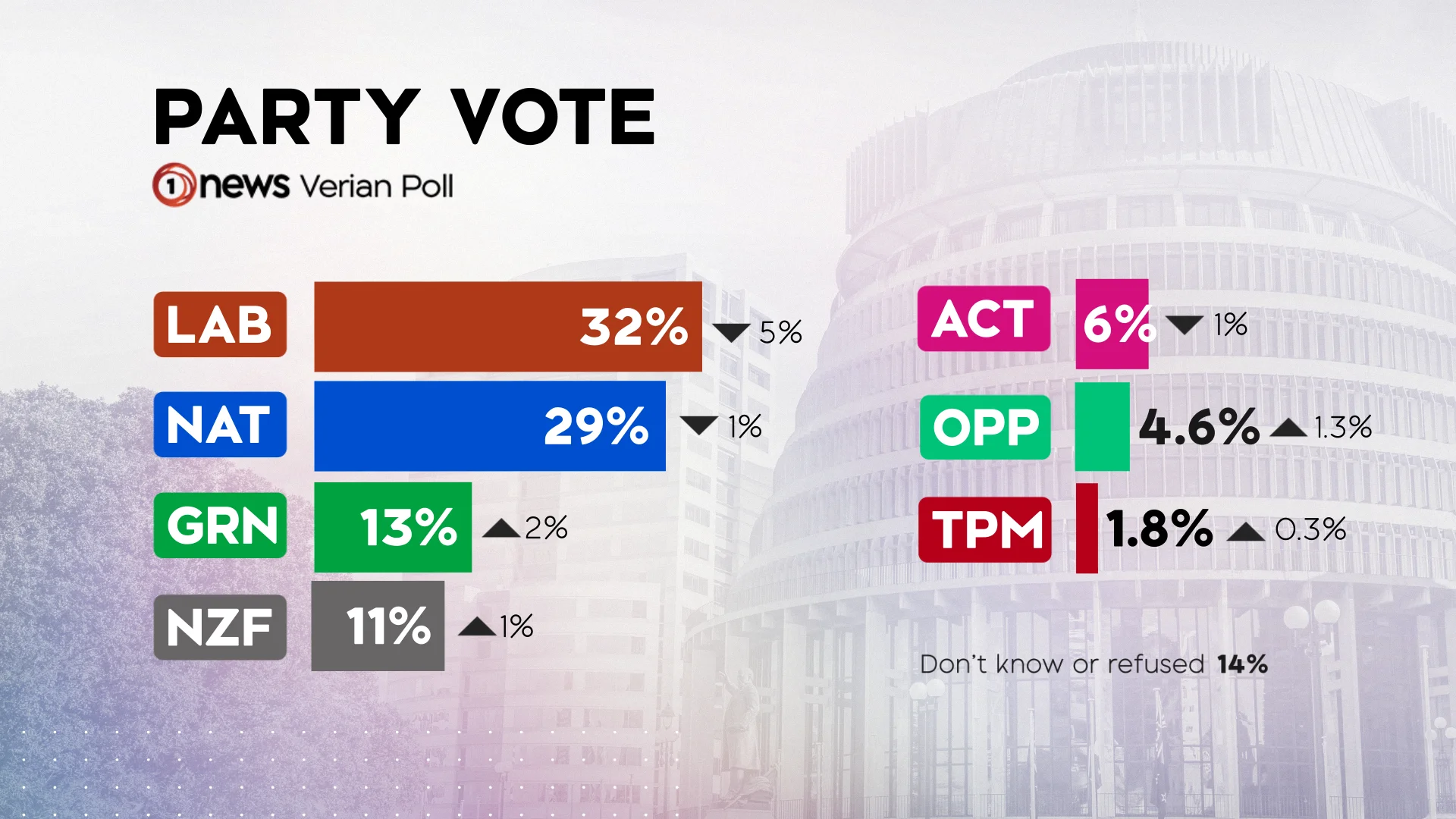
- National Party support dropped to 29%, while the Labour Party fell to 32%.
- Minor parties like NZ First, the Greens, and Opportunity experienced notable polling gains.
- Opportunity is currently on the verge of clearing the 5% parliamentary threshold.
- Preferred Prime Minister support for Christopher Luxon remains stagnant at 18%.
Senior Minister Chris Bishop stated that the National Party intends to increase its numbers significantly before the country heads to the ballot box, noting that the organization does not want to register at 29% on election day.
The latest 1News Verian polling data reflects a downward trajectory for both major factions. The National Party experienced a 1% drop to land at 29%, whereas the Labour Party suffered a more substantial 5% contraction, sliding down to 32%.
This displaced voter base migrated toward minor political organizations. Factions such as NZ First, the Green Party, and the Opportunity Party recorded measurable increases, with the latter positioned extremely close to securing parliamentary representation.
During a broadcast interview this morning, commentators questioned Bishop regarding his immediate assessment of these newly released figures.
Bishop noted that the political landscape still offers an extended runway before citizens cast their final votes. He acknowledged an organizational desire to secure higher polling percentages than the current baseline.
The minister stated that clear-minded observers would anticipate exactly this type of competitive outlook, reinforcing that the timeline to the election remains substantial.
He explained that the National Party is managing a dual mandate, actively introducing fresh policy frameworks while simultaneously navigating governance responsibilities through highly volatile economic conditions.
If these specific polling trends manifest identically during the formal election cycle, multiple incumbent National members face a realistic threat of losing their parliamentary seats.
Bishop currently holds the electorate seat for Hutt South, a constituency that has historically fluctuated between National and Labour representatives in recent political cycles.
A failure to secure this specific electorate in November would force Bishop to depend entirely on his position within the party list, risking a complete exit if the wider party vote underperforms.
The minister acknowledged that such an outcome remains a distinct structural reality in mixed-member proportional systems.
He emphasized that the party vote remains the foundational metric of success, reiterating the organization’s collective drive to elevate that core number before voting begins.
Bishop explicitly reinforced that anchoring at a 29% support level when election day arrives is an unacceptable outcome for his team.
The cabinet minister further observed that these shifting dynamics mirror broader international trends currently disrupting democratic systems globally.
He pointed to legislative fragmentation across multiple foreign parliaments, citing recent electoral patterns within the United Kingdom and Australia as prime examples of fringe growth.
Bishop noted that this specific style of multi-party fragmentation had not heavily impacted New Zealand until the preceding two years.
The official reconfirmed that National intends to anchor itself firmly as a mainstream, centre-right political option for voters.
Labour Member of Parliament Kieran McAnulty, appearing alongside Bishop during the broadcast, expressed a calm perspective regarding his own party’s recent statistical decline.
McAnulty asserted that the current figures remain significantly elevated compared to Labour’s performance during the prior election cycle, highlighting that their wider coalition retains government-forming numbers.
He claimed that Labour historically outperforms its polling data when official ballots are counted, dismissing immediate anxieties and labeling the release as a net positive result.
Interviewers questioned McAnulty on whether National’s descent into the high-20s threshold warranted an immediate challenge to Christopher Luxon’s leadership, given his 18% preferred Prime Minister rating.
McAnulty suggested that any realistic window to replace Luxon had closed, noting prior internal party fractures failed to yield a leadership change.
He stated that the opposition is comfortable facing the current leadership structure, expressing satisfaction with Luxon remaining at the helm of the National Party.
When pressed on whether the timeline was too compressed for National to install an alternative leader, Bishop declined to address the leadership speculation directly.
Instead, the minister pivoted to emphasize that National’s immediate priority centers on passing critical legislative packages through the house before the formal pre-election adjournment.
‘I would like his job’
While analyzing the scenario where Bishop might lose his electorate seat, the broadcast moderator lightheartedly questioned McAnulty on whether he would miss their regular joint media appearances.
McAnulty responded that personal camaraderie did not translate into a desire to see his political opponent retain ministerial office.
Bishop adjusted the tone of the exchange, jokingly stating that his colleague was clearly executing a strategy to unseat him.
McAnulty openly confirmed his ambition to assume Bishop’s ministerial responsibilities, expressing a specific desire to take over the housing and infrastructure portfolios.
Bishop countered by stating he had no interest in McAnulty’s current role, expressing complete satisfaction with his existing cabinet responsibilities.
The minister concluded the interaction by dismissing any prospective exchange of positions, confirming his intent to retain his current offices.
New Zealand Electoral Trends
This current polling shift represents a historic low point for New Zealand’s traditional two-party dominance. For nearly three decades, the National and Labour parties have collectively commanded the vast majority of the party vote. The rise of smaller parties reflects growing voter dissatisfaction with mainstream economic management amid persistent inflationary pressures. If minor factions like the Opportunity Party successfully cross the 5% threshold, the resulting parliament will require highly complex coalition negotiations to form a functioning government, a dynamic that complicates long-term infrastructure and housing policy deployment.
FAQs
What were the results of the latest 1News Verian poll?
The National Party fell one point to 29%, while the Labour Party dropped five points to 32%. Minor parties, including NZ First, the Greens, and the Opportunity Party, saw increases in voter support.
What happens if a New Zealand MP loses their electorate seat?
If an MP loses their local electorate seat, they can still enter Parliament via the party list. However, if their party’s overall total vote is too low, list candidates low on the rankings may miss out on a seat entirely.
What is the threshold for a minor party to enter Parliament?
A political party must secure at least 5% of the overall party vote or win at least one electorate seat to gain entry into New Zealand’s Parliament under the Mixed Member Proportional system.
What is Christopher Luxon’s current preferred Prime Minister rating?
According to the latest polling data, Prime Minister Christopher Luxon currently holds an 18% rating as the preferred Prime Minister.