US-India Ties Fray at G7 Summit Over Tariffs and Regional Conflicts
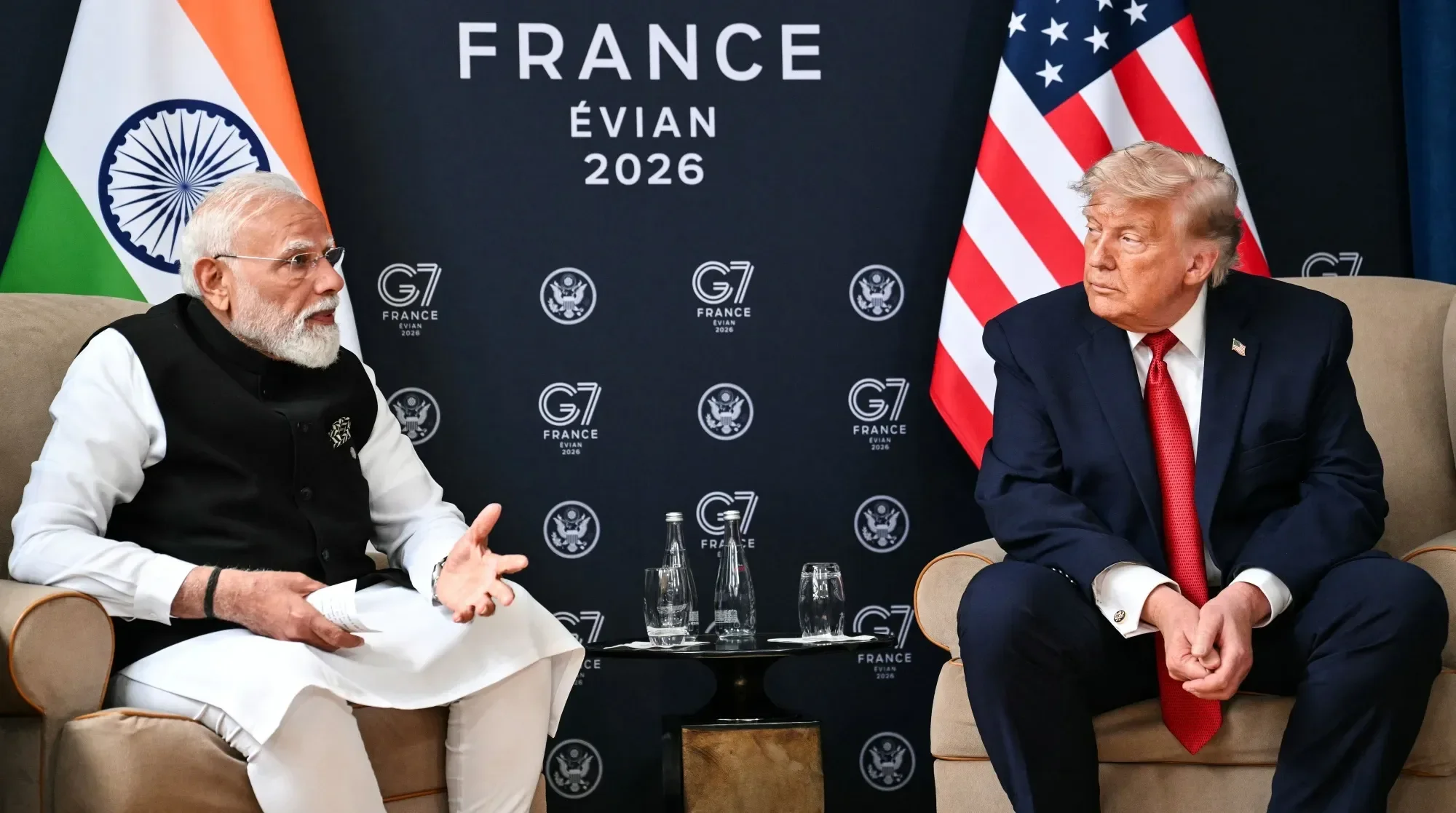
A high-stakes bilateral meeting between Indian Prime Minister Narendra Modi and US President Donald Trump at the G7 summit exposed deepening fractures in the bilateral partnership. The leaders faced immediate pressure over contentious trade tariffs, divergent strategies regarding the Iran conflict, and unresolved regional friction involving Pakistan.
Key Highlights
- PM Modi and President Trump held their first face-to-face meeting in 16 months at the G7 summit in Evian, France.
- The historical “bromance” has cooled as Trump’s aggressive tariff policies increasingly target Indian economic sectors.
- Washington’s self-centric approach to multilateral institutions continues to isolate allies and complicate democratic partnerships.
The picturesque French town of Evian hosted the G7 summit, where shifting diplomatic dynamics between India and the United States took center stage. On the banks of Lake Geneva, amidst leaders from over 50 nations, Prime Minister Narendra Modi and US President Donald Trump held crucial discussions.
This encounter marked the first physical meeting between the two leaders in approximately 16 months. Historically, their personal chemistry was viewed as a unique “bromance” within global politics, celebrated during lavish public spectacles. The grand 2019 “Howdy Modi” rally in Houston and the 2020 “Namaste Trump” event in India explicitly showcased their tight-knit political alignment.
However, Trump’s second presidential tenure has introduced undeniable friction into the bilateral relationship. The administration’s rigid trade policy has explicitly targeted India through punitive tariffs, straining long-term economic cooperation. Trump’s self-centric political philosophy and explicit disdain for multinational coalitions have systematically reduced the relevance of global institutions.
Historically, the US spearheaded the post-WWII international order, shaping institutions like NATO, the World Bank, the IMF, the UN, and the WHO. In a relentless bid to alter American fiscal responsibilities, Trump has discarded these traditional frameworks, even withdrawing from vital global climate change pacts.
Future Outlook
The evolving friction between Washington and New Delhi signals a transactional shift in global alliances. As India positions itself as a leader of the Global South, balancing independent foreign policy with American trade demands will require sophisticated diplomacy. Future ties hinge heavily on whether bilateral negotiations can mitigate tariff disputes and align on escalating Middle Eastern security risks.
FAQs
Why are US and India relations currently strained?
Bilateral ties are facing friction due to aggressive trade policies initiated by the Trump administration, specific targeting of Indian goods with tariffs, and divergent diplomatic stances on global conflicts and multilateral institutions.
When did PM Modi and President Trump last meet before the G7 summit?
Prior to their bilateral meeting at the G7 summit in Evian, France, the two leaders had not held a face-to-face meeting for approximately 16 months.
What historical events previously defined the relationship between Modi and Trump?
The personal alliance between the two leaders was previously highlighted by two massive public events: the “Howdy Modi” rally held in the US in 2019 and the “Namaste Trump” event hosted by India in 2020.