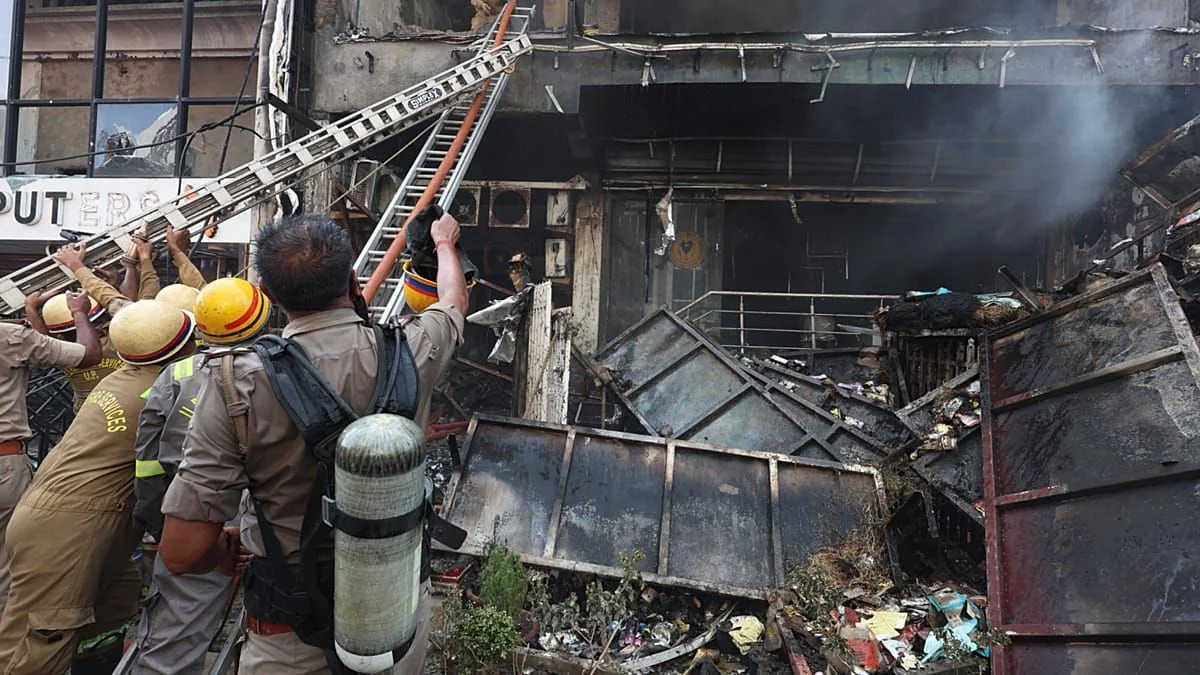
Lucknow Animation Studio Fire Kills 15 Students
A horrific blaze inside a commercial structure in Lucknow has claimed at least 15 lives and left 9 others injured. The tragedy has exposed severe violations of building safety regulations and triggered intense political scrutiny over administrative corruption and lax enforcement standards in crowded urban zones.
Key Highlights
- A multi-story commercial complex in Aliganj caught fire on Monday afternoon, killing at least 15 individuals.
- The structure completely lacked emergency exits, adequate escape routes, and a valid fire safety clearance.
- Police have booked 6 individuals and arrested 4 suspects, while 4 public officials face immediate suspension.
- Opposition leaders are demanding 10 million rupees (Rs 1 crore) in compensation for the families of the deceased students.
The fire happened in a building housing a student training centre in northern India, raising fresh concerns about fire safety in the country.
A lethal inferno in the northern Indian city of Lucknow has killed at least 15 people and left multiple others suffering from injuries.
The catastrophe has re-ignited nationwide anxieties regarding fire safety protocols within India’s densely populated commercial structures after investigators revealed the site completely lacked emergency exit doors and sufficient escape pathways.
The blaze erupted on Monday afternoon inside a three-storey building situated in the Aliganj Sector-D neighborhood of Lucknow. A pet studio and veterinary clinic operated on the ground level, whereas the upper stories contained a 3D animation centre and gaming hub alongside a library packed with trapped college scholars and professional trainees.
A vast majority of the casualties were young students and corporate staff members trapped on the upper floors when the conflagration began. Eyewitnesses recounted terrifying moments of panic as victims, overwhelmed by thick smoke, screamed for help, slithered down external electrical lines, or leaped from windows to escape the heat. Rescuers eventually accessed the roof via an adjacent property, smashing through a brick wall to extract trapped survivors.
One trapped student managed a final phone call to his father from the smoke-filled room, crying, “Papa, there’s a fire. Save me, I’m trapped inside.”
Mohammad Asin, an animator working at the studio, stated, “At first we thought it was a small fire. By the time we tried to leave, smoke had filled the rooms and passageways.”
Investigators have yet to pinpoint the exact ignition source, though initial assessments point to an electrical short circuit. Law enforcement authorities have booked 6 individuals and arrested 4 people on criminal charges related to culpable homicide and endangering public life. Additionally, 4 municipal officials were suspended as the Uttar Pradesh government initiated a formal high-level inquiry.
The Aliganj disaster represents the latest tragedy in a chronic pattern of fatal industrial and commercial blazes across India that underscore a systemic failure to enforce municipal building codes. Structural fires remain highly frequent nationwide due to flagrant safety non-compliance, absent firefighting equipment, and electrical overloads triggered by poorly engineered wiring networks.
Behind the glitter
The fatal destruction of this commercial complex has left local residents deeply shaken, triggering widespread public alarm regarding how commercial properties flagrantly flout safety laws. It highlights dangerous trends where residential sites are converted illegally into commercial venues without upgrading electrical load capacities or installing visible escape infrastructure.
A senior municipal official, speaking anonymously, warned that citizens must look past modern facades and stay alert to structural hazards when entering public venues. Experts state that visitors should be able to identify an exit route within 10 seconds of entering any establishment and should entirely avoid properties relying on a solitary entry and exit bottleneck.
Safe properties should display clear compliance documentation, accessible carbon dioxide extinguishers near main power frameworks, and visible external red piping infrastructure. This infrastructure, known as a Fire Department Connection, features two distinct inlets that allow arriving fire engines to pump water directly into internal suppression networks during an emergency.
Political Backlash & Compensation Demands
The tragedy has quickly escalated into a political battleground, with Samajwadi Party leader Akhilesh Yadav demanding a minimum of 10 million rupees (Rs 1 crore) in state compensation for every grieving family. Following a visit to wounded survivors at King George’s Medical University, Yadav launched a scathing attack against the ruling government, blaming institutional corruption for the catastrophic loss of life.
Yadav asserted that the disaster was entirely preventable and alleged that municipal building clearances under the current Bharatiya Janata Party administration are systematically issued without verifying structural compliance. The opposition leader demanded a sweeping independent audit into the issuance of fire safety certificates and No Objection Certificates across the region.
Regional Fire Safety Infrastructure
Data compiled by local emergency services reveals a stark contrast between structural regulations and field enforcement during urban disasters in Uttar Pradesh.
| Metrics & Response Details | Operational Figures |
|---|---|
| Confirmed Fatalities | 15 individuals |
| Hospitalized Injuries | 9 patients |
| Deployed Fire Tenders | 20 emergency vehicles |
| Active Firefighters on Scene | 125 personnel |
| Building Height | Under 15 meters |
| Fire NOC Status | Non-existent / Not legally mandated |
According to Lucknow Chief Fire Officer Ankush Mittal, because the structure measured under 15 meters in total height, it technically fell outside the legal threshold requiring a mandatory fire department clearance certificate. Despite the architectural limitations of the building, a contingent of 125 firemen utilizing 20 fire engines successfully prevented the fire from spreading to adjacent residential units.
FAQs
What caused the Lucknow animation studio fire?
Initial findings indicate the fire was likely triggered by an electrical short circuit on the lower levels of the three-storey commercial building before rapidly spreading upwards.
Why did the Aliganj building lack a fire safety certificate?
The local fire department stated that because the commercial structure stood under 15 meters tall, municipal regulations did not legally mandate the acquisition of a formal fire safety certificate.
How many casualties resulted from the Aliganj fire incident?
The disaster resulted in at least 15 confirmed deaths, primarily consisting of young students, trainees, and animation studio staff, while 9 others sustained injuries.
What legal actions have authorities taken following the fire?
Lucknow police have booked 6 individuals and arrested 4 suspects under public endangerment charges, while the state government suspended 4 officials and ordered a formal inquiry.