Hundreds March in Manhattan for Democracy
Event Date: November 7, 2026 Location: Midtown Manhattan, New York City
Hundreds of progressive demonstrators, union members and immigrant rights advocates marched through Midtown Manhattan on Saturday, November 7, 2026, demanding electoral accountability and challenging Democratic congressional leadership following the midterm elections.
The demonstration, titled “March for Our Democracy: The Fight Isn’t Over,” was organized by a coalition including Hands Off NYC, NYC-DSA, Make the Road New York, the United Federation of Teachers and the PSC-CUNY, representing City University of New York instructional staff.
The march assembled at approximately noon near the red TKTS staircase at West 47th Street and Seventh Avenue before proceeding south toward 14th Street. Participants carried political signs and chanted against Democratic Party leaders while pressing demands concerning election integrity and federal immigration enforcement.
March Shifts Toward Democratic Leadership
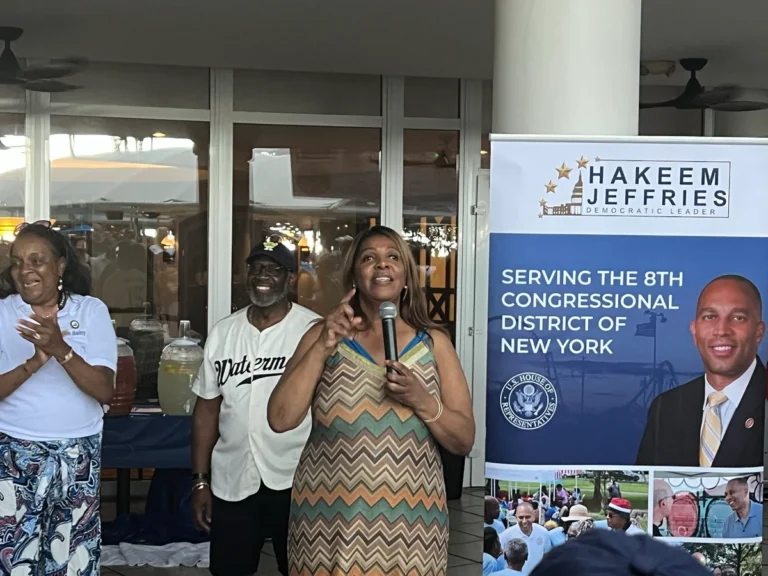
The demonstration shifted from defending the midterm election count toward challenging Democratic leadership following projected congressional gains. Protesters targeted Chuck Schumer and Hakeem Jeffries and opposed Immigration and Customs Enforcement activity in New York City institutions.
Organizers initially planned the gathering as a contingency mobilization to protect the results of the November midterm elections. The official PSC-CUNY notice called for a mass demonstration to “demand accurate vote counts and defend the results of the midterm elections”.
The notice also warned that “the struggle to defend the legitimacy of the election may extend long past Election Day”.
With Democrats projected to gain control of both chambers of Congress, demonstrators directed attention toward the party’s leadership and the policies they wanted elected representatives to pursue.
The political shift changed the immediate focus of the demonstration. Instead of concentrating exclusively on potential disputes over election results, participants pressed lawmakers over immigration enforcement and their approach to governing.
Schumer and Jeffries Face Protest Demands
Protesters challenged two of New York’s most prominent Democratic federal lawmakers over the party’s leadership and political priorities.
Schumer was identified in the post-election political context as the presumptive incoming Senate majority leader, while Jeffries was identified as the presumptive incoming House Democratic leader. Both were targets of demonstrators dissatisfied with established Democratic leadership.
Organizers and participants criticized what they regarded as excessive corporate donor influence and centrist policy positions within the party. Those criticisms represented the protesters’ political assessment rather than an independently established finding about either lawmaker.
The demonstrators’ criticism reflected their opposition to the leadership positions and corporate donor influence they associated with Schumer and Jeffries.
For the labor and immigrant rights organizations involved, the demonstration provided an opportunity to press their demands at a moment when projected election gains had increased expectations of Democratic influence in Washington.
The political dispute also concerned the direction of congressional leadership ahead of the 120th Congress, scheduled to convene in January 2027. The protesters’ demands placed progressive policy priorities alongside questions about who would guide the party following the election.
Immigration Enforcement Becomes Central Demand
One of the clearest demands concerned the role of U.S. Immigration and Customs Enforcement (ICE) in New York City.
As demonstrators advanced along Seventh Avenue, marchers repeatedly chanted: “Jeffries, Schumer, let’s be clear: ICE is not wanted here.”
The chant directly connected the protest’s immigration demands to the congressional leaders being challenged. Participants wanted federal lawmakers to oppose immigration enforcement activity within municipal institutions.
The demand placed national immigration policy within a local political setting. Protesters were calling on New York’s federal representatives to respond to concerns about the presence and activities of a federal enforcement agency in the city.
ICE was the subject of the demonstrators’ objections. The documented protest demands did not establish that federal immigration officers were participating in the event or conducting an enforcement operation along the march route.
The policy issue intersects with New York City’s existing municipal immigration rules, including provisions of the city’s Administrative Code governing interactions with federal immigration authorities.
Federal immigration enforcement also operates under federal law, creating a distinction between the municipal protections sought by protesters and the powers exercised by federal immigration authorities.
The organizers’ demands therefore raised questions about how congressional representatives could address the relationship between city immigration policies and federal enforcement activity.
No specific legislative proposal or formal commitment from Schumer or Jeffries was established in the documented account of Saturday’s march.
Labor and Progressive Groups Mobilize
The participating coalition included organizations representing different constituencies, including educators, public university instructional staff, immigrant rights advocates and progressive political activists.
The United Federation of Teachers and PSC-CUNY brought organized labor into the demonstration. PSC-CUNY represents instructional staff within the City University of New York system.
Make the Road New York, NYC-DSA and Hands Off NYC were also identified among the organizations involved.
Their participation connected workplace representation, immigrant rights advocacy and progressive political organizing within a single public action.
The NYC-DSA contingent was separately promoted through an Action Network event notice, while Hands Off NYC’s mobilization appeared on Mobilize.
The coalition’s official notices established the planned demonstration’s broader organizing framework and its emphasis on political engagement following the elections.
Demonstration Ends Near 14th Street
The procession followed Seventh Avenue south from Times Square toward West 14th Street, where participants dispersed on Saturday afternoon.
The march followed the organizers’ nonviolent guidelines. Municipal public-safety authorities were described as reporting no major disturbances, although no specific agency spokesperson was identified.
Although the gathering involved hundreds of demonstrators, an exact independently confirmed participant count was not established.
The march’s original organizational notices anticipated that defending election results might require continued mobilization beyond Election Day.
No confirmed date, route or attendance estimate for a subsequent demonstration was announced in the documented material.
Saturday’s action concluded with demonstrators having directed their demands toward two named congressional leaders. Neither a formal policy response from those lawmakers nor a timetable for further coalition demonstrations was established in the reported account.