Indian Government and Youth Dissent Tension
A growing friction persists between administrative powers and student-led initiatives across modern India. While authorities consistently champion youth-driven enterprise and demographic advantages, state machinery repeatedly shows immense friction when younger demographics exercise independent critical thought or question existing administrative systems.
Key Highlights
- Structural friction exists between official praise for youth innovation and state crackdowns on student critics.
- Public digital restrictions and heavy policing met peaceful student demonstrations over employment and examinations.
- Regional diversity and socio-economic differences prevent the formation of a singular, cohesive national youth coalition.
- Legal scholars and activists emphasize that institutional criticism strengthens rather than weakens democratic resilience.
The Uneasy Relationship Between Power and Young Voices
A distinct socio-political dynamic has surfaced within contemporary India. Administrations that publicly celebrate economic modernization, technological startups, and the vast potential of a young workforce simultaneously exhibit profound unease when those same citizens express autonomous viewpoints or challenge state policies.
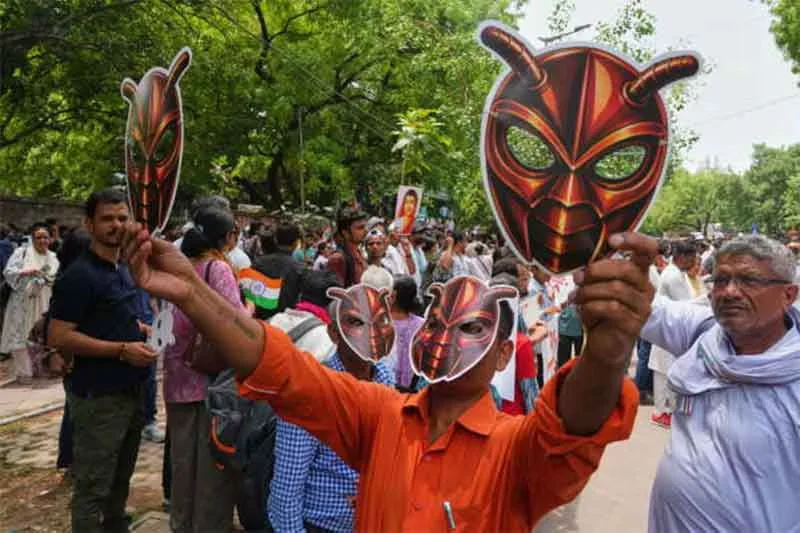
The recent mobilization of the Cockroach Janata Party (CJP), a student-organized collective targeting systemic civil service testing flaws and widespread underemployment, perfectly underscores this policy contradiction. A small, non-violent assembly encountered intense administrative resistance, resulting in digital censorship, massive security deployments, and initial state classifications labeling the group as public safety hazards.
This institutional pushback points to a systemic issue deeper than simple concern over localized demonstrations. It highlights a widespread, entrenched institutional aversion to youth-led political opposition and civic non-conformity.
Why Governments Fear Independent Youth
State leadership frameworks globally demonstrate a clear preference for compliant populations that integrate seamlessly into established governmental narratives. Alternative perspectives regarding national identity, institutional critique, and decentralized citizen coalitions driven by younger demographics routinely generate official skepticism.
However, the systemic demand for ideological uniformity conflicts directly with ongoing official policy mandates calling for economic originality and industrial breakthroughs. True creative output cannot thrive within an environment governed by intimidation and state censorship.
Original problem-solving demands persistent questioning, systemic experimentation, and total liberty to challenge conventional dogmas. A civil structure that demands absolute compliance from younger generations cannot logically expect those same individuals to pioneer complex socio-economic solutions.
The CBSE Controversy and the Right to Question
The institutional friction involving the CBSE Online Marking System perfectly mirrors this societal impasse. When a pair of students successfully identified critical errors and systematic inefficiencies in grading infrastructure, standard administrative governance should have dictated open public discourse, systemic accountability, and structural remediation. Instead, state institutions resorted to institutional defensiveness and information suppression.
In a similar vein, a decentralized digital campaign lampooning remarks made by Chief Justice Surya Kant regarding jobless youth triggered intense federal anxiety. Far from dissipating naturally, the online push gained significant public momentum, transforming into an expansive socio-political campaign demanding educational accountability and the direct resignation of the federal education minister.
The overarching political takeaway remains clear: aggressive state maneuvers to suppress legitimate public grievances inevitably amplify those exact protests.
A Culture of Overreaction
Official hypersensitivity toward public policy critiques occasionally reaches irrational proportions within regional administrations.
A regional minister inside Uttar Pradesh historically condemned a classic children’s nursery rhyme for promoting values counter to national heritage, claiming it validated childhood defiance. Such public assertions expose a deep-seated institutional nervousness regarding any erosion of hierarchical compliance.
This systemic tendency toward disproportionate state escalation has grown significantly more pronounced over the past decade.
During nationwide demonstrations against the Citizenship Amendment Act (CAA), a 19-year-old female student faced immediate sedition charges and incarceration in Bengaluru for uttering pro-Pakistan phrases at a peaceful rally. Though the speech was explicitly antagonistic and ill-advised, the single teenager posed no genuine threat to state security.
The anti-CAA demonstrations also generated aggressive police interventions at Jamia Millia Islamia, where state forces breached university boundaries and library facilities, deploying tear gas and physical force against student groups. Multiple demonstrators faced immediate detention under rigorous state security protocols.
The political message remained clear: youth activism would be viewed through a lens of national security.
The Farmers’ Protest and Global Attention
The widespread agricultural demonstrations spanning 2020 and 2021 offered another clear manifestation of this internal security dynamic.
Tens of thousands of agricultural workers blockaded primary transit corridors and maintained highly organized encampments for numerous months. Yet the most visible state counter-escalation involved the sudden detention of Disha Ravi, a 22-year-old environmental advocate working out of Bengaluru.
Her state-prosecuted infraction involved the modification and digital distribution of an online informational guide advocating peaceful civil strategy and digital public relations management.
Federal prosecutors categorized the digital planning document as an organized effort to incite public disaffection against the state, attempting to connect the climate activist to wider geopolitical secessionist networks.
Subsequent international scrutiny quickly complicated domestic narratives.
When global climate figure Greta Thunberg alongside musical artist Rihanna broadcasted public solidarity with the agricultural movement, federal authorities responded with rapid diplomatic defensive maneuvers. Social media accounts faced immediate state-directed blackouts, while official channels published warnings detailing alleged international subversion schemes.
The aggressive response damaged India’s global reputation as a resilient, self-assured democracy capable of internalizing domestic policy opposition.
Why a National Youth Movement Is Difficult in India
Despite the visible momentum generated by organizations like the CJP, predicting a unified, country-wide youth revolution akin to recent overthrows observed in Bangladesh or Nepal remains sociologically inaccurate.
The domestic socio-economic structures of India remain distinct from its neighbors.
Neighboring nations boast smaller geographic footprints and significantly higher degrees of cultural uniformity. India, by contrast, presents a hyper-stratified reality defined by deep linguistic, cultural, financial, and regional divides.
The primary socioeconomic ambitions of Indian youth diverge dramatically based on class and geographic positioning.
For urban, middle-class university students, primary socio-political anxieties center on standardized test transparency, university allocations, and white-collar employment. Conversely, for youth coming from economically marginalized rural households, immediate survival concerns like general inflation, systemic joblessness, and raw infrastructure access take absolute precedence.
Consequently, the rhetoric, political imagery, and digital organization of localized student demonstrations fail to find universal traction across all demographics of Indian youth.
This deep societal fragmentation has historically prevented the formation of a singular, monolithic national youth movement.
The Significance of Peaceful Defiance
Nonetheless, the broader cultural weight of these modern student mobilizations remains highly significant.
The CJP may never scale into a sweeping electoral disruption vehicle comparable to historical anti-corruption campaigns. However, the heavy-handed bureaucratic reactions to its activities reveal deep institutional vulnerabilities.
The enforcement of digital account suspensions and the mobilization of massive riot units to manage small student gatherings prove that the governing elite remains highly uncomfortable with young citizens acting as autonomous intellectuals and organized policy critics.
Concurrently, the reality that these demonstrations progressed without reverting to systemic violence, coupled with the eventual reduction of security forces, offers a positive signal.
Democratic structures are fundamentally fortified, rather than degraded, by public non-violent opposition.
Young students analyzing state bodies, exposing systemic errors, and demanding policy transparency do not threaten national sovereignty; they signal an active, politically conscious electorate.
The Need to Listen – The Final Words
The state routinely praises its young demographic as its premier national resource. Yet that rhetorical adulation loses all systemic meaning if the state expects younger generations to exhibit blind obedience without questioning existing institutions.
A resilient, mature democracy does not fear ideological critique from its academic populations.
It openly recognizes that incoming generations possess the fundamental democratic right—and perhaps the civic obligation—to systematically audit the political frameworks inherited from ancestral leaders.
Currently, the rise of non-violent student opposition within the country represents a positive civic trend that warrants institutional inclusion rather than state security crackdowns. It serves as visual confirmation that democratic ideals remain resilient when the youngest stakeholders maintain faith in their collective voice.
FAQs
What triggered the recent youth protests led by the Cockroach Janata Party?
The demonstrations erupted primarily due to widespread public concerns regarding examination irregularities, grading system flaws, and rising youth unemployment across several states.
Why is a single, unified national youth movement difficult to sustain in India?
India’s immense linguistic, cultural, and socio-economic diversity means that young people from different backgrounds have vastly different priorities, ranging from university admissions to basic economic survival.
How did the international community respond to the state’s handling of the 2020-2021 protests?
Global figures and international activists expressed solidarity with the demonstrators, drawing widespread attention to the government’s use of internet restrictions and security crackdowns.