Colombia Presidential Runoff Polls Close as Rapid Vote Counting Begins
Colombian electoral jurisdictions closed voting booths on June 21, 2026, commencing an immediate ballot count to select the nation’s chief executive. The highly polarized runoff election pits right-wing businessman Abelardo de la Espriella against left-wing senator Iván Cepeda following months of intense campaigning that captivated the South American nation.
Key Highlights
- Polling centers officially closed at 4:00 p.m. local time across Colombia to initiate the rapid preliminary counting phase.
- The decisive contest follows a May 31 first-round vote where De la Espriella secured 43.7% and Cepeda garnered 40.9%.
- National Registrar Hernán Penagos vouched for the absolute security of the paper-based ballot framework amid deep political polarization.
- More than 41 million citizens were eligible to cast ballots, monitored by over 1,250 international electoral observers.
Colombians are voting in a presidential runoff today to determine whether the country continues on its leftist path or shifts rightward by electing a political outsider who has vowed to crack down on crime and armed groups. The race pits leftist Senator Iván Cepeda, 63, against Abelardo de la Espriella, a 47-year-old lawyer and businessman with no prior political experience.
The runoff follows a crowded first-round election on May 31 in which no candidate secured the majority required to win outright. De la Espriella won 43.7% of the vote and Cepeda won 40.9%, setting up today’s decisive contest. Out of 23,676,056 valid ballots cast in that opening round, De la Espriella obtained 10.3 million votes (43.78 percent) while Cepeda secured 9.7 million votes (40.98 percent).
Cepeda is a human rights activist and philosopher who lost his father, Senator Manuel Cepeda, to assassination in 1994. He represents the Historic Pact, the ruling coalition, and backs continuing President Gustavo Petro’s policies, which include state pension payments for the poor, union-backed labor reforms, peace talks with armed groups, and a moratorium on new oil projects. De la Espriella, who calls himself “the Tiger,” proposes the opposite: ending talks with armed groups, launching a broad military offensive against them, and boosting Colombia’s oil and gas sector. He has blamed Petro for the country’s economic and security woes and has vowed to lower taxes and reduce the state by up to 40%, though he has said he will preserve Petro’s 23% increase in the minimum wage.
Security dominates voters’ minds. Armed groups have expanded territorial control under Petro, and drug trafficking gangs have grown in power, leading to spikes in murders and extortion along the Caribbean coast. De la Espriella has cast Petro and Cepeda as allies of criminals, though Petro’s government says it has seized more cocaine than any other government. Cepeda has rejected the accusations, saying there is no evidence for them. Cepeda has critiqued De la Espriella’s work as a lawyer for people tied to right-wing paramilitary groups and corruption cases, including Alex Saab, who faces U.S. charges for allegedly laundering money for ousted Venezuelan President Nicolás Maduro. De la Espriella says his professional relationships do not involve any complicity or crime.
Colombia’s election reflects a broader regional rightward shift. Voters in Chile, Argentina, Costa Rica, and Ecuador have elected right-wing presidents in recent races, while Bolivia ended two decades of leftist rule by electing center-right Rodrigo Paz last year. In Peru, conservative Keiko Fujimori, daughter of former President Alberto Fujimori, is poised to win the presidency after three failed attempts. Most of these elections were driven by concerns over rising crime and weak economies, according to Reuters reporting.
U.S. President Donald Trump has openly endorsed De la Espriella this month, saying the results of today’s race are “very important to the future of Colombia and its relationship to the United States.” Trump has publicly feuded with Petro and moved to increase U.S. presence and influence in the region, including by creating the Shield of the Americas, a military alliance of right-wing leaders pledging to fight drug trafficking. Other international figures have also tracked the race; U.S. politician Bernie Moreno commented on social media that Colombia’s strict voter authentication framework, requiring a single valid physical identification card with no mail-in voting options, debunks arguments used against the Save America Act in the United States.
Polls and markets favor De la Espriella, though analysts expect a tight race. Both candidates have taken pains to raise turnout among the nearly half of eligible voters who skipped the May first round. More than 41 million Colombians are eligible to vote, and polls opened for eight hours starting at 8 a.m. local time. Whoever wins will grapple with high public debt and a divided Congress, which could stymie reform proposals.
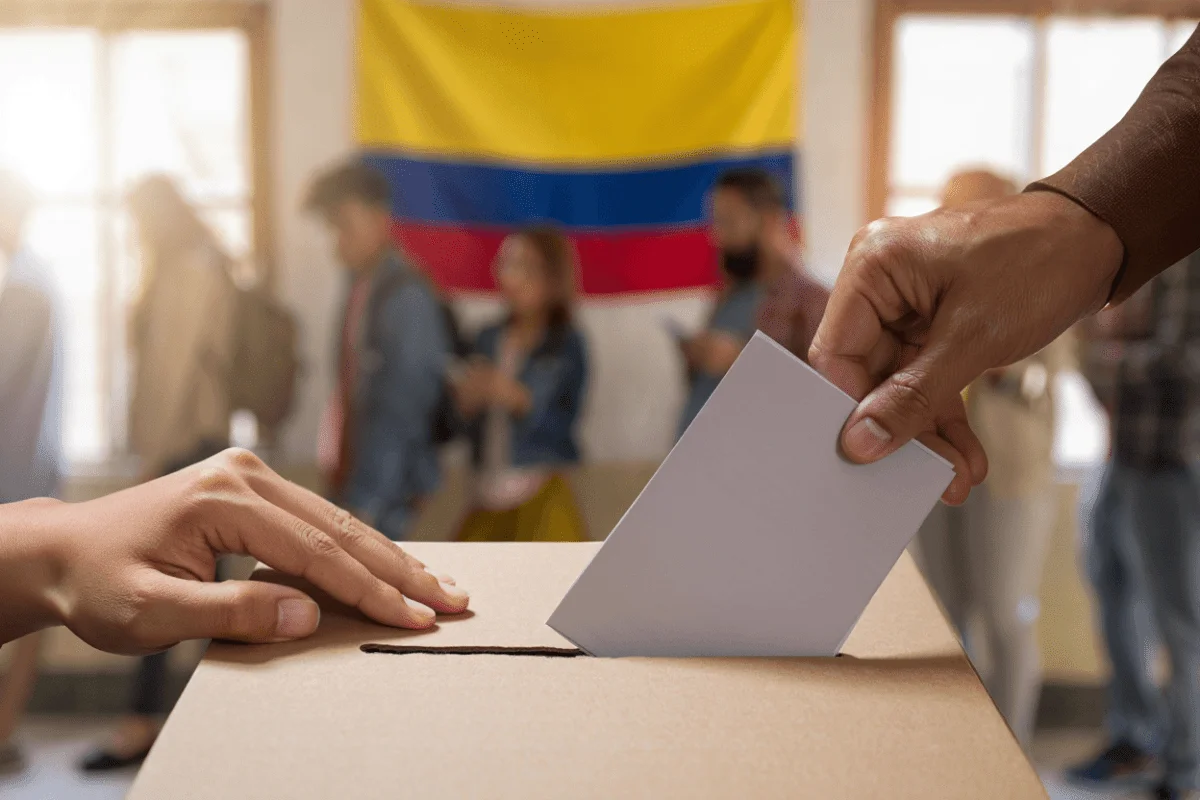
Electoral authorities ordered the closure of polling stations throughout Colombia precisely at 4:00 p.m. local time. Citizens who were already inside the locations before the deadline were allowed to finish exercising their right to vote. Once closed, the “preconteo” or rapid preliminary counting process began immediately, providing public updates every 10 to 15 minutes ahead of the final certification by the National Electoral Council (CNE).
National Registrar Hernán Penagos defended the integrity of the country’s voting infrastructure and called for peace following potential threats of post-election unrest. He recalled past tragedies, including an October 2023 arson attack on an election facility in Gamarra that claimed the life of an official, to illustrate the danger of severe polarization.
Penagos asserted that the electoral machinery is robust, relying on over 860,000 randomly selected voting jurors, 400,000 party witnesses, and thousands of judicial officials overseeing the paper counts. The CNE deployed 1,250 international observers, 8,588 overseas witnesses, and more than 250,000 domestic witnesses to monitor the second-round ballot transmission. Penagos concluded that the material, paper-based nature of the vote makes allegations of digital fraud unfeasible, guaranteeing absolute transparency.
Future Outlook
The incoming president will face immediate governance challenges beginning in August 2026. With public debt remaining high and the Colombian Congress severely fractured, implementing major reforms will require extensive coalition-building. If De la Espriella triumphs, markets anticipate immediate regulatory rollbacks in the hydrocarbon sector and a hardline restructuring of domestic security operations. Conversely, a Cepeda victory would signal a mandate to solidify Petro’s welfare expansions, though it would face intense institutional resistance from a rising regional conservative bloc and a hostile U.S. executive branch.
FAQs
What time did polling stations close in the Colombian election?
Electoral authorities officially closed all domestic polling locations at 4:00 p.m. local time on Sunday, June 21, 2026.
What were the results of the first-round election on May 31?
Abelardo de la Espriella won 43.7% of the vote (10.3 million ballots) and Iván Cepeda secured 40.9% (9.7 million ballots), leading to the two-candidate runoff.
How is the Colombian vote counted so quickly?
Colombia utilizes an informal rapid preliminary counting system called “preconteo.” This physical paper-ballot auditing process delivers public data updates every 10 to 15 minutes directly from processing centers.
Who monitored the integrity of the runoff election?
The electoral process was supervised by 1,250 international observers, 8,588 overseas witnesses, over 250,000 domestic witnesses, and more than 860,000 randomly chosen voting jurors.