BRICS Security Chiefs Unveil Joint Defense Strategy Against Emerging Digital Threats Prime Minister Narendra Modi and to…
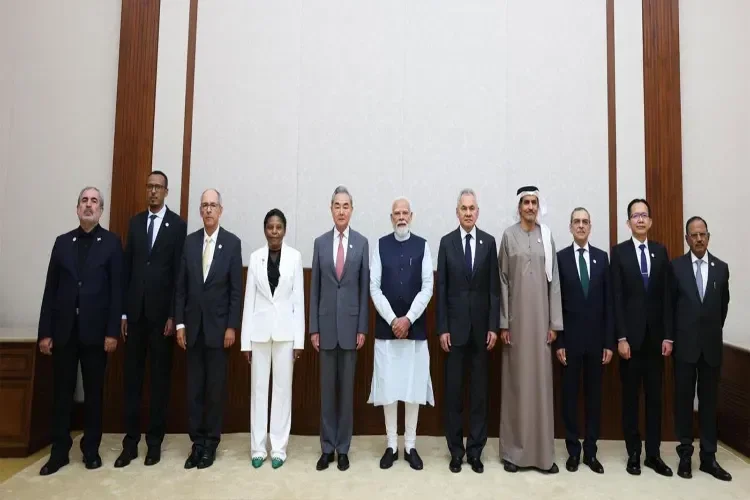
Prime Minister Narendra Modi on Tuesday interacted with National Security Advisers (NSAs) and senior security representatives from BRICS nations, underlining the growing importance of the grouping in addressing evolving global security concerns.
Key Highlights
- High-Level Enclave: New Delhi hosted the 16th BRICS National Security Advisers’ Meeting, establishing a collaborative framework for multi-domain defense.
- Geopolitical Volatility: Top diplomats confronted multiplying cross-border challenges, including systemic cyber risks and the exploitation of disruptive technologies by extremist networks.
- Strategic Pivot: India leveraged its 2026 chairmanship to amplify the socio-economic and security priorities of the Global South.
- Energy Security Boost: National Security Adviser Ajit Doval welcomed the recent U.S.-Iran memorandum of understanding, noting that the reopening of the Strait of Hormuz will stabilize global trade.
The high-level convergence followed the 16th BRICS National Security Advisers’ Meeting in New Delhi, chaired by India’s National Security Adviser Ajit Doval. These critical deliberations unfolded against a backdrop of intensifying geopolitical volatility, concentrating heavily on state-level defense strategies against terrorism, systemic cyber liabilities, and the underlying security risks posed by rapid technological breakthroughs.
During the extensive security dialogue, Modi characterized the expanded alliance as an indispensable multilateral arena for strengthening intelligence partnerships and defenses within a fluid international architecture. He pressured participating states to harmonize their defensive architectures and collectively neutralize shared asymmetric vulnerabilities that threaten macroeconomic and territorial stability.
In an official communication broadcast across digital platforms following the summit, the Prime Minister reasserted the core tenets driving India’s executive leadership of the bloc, which is organized under the operational directive “Building for Resilience, Innovation, Cooperation and Sustainability.” He emphasized that the Indian administration intends to spearhead functional security partnerships, champion the sovereign and economic rights of the Global South, and foster an international ecosystem that is demonstrably safer and more equitable.
The transnational alliance now encompasses a formidable economic and strategic footprint, counting Brazil, China, Egypt, Ethiopia, India, Indonesia, Iran, Russia, Saudi Arabia, South Africa, and the United Arab Emirates among its permanent state members.
Earlier during the initial plenary sessions, Doval framed the expanding alliance as an elite, highly specialized coalition tasked with an essential mandate to reshape the multi-polar global order. He drew attention to the mounting geopolitical leverage wielded by the bloc, calling for unprecedented coordination between permanent member states and designated dialogue partners.
The ministerial-level assembly drew a prestigious cohort of global state actors, including Russian Security Council Secretary Sergey Shoigu, Chinese Foreign Minister Wang Yi, South African Minister in the Presidency Khumbudzo Ntshavheni, and UAE Supreme Council for National Security chief Ali Mohammed Hammad Al Shamsi.
The extensive diplomatic roster also featured Brazil’s Secretary of Multilateral Political Affairs Carlos Marcio Bicalho Cozendey, Egyptian State Information Service Head Alaa Youssef, Iranian Supreme National Security Council Deputy Secretary Ghadir Nezamipour, Indonesian National Resilience Council Representative Yayat Ruyat, and Ethiopian National Intelligence Executive Director Million Lema Tadesse.
On the sidelines of the centralized summit, Doval orchestrated a series of targeted bilateral negotiations with multiple incoming state delegations to deepen intelligence sharing and synchronize regional defense policies.
The assumption of the BRICS rotary presidency in 2026 marks the fourth historical occasion that India has steered the strategic direction of the coalition, following previous executive terms in 2012, 2016, and 2021. Over its multi-decade evolution, the bloc has systematically expanded its scope far beyond basic macroeconomic cooperation, anchoring its modern institutional mandate upon three equal operational pillars: political and security synchronization, economic and financial integration, and deep socio-cultural exchanges.
Concurrently, the intergovernmental forum provides a sophisticated framework for high-level policy convergence on an array of systemic structural challenges, encompassing counter-terrorism matrices, global climate adaptation, cross-border energy and food security, multilateral governance reforms, international trade flows, agricultural technology, and systemic financial restructuring.
During his comprehensive opening address, Doval warned that the international community is currently navigating a period of unprecedented structural turbulence, asserting that the alliance must aggressively dictate the terms of global crisis management. He observed that the international arena is buckling under simultaneous geopolitical fragmentations, macroeconomic distortions, and malicious applications of technological innovations.
Furthermore, he stressed that while asymmetrical threats are compounding exponentially, traditional legacy institutions and multilateral architectures are proving fundamentally inadequate at managing or de-escalating these friction points, signaling a dangerous retreat from rules-based global governance.
In a highly significant geopolitical assessment, Doval explicitly applauded the recent diplomatic breakthroughs negotiated between Washington and Tehran, identifying the reopening of the critical Strait of Hormuz maritime corridor as a vital stabilization mechanism for international shipping lanes and energy supply chains.
He stated that India formally recognizes the memorandum of understanding established between the United States and Iran, expressing a sense of cautious optimism that the diplomatic framework will successfully fortify international energy security. Concurrently, he issued a stern warning regarding non-traditional threats, pointing out that cross-border technological manipulation, advanced cyber weaponry, and transnational criminal syndicates are routinely outpacing legacy state defense structures.
The assembled heads of delegation engaged in rigorous intelligence assessments regarding both conventional and non-traditional threats to global stability. The closed-door debates centered squarely on long-term energy availability, agricultural supply continuity, logistical resilience, infrastructure cybersecurity, climate-driven resource migration, and the disturbing proliferation of artificial intelligence and encrypted platforms by decentralized terrorist rings.
The executive assembly concluded by reviewing the operational outputs of the BRICS Joint Working Groups on Counter-Terrorism and the Security in the Use of Information and Communication Technologies.
The security chiefs formally ratified a comprehensive pact to escalate resource allocation for defense capacity building, real-time threat intelligence transmission, and joint judicial coordination among sovereign law enforcement bodies to systematically dismantle transnational extremist structures and cyber warfare syndicates. The NSAs/Heads of Delegation reaffirmed their commitment to combating terrorism in all its forms across the global landscape.
History of India’s BRICS Chairmanship
India’s leadership of the BRICS bloc has historically signaled major transitions in the group’s institutional identity, driving its evolution from an economic discussion club into a powerful security and political apparatus.
| Year | Milestone Focus | Key Operational Outcome |
|---|---|---|
| 2012 | Global Governance Reform | Initial blueprinting of the New Development Bank (NDB) to counter Western-led financial institutions. |
| 2016 | Counter-Terrorism Framework | Adoption of the Goa Declaration, placing cross-border extremism at the center of the BRICS security agenda. |
| 2021 | Digital Innovation & Health | Establishment of the Counter-Terrorism Action Plan and intra-bloc medical supply chains during global disruptions. |
| 2026 | Global South Multi-Domain Resilience | Expansion to 11 permanent members with a focus on cyber warfare defense and supply chain insulation. |
FAQs
What was the main outcome of the 2026 BRICS National Security Advisers’ meeting?
The summit resulted in a unified defense pact among the 11 member nations to increase real-time intelligence sharing, boost cyber defense capabilities, and enhance law enforcement coordination to counter terrorism and the malicious use of emerging technologies.
Who represented the major global powers at the New Delhi security summit?
The high-level meeting was attended by prominent global security figures, including Indian National Security Adviser Ajit Doval, Chinese Foreign Minister Wang Yi, Russian Security Council Secretary Sergey Shoigu, and top security officials from the UAE, South Africa, Iran, Egypt, Brazil, Ethiopia, and Indonesia.
Why did India welcome the U.S.-Iran understanding during the BRICS summit?
Indian National Security Adviser Ajit Doval noted that the memorandum of understanding between the United States and Iran allowed for the reopening of the Strait of Hormuz. This is highly critical for global energy security and shipping lane stability, which directly impacts the economic interests of BRICS nations.
How many times has India chaired the BRICS grouping?
India has assumed the chair of the BRICS alliance four times. Its previous terms of leadership occurred in 2012, 2016, and 2021, with the 2026 chairmanship marking its fourth institutional rotation.