Union Home Minister Amit Shah Unveils PM Family Care Tracker Pilot in Gujarat
Union Home Minister Amit Shah launched the pilot of the PM Family Care Tracker and Health Passport in Gandhinagar on Sunday to automate welfare monitoring. The digital platform integrates multi-department databases to ensure real-time tracking of child nutrition, health, and education, ensuring that zero eligible beneficiaries face exclusion.
Key Highlights
- Automated Welfare Alerts: The platform triggers automated notifications to local officials and lawmakers if a child misses vaccinations or exits school.
- Comprehensive Digital Ledger: A Health Passport will catalog individual medical data, including hereditary conditions, from birth up to 18 years.
- Massive Financial Outreach: The broader administrative network has remitted welfare provisions directly to nearly 70 crore impoverished citizens over 12 years.
- Urban Transit Upgrade: The event also marked the official rollout of the PM eBus Sewa network to optimize Gandhinagar’s urban transit structure.
Gandhinagar marked the beginning of a transformed model of social welfare administration within India on Sunday, driven by the rollout of technology-centric state monitoring systems. Union Home and Cooperation Minister Amit Shah declared that the year 2014 established an enduring inflection point for transparent, data-verified civic governance.
Speaking at the inaugural rollout of the pilot implementation of the PM Family Care Tracker (PM-FCT) and Health Passport, Shah emphasized the structural shift in national development.
He stated that future chronologies documenting the first 100 years of national independence will differentiate progress across two distinct eras, specifically separated by the milestone year 2014.
The Union Home Minister remarked that the current administration has driven sweeping, long-term systematic upgrades spanning the economic theater, industrial growth, public education networks, and administrative accountability. Direct benefits transfer protocols have removed intermediaries, moving financial aid cleanly into individual bank accounts.
Deploying the localized pilot project, Shah indicated that the unified database relies on a standardized identification core to prevent administrative gaps from denying underprivileged groups their rightful state benefits.
Reflecting on past personal encounters with severe economic deprivation in Uttar Pradesh, the Union Minister stated that targeted welfare interventions have upgraded living standards for approximately 70 crore citizens over the past 12 years. These measures include housing, power grids, clean water access, sanitation, cooking gas, and free medical coverage capvalued at Rs 5 lakh.
According to Shah, these persistent public provisions have realized long-deferred generational aspirations. Drawing parallels to traditional philosophies of citizen-centric governance, he noted that true administrative merit rests on tracking individual well-being rather than merely launching isolated programs.
He extended commendations to Chief Minister Bhupendra Patel, Deputy Chief Minister Harsh Sanghavi, and the technology teams for engineering the interconnected software architecture. Shah detailed that the platform synchronizes vital registries covering births, deaths, educational enrollment, public nutrition, and social safety nets into one digital node.
The structural framework issues automatic warning flags to field administrative officers, legislative representatives, and Members of Parliament if a juvenile misses a routine immunisation milestone or leaves the formal schooling stream. This immediate warning mechanism mobilizes civic volunteers and local agencies to implement corrective steps. The database maintains detailed oversight of maternal-child health metrics from the prenatal phase up to age 16.
Chief Minister Patel categorized the PM Family Care Tracker and Health Passport as a deeply empathetic, highly organized piece of public digital infrastructure. He noted that the asset marks an administrative turning point aimed at safeguarding wellness and personal dignity from maternal gestation through adolescent development.
He noted that national strategy views public health as an essential asset, prompting a structural migration away from reactive clinical care toward integrated wellness infrastructure. Patel summarized that the regional framework rests upon four distinct health priorities: preventive care, promotive wellness, fiscal affordability, and digitized administration to protect 140 crore residents.
The Chief Minister subsequently detailed the regional milestones secured by the state of Gujarat across maternal health metrics and public nutritional security.
Citing the operational Namo Shri Yojana, Patel stated that qualifying pregnant and lactating individuals receive direct financial supplements totaling up to Rs 12,000. He highlighted parallel expansions across localized dialysis networks, day-care infrastructure, oncology centers, advanced cardiac theaters, and specialized nephrology wards distributed across individual districts.
Expressing firm expectations for the systematic data rollout, Bhupendra Patel stated that the tracking tool would structurally depress infant and maternal mortality counts while fortifying healthcare delivery.
Delivering the introductory address, Health Minister Prafull Pansheriya asserted that the province has positioned itself as a primary national reference point for public medical systems. He observed that the pilot framework in Gandhinagar materialized through unified coordination between the Departments of Health, Education, and Women and Child Development.
Pansheriya affirmed that the comprehensive platform will prevent gaps in localized immunisation coverage. Every newborn will receive a customized digital health card detailing comprehensive medical histories, tracking hereditary disorders alongside general ailments until they turn 18.
The Health Minister additionally noted that the state has initiated a 3-day Pulse Polio drive, affirming national pride in maintaining polio-free certification. He reconfirmed that the state health apparatus remains dedicated to insulating children from 11 dangerous preventable ailments, advancing the goal of equitable service delivery to the outermost margins of the populace.
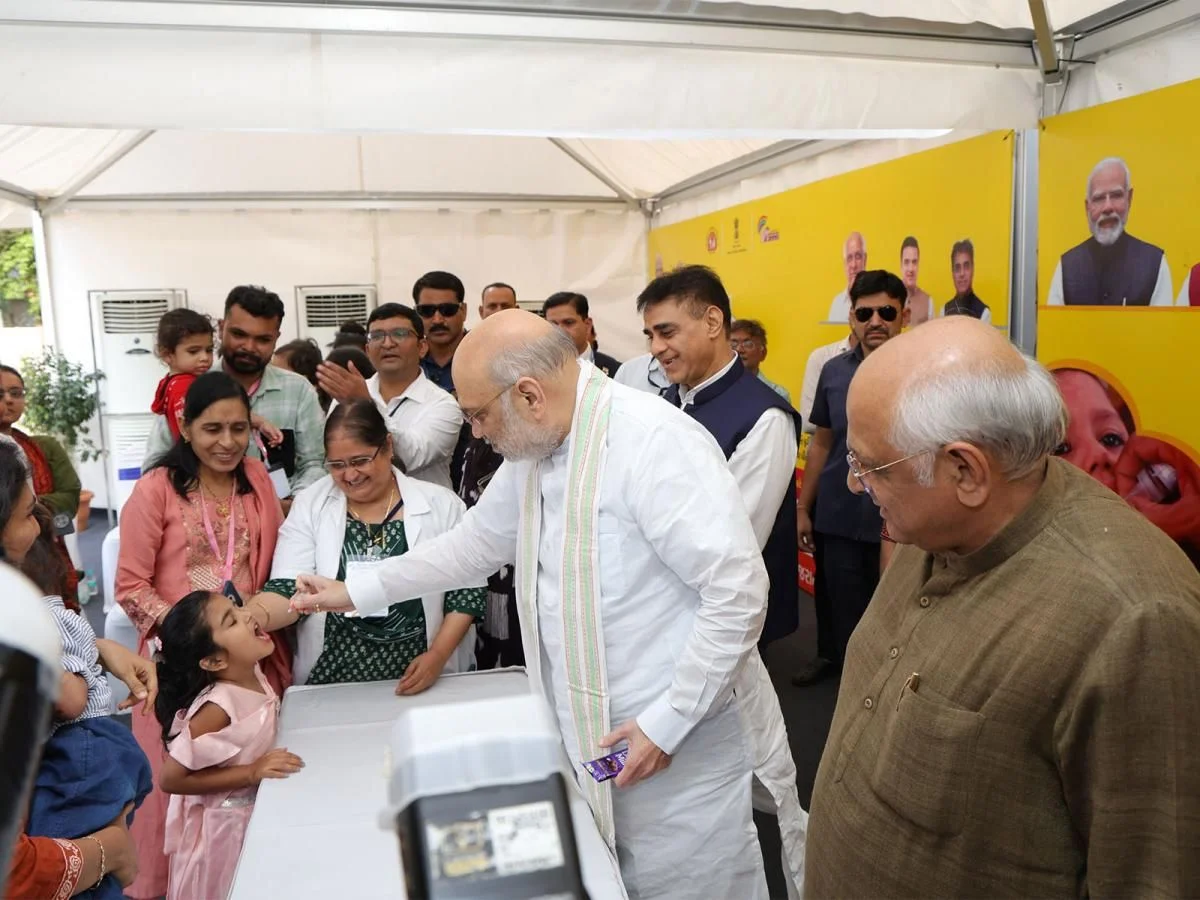
During the launch ceremony, Union Home Minister Amit Shah presented initial digitized certifications to a trio of local beneficiaries, distributed fortified nutritional bundles, and issued physical Health Passports.
Concurrently, Shah flagged off the PM eBus Sewa fleet within Gandhinagar, introducing low-emission municipal transit assets to the metropolitan transport matrix.
Platform monitors women’s and children’s health, nutrition, education
Alerts ensure all eligible get government welfare benefits
Future Outlook
The deployment of the PM Family Care Tracker pilot signifies a broader shift toward predictive digital governance across the country. By converging data pipelines from separate ministries, the state aims to eliminate manual oversight errors. If the Gandhinagar pilot yields measurable drops in dropout rates and vaccine truancy, officials intend to scale the data architecture nationwide, creating a blueprint for real-time welfare compliance monitoring.
FAQs
What is the primary purpose of the PM Family Care Tracker?
The platform integrates separate departmental databases to monitor child health, schooling, and nutrition continuously from pregnancy up to age 16. It generates automated alerts for local officials if a beneficiary misses vaccinations or leaves school.
Who receives alerts if a child falls behind on public welfare metrics?
Automated system warnings are transmitted directly to local field officials, regional legislators, and regional Members of Parliament to prompt direct volunteer interventions.
What parameters are included in the Health Passport?
The Health Passport functions as a lifelong digital medical card issued at birth, archiving an individual’s complete medical history, including genetic and hereditary conditions, up to the age of 18.
What other urban infrastructure project did Amit Shah launch during the event?
In addition to the welfare platform, the Union Home Minister inaugurated the PM eBus Sewa in Gandhinagar to expand clean energy mass transport links across the city.