Amit Shah Accuses Congress of Ignoring Farmers at Maharashtra Rally
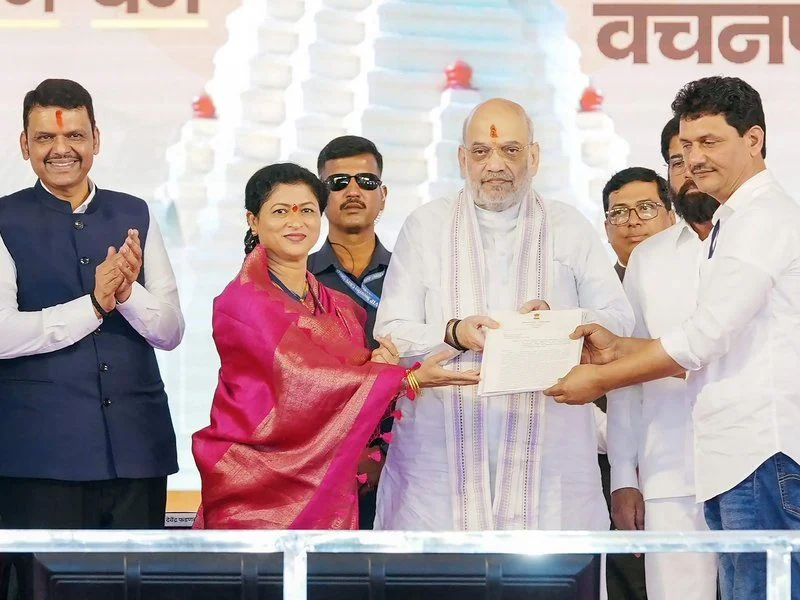
Union Home and Cooperation Minister Amit Shah targeted the Congress party on Saturday, claiming it consistently neglected the agricultural sector. Speaking at an industrial rally, Shah questioned opposition leader Rahul Gandhi regarding the historical scale of crop loan waivers under past administrations.
Key Highlights
- Union Minister Amit Shah challenged the opposition over its historical 10-year agricultural record.
- The current administration waived Rs 46,000 crore in income tax for sugarcane factories.
- Direct bank transfers to farmers reached Rs 4.28 lakh crore across 12 years.
- A new cooperative plant worth Rs 1,500 crore is planned for western Maharashtra.
Union Minister Amit Shah asserted that the opposition spent decades ignoring the fundamental financial struggles of the farming community. Addressing a public gathering in Ichalkaranji, he demanded clarity from Rahul Gandhi on the total volume of agricultural debt canceled during opposition tenures, contrasting it against current policies.
Shah stated that previous administrations managed only Rs 60,000 crore in total debt relief over a decade. He emphasized that the current political leadership treats rural development as a core operational priority rather than a temporary electoral tool.
The Home Minister highlighted recent tax reforms specifically targeting the sugarcane cultivation sector. He noted that long-standing appeals to eliminate specific levies on sugar processing profits had been systematically overlooked by previous political regimes.
In a swift policy intervention, Prime Minister Narendra Modi cleared an income tax exemption totaling Rs 46,000 crore for these processing units. Shah remarked that this decision fundamentally altered the fiscal health of regional sugar mills.
Statistical data presented at the rally indicated that the federal government distributed Rs 4.28 lakh crore directly to agricultural bank accounts. This capital deployment occurred over 12 years, distributed through 22 instalments via direct benefit transfers.
Shah urged the electorate to support an administration dedicated entirely to sustained infrastructure and rural expansion. He called for a governance model that demonstrates continuous developmental commitment over its full five-year mandate.
Industrial upgrades highlighted during the speech included the widespread deployment of multi-feed processing plants. Additionally, federal tax authorities lowered the Goods and Services Tax on ethanol production significantly, dropping the rate from 28% down to 5%.
Acknowledging fiscal constraints in the region, Shah noted that several processing cooperative units across Maharashtra lack the independent capital necessary to construct modern ethanol facilities. To address this, the federal government initiated a major infrastructure project.
The central administration is financing a specialized cooperative processing facility in western Maharashtra, investing Rs 1,500 crore into the development. All subsequent financial yields from secondary products will return directly to local cooperative mills.
Shah praised the Prime Minister as a unique leader who successfully prioritized both grassroots cooperative economics and advanced aerospace milestones. He positioned these twin achievements as proof of comprehensive national development.
The Home Minister characterized the past 12 years under the current leadership as merely an introductory phase of governance. He predicted that the ruling coalition would maintain its legislative trajectory for an extended period.
The Bharatiya Janata Party remains focused on fulfilling a specific socio-economic vision aimed at establishing a fully developed nation by 2047. Shah insisted that the ruling party alone possesses the political will to achieve this benchmark.
According to Shah, the current Prime Minister holds the record as the longest-serving elected head of state in democratic Indian history. He stated that future historical records would recognize this era for its transformative legislative milestones.
The minister pointed to a broader national shift toward technological research, scientific discovery, and grassroots economic empowerment. This framework explicitly connects rural self-help groups, village committees, and modern technology startups.
Shah contrasted the current national security environment with the political climate of twelve years ago. He criticized past leadership for remaining silent during periods of cross-border security threats and frequent urban bombings.
The current administration modified India’s defense posture by introducing decisive cross-border security measures. Shah referenced targeted surgical strikes, strategic air maneuvers, and Operation Sindoor as definitive proof of an active counter-terrorism policy.
These strategic military operations demonstrated a global precedent regarding territorial defense. Shah stated that the nation successfully conveyed an uncompromising stance on sovereign security to international observers.
Domestic security monitoring showed that long-standing internal insurgencies have been effectively neutralized. Shah declared that five-decade-old Naxalite movements have now been relegated to past history.
Geopolitical stability has improved across several historically sensitive regions. The minister affirmed that peaceful conditions now extend through Ladakh, Lakshadweep, the Northeast, and Punjab.
The domestic political landscape also saw major statutory updates, including the formal removal of Article 370 from Jammu and Kashmir. Shah concluded by listing major cultural infrastructure projects completed under the current administration.
These cultural restorations include the construction of the Ram Mandir, the Kashi Vishwanath Corridor, and the Mahakal Lok development. Additional engineering initiatives are currently underway to apply gold plating to the historic Somnath Temple.
Future Outlook
The transition toward ethanol blending and cooperative modernization marks a permanent shift in Indian agricultural policy. By lowering the processing tax to 5% and building a dedicated Rs 1,500 crore plant, the government aims to insulate sugarcane farmers from volatile global sugar cycles. This framework establishes a self-sustaining financial loop where secondary industrial profits directly subsidize traditional farming operations through 2047.
FAQs
What tax relief did Amit Shah announce for the sugarcane sector?
The federal government provided an income tax waiver worth Rs 46,000 crore for sugarcane processing factories to improve their operational profitability.
How much money has been sent directly to farmers over the last 12 years?
The government deposited a total of Rs 4.28 lakh crore directly into farmer bank accounts through 22 instalments.
What infrastructure project is planned for western Maharashtra?
The central government is establishing a cooperative processing plant in western Maharashtra with an investment of Rs 1,500 crore, returning all derivative profits to local mills.
How much was the GST on ethanol reduced?
The Goods and Services Tax applied to ethanol production was lowered from 28% to 5% to promote biofuel manufacturing.