Publication: Security Journal Americas
Editorial status: Pending completion of source verification and production checks Story topic: Stepping up to the plate: security at the New York Mets
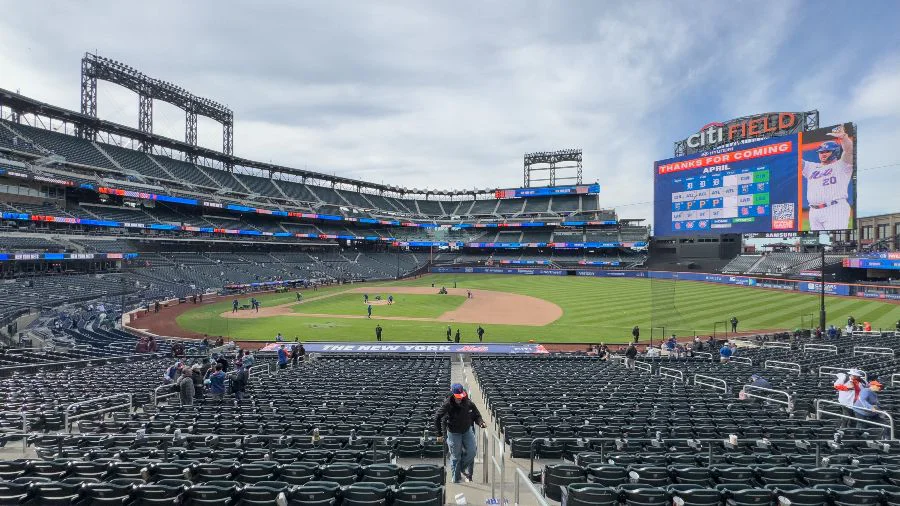
The New York Mets replaced 40 traditional walkthrough metal detectors at Citi Field with 11 Evolv Express dual-lane systems, a 75% reduction in screening infrastructure reported in Evolv Technology’s January 2024 case study.
The stadium’s wider security arrangements include optional facial authentication, an on-site police substation and game-day coordination with New York City emergency services.
Key Takeaways
- Citi Field’s screening configuration changed substantially, but the published figures do not establish whether detection accuracy or entry times improved.
- Keechant Sewell’s appointment created a senior executive role combining venue security and guest experience.
- Mets Entry Express offers an optional facial-authentication route for ticket validation, separate from Evolv’s weapons-screening function.
- Evolv’s proposed Genetec integration remains a planned development in the documented material, not a confirmed production deployment.
Sewell’s appointment linked security with guest experience
The Mets announced Keechant Sewell’s appointment on November 2, 2023, naming the former New York City police commissioner senior vice president of security and guest experience, according to the MLB announcement.
The position placed venue security and guest-service responsibilities under one senior executive.
Sewell brought 27 years of law enforcement experience to the role, according to the Mets’ announcement and the professional background documented in the verified dossier. Her previous position as New York City’s police commissioner gave her experience in municipal policing before she moved into professional sports venue management.
The chronology begins earlier in the same year. Evolv Technology announced its Citi Field deployment on April 20, 2023, with the technology scheduled for use during that Major League Baseball season.
The Mets announced Sewell’s appointment later, on November 2, and Evolv published its venue case study in January 2024. These milestones document separate developments in screening technology, executive leadership and technical planning; they do not establish that Sewell initiated or personally directed the Evolv installation.
The Mets’ documented game-day arrangements involve front-office personnel, private security contractors, event operations staff and the New York City Police Department (NYPD). These groups contribute different functions to stadium operations, bringing private venue management into contact with municipal law enforcement.
The documented material does not provide staffing totals or measured evidence linking the organisational structure to a particular change in incident response.
Citi Field’s Security Operations Center supports communications between private event personnel, the NYPD and the Fire Department of the City of New York (FDNY), according to the operating arrangements described in the verified dossier.
The centre provides a coordination point for venue and public-safety personnel, but no quantified response-time results are documented.
The NYPD also operates a dedicated substation with processing facilities at the stadium, according to the same source material. This establishes an on-site police presence alongside private security operations, although the available figures do not show how officers and contractors are allocated across individual events.
Evolv’s installation changed the screening footprint
Evolv announced its Citi Field deployment on 20 April 2023, stating that fans would experience its screening technology during the 2023 Major League Baseball season. The announcement established the planned season of use; the vendor’s subsequent case study supplied the reported equipment figures.
According to Evolv’s case study, published in January 2024, the stadium moved from 40 traditional walkthrough metal detectors to 11 Evolv Express dual-lane systems. The reported 75% reduction concerns screening infrastructure.
It is not a 75% reduction in staff, weapons incidents, detection failures or waiting times.
Evolv describes Express as a screening system that combines artificial-intelligence software with sensor arrays to distinguish everyday objects, including keys and smartphones, from potential weapons threats. That description comes from the technology vendor.
The documented case study does not provide an independent test result establishing detection accuracy under Citi Field’s operating conditions.
The equipment change alters the physical arrangement of the admission process, but fewer installations do not automatically demonstrate faster entry. Establishing a change in waiting times would require comparable measurements from before and after deployment, using a consistent method and comparable event conditions.
No such stadium-wide comparison is provided in the cited case study.
The distinction between installation figures and performance outcomes is central to interpreting Evolv’s claims. The equipment count documents a change in the screening configuration, while claims about detection performance, queue reduction or overall security effectiveness require separate evidence.
Neither the April 2023 announcement nor the January 2024 case study supplies a comprehensive, independently verified assessment of those outcomes.
The case study is nevertheless useful as a record of the vendor’s reported installation and technical plans. Its engineering details identify the systems involved and describe intended connections with other security technology.
They should not be treated as an independent audit of the stadium’s entire security operation.
Fernandez describes the Mets’ experience
Oscar Fernandez, the Mets’ vice president of technology solutions, offered a positive assessment of the Evolv deployment in a statement published by the vendor.
Fernandez said: “We’ve had tremendous success with Evolv, and the feedback from fans has been overwhelmingly positive”.
The quotation provides Fernandez’s direct assessment of the system and the feedback received by the organisation. It is a qualitative statement rather than a measured satisfaction result.
The documented vendor material does not attach a survey sample, satisfaction score or breakdown by entrance to the comment.
That distinction matters when assessing the evidence. The equipment figures describe the physical installation, while Fernandez’s statement communicates the Mets’ view of the experience.
Neither should be used as a substitute for independently measured entry times, detection accuracy or incident outcomes.
The statement is relevant because it identifies the assessment of a named Mets technology executive rather than an anonymous or generalised endorsement. It does not, however, establish that every fan shared the same experience or that the deployment produced a quantified improvement in safety.
Mets Entry Express offers optional facial authentication
The Mets also offer Mets Entry Express, a voluntary programme using facial-authentication technology supplied by Wicket. The programme is intended to connect facial authentication with ticket validation and provide a touchless entry option.
Its function differs from that of Evolv Express. Wicket’s technology supports facial authentication for ticket validation, while Evolv’s systems screen for potential weapons threats.
Treating these products as interchangeable would obscure the separate roles they play in the stadium’s entry arrangements.
The programme’s voluntary status is important to describing how it operates. Mets Entry Express is an available option rather than a requirement for every visitor.
Its existence does not establish that biometric authentication has replaced conventional ticket validation throughout Citi Field.
The documented material identifies Wicket as the provider but does not establish an enrolment total, participation rate, authentication-failure count or average time saved. Those figures would be necessary to assess adoption and compare the option’s performance with other entry methods.
The evidence also does not establish a biometric-data breach or other privacy incident associated with the programme. Equally, the programme’s voluntary nature alone does not establish its data-handling arrangements.
Specific claims about retention periods, deletion practices, encryption or access controls would require direct technical documentation or statements from Wicket or the Mets.
For the stadium’s overall security picture, facial authentication is one component of admission rather than evidence of a complete biometric security system. Its practical significance depends on how the option is implemented and used, details that cannot be quantified from the documented programme description.
The operations centre connects private staff and city agencies
Citi Field’s security arrangements extend beyond the screening equipment. The stadium’s Security Operations Center (SOC) supports game-day communications among private event staff, the NYPD and the FDNY, according to the documented operating arrangements.
The centre’s coordination role is distinct from the admission screening function. Evolv’s equipment addresses potential weapons threats at entry points, while the SOC provides a location for communications among venue personnel and public-safety agencies.
The two functions form separate parts of the wider operation, and the documented material does not quantify their combined effect.
The on-site NYPD substation adds a dedicated law-enforcement presence at the stadium. Its processing facilities support police operations at the venue, alongside private contractors and event personnel responsible for managing the event environment.
The source material does not provide a detailed staffing breakdown for the operations centre, agency-by-agency deployment totals, incident counts or response-time measurements. Those omissions limit the conclusions that can be drawn about operational performance.
The existence of a coordination structure establishes an organisational arrangement, not proof that incidents are resolved more quickly.
The distinction between current operations and planned technical work is also important. The operations centre, police substation and game-day agency coordination are described as existing arrangements.
Evolv’s proposed Genetec connection is a separate engineering development whose completed deployment has not been established by the documented case study.
Genetec integration remains a technical plan
Evolv’s January 2024 case study identifies a planned Genetec integration involving perimeter sensors and the Genetec Security Operations platform. The document describes an intended technical connection rather than a confirmed production launch.
The stated objective is to send verified perimeter alarms to Citi Field’s Security Operations Center in real time. Such a connection would link sensor information with the venue’s security-management software, but the documented material does not establish that the system has been deployed or demonstrate its operational effect.
No confirmed completion date or production-launch record is established in the case study. The proposed integration must therefore remain described as planned.
It would be inaccurate to report that automated alarm handling is already operational on the strength of the planning description alone.
The same limitation applies to claims about automated dispatch, fewer manual checks, improved detection or faster incident response. Those are potential outcomes to assess only after deployment evidence and performance results become available.
A technical objective does not establish that the intended result has been achieved.
Confirmation of deployment would be the next meaningful development to monitor, followed by evidence showing how the connection handles alarms during live operations. Without those records, the case study establishes the intended architecture but not its effectiveness.
What the evidence establishes
The documented record identifies several distinct parts of Citi Field’s security arrangements: Sewell’s executive appointment, Evolv’s screening installation, Wicket’s optional facial-authentication programme and game-day coordination with city agencies.
The sources establish the existence or stated purpose of these arrangements, but they do not provide a single performance assessment covering the entire stadium.
The primary records also have different evidentiary roles. The Mets’ announcement documents Sewell’s appointment, Evolv’s April 2023 release records the screening deployment announcement, and the January 2024 case study supplies the vendor’s equipment figures and proposed integration.
Fernandez’s statement records the Mets technology executive’s assessment of the deployment.
The principal unresolved technical question concerns the Genetec connection. A confirmed deployment record and operational performance data would be needed to determine whether the proposed integration has moved beyond planning.
Comparable measurements of entry times, detection performance and security incidents would likewise be needed before drawing broader conclusions about the stadium’s security outcomes.
Publication remains conditional on two production checks identified in the newsroom clearance record: verifying image rights and completing a final inspection of the rendered article, image credits, byline and publication date.
Until those checks are complete, the dossier’s status remains conditional rather than fully cleared for publication.
ChatGPT is AI and can make mistakes.
ChatGPT
New chat
Images
Plugins
See plans and pricing
Help
Deep research
Settings
Get responses tailored to you
Log in to get answers based on saved chats, plus create images and upload files.
Log in
Chat with ChatGPT
Send message