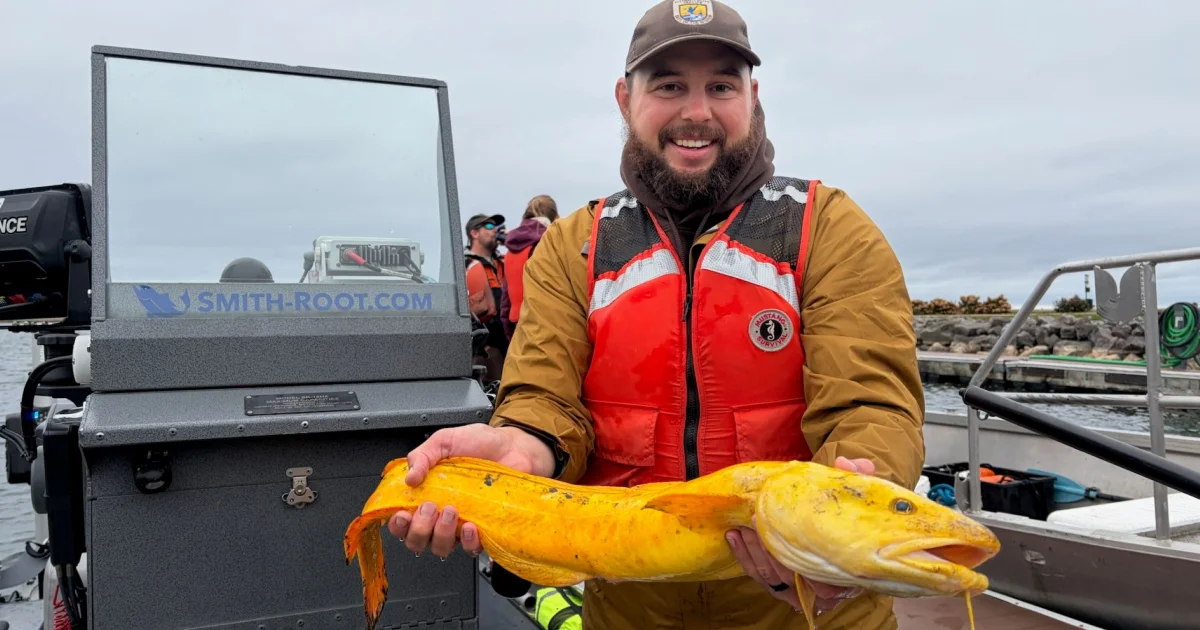
Rare Yellow Burbot Caught in New York’s Oswego Harbor
Federal biologists caught a rare yellow burbot in Oswego Harbor on Lake Ontario’s southeastern shore in New York in October 2026, the U.S. Fish and Wildlife Service said Nov. 10.
The agency said the native burbot, Lota lota, was the first of its species documented during a fisheries survey of the harbor, where a few anglers had reported catches. Burbot numbers in Lake Ontario remain low, and the species usually inhabits deeper, colder water than the harbor offers.
A genetic mutation that suppresses normal pigmentation gave the fish its yellow-orange color, the service said. The condition, called xanthochromism, occurs less often in wild fish than albinism or melanism.
Burbot normally have mottled olive, brown or dark green coloring that helps them blend into rocky or muddy lake beds.
The agency said the crew from its Lower Great Lakes Fish and Wildlife Conservation Office caught the fish during a routine survey under the Aquatic Invasive Species Early Detection and Monitoring Program. The program looks for invasive species on a watchlist in Great Lakes harbors, rivers and bays, where newly arrived populations can be small and hard to find.
The program combines electrofishing with fyke nets, gill nets and environmental DNA sampling, the service said. The gear lets crews sample different depths and bottom habitats.
Genetic traces in water samples can help biologists detect species that escape conventional sampling.
Most fish caught in the surveys are native species that crews expect to find, the agency said. Finding a scarce fish such as the burbot suggests the survey can also pick up newly arrived invasive species when their numbers are low.
An early detection gives fisheries managers a chance to act before an invasive population becomes established.
U.S. Geological Survey fisheries biologists examining the catch found the burbot emaciated and judged it to be in poor health, the service said. The agency cited the fish’s condition and questions about why burbot numbers in Lake Ontario remain low in deciding to send the specimen for veterinary analysis.
The Cornell University College of Veterinary Medicine received the fish for a diagnostic health assessment. The examination could look for parasites, disease or nutritional stress and help determine whether the unusual pigmentation had any bearing on the fish’s condition.
The service said the findings could inform how fisheries managers assess burbot health elsewhere in the Great Lakes basin.