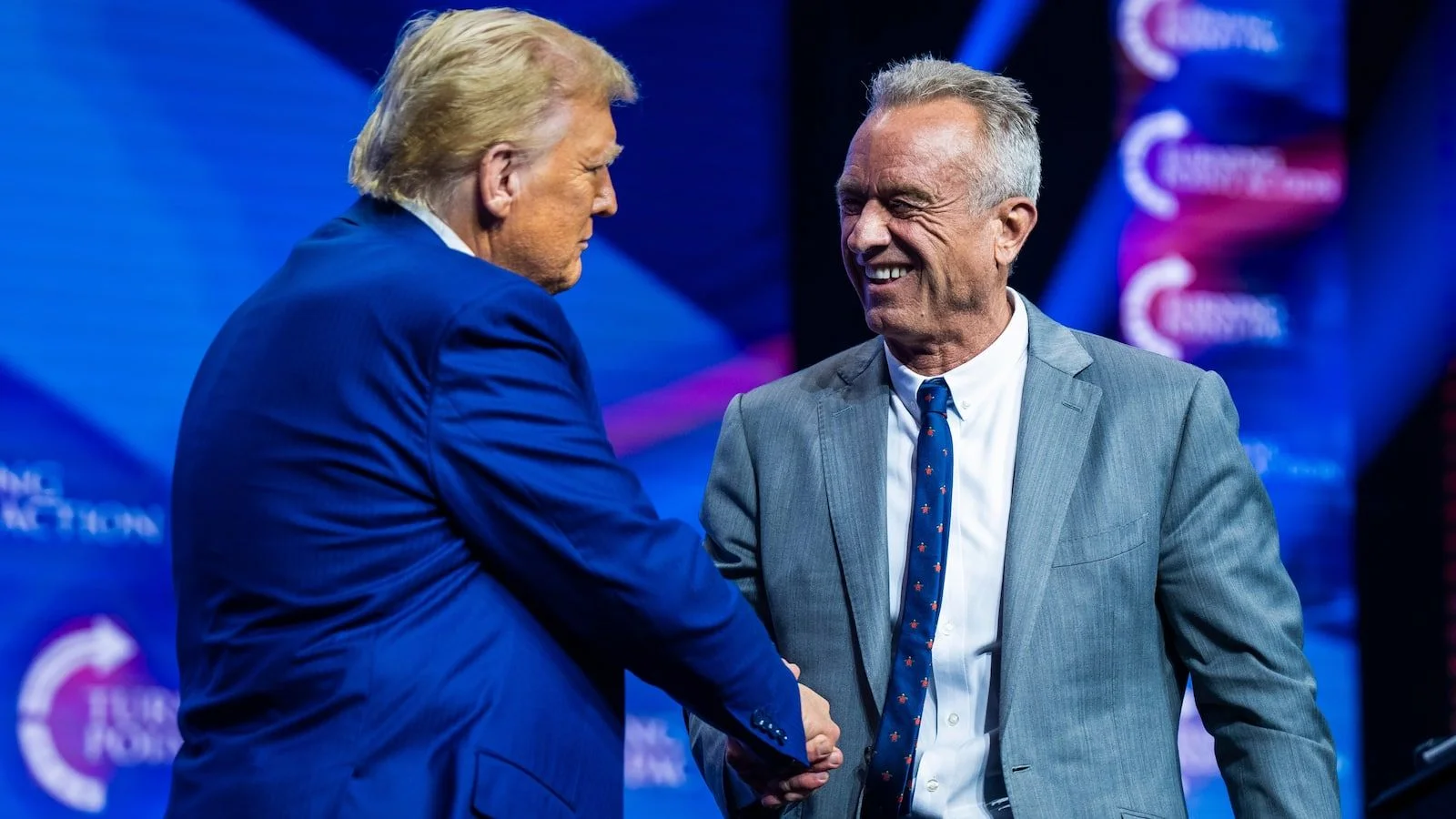
RFK Jr
RFK Jr. Accused of Pressuring Libertarian to Exit Race Health Secretary Robert F. Kennedy Jr. urged an Iowa Libertarian candidate to withdraw from a competitive congressional race to protect the Republican majority, according to a leaked audio recording. This development triggers significant legal and ethical scrutiny regarding federal election interference.
Key Highlights
- Health Secretary Robert F. Kennedy Jr. was recorded pressuring a Libertarian candidate to exit a competitive Iowa congressional race.
- Kennedy indicated he was acting as an intermediary for the White House to safeguard the Republican legislative agenda.
- Legal and ethics experts warn the interaction potentially violates federal statutes, including the Hatch Act.
- The targeted candidates rejected the pressure and intend to remain on the ballot for the 2026 midterms.
United States Health Secretary Robert F. Kennedy Jr. pressured a Libertarian congressional contender in Iowa to exit a highly competitive House race to assist Republicans in maintaining legislative control, an audio recording of the discussion reveals.
During the conversation, Kennedy explicitly stated he was acting as an intermediary for the White House. He argued that a Democratic takeover of the House of Representatives would severely impede President Donald Trump’s legislative agenda.
Kennedy further suggested he could provide subsequent assistance to the candidate if he withdrew. He proposed that the contender execute an accord that would yield more practical results than a merely symbolic campaign.
“I can’t go into specifics because there’s legal prohibitions about that,” Kennedy informed Rick Stewart, the Libertarian nominee in Iowa’s 2nd Congressional District, during a June 11 phone call.
The cabinet official told the candidate that they could discuss particular details privately if the candidate expressed interest in exploring the arrangement further.
According to local Libertarian politicians, this phone call represents at least the second time this month that Kennedy has intervened with an Iowa congressional candidate.
Government accountability experts stated that Kennedy’s backroom intervention in the Iowa elections was unethical and potentially illegal. The legality depends on whether he promised explicit government favors or made the calls using his official authority.
Danielle Caputo, an attorney representing the nonpartisan voters’ rights organization Campaign Legal Center, stated that Kennedy should have completely avoided involvement in these congressional races.
Caputo noted that proving a definitive violation of federal laws like the Hatch Act remains difficult. The law restricts federal employees from leveraging their official positions to influence electoral outcomes.
The legal analyst emphasized that the public deserves an unmanipulated choice at the ballot box. She stated that government officials must not covertly alter election dynamics by pressuring specific candidates to withdraw.
Stewart, a 74-year-old perennial candidate who has run for multiple offices in Iowa, stated in an interview that he interpreted the 12-minute conversation as an implicit quid pro quo attempt.
While no explicit reward was extended, Stewart noted the underlying proposition was unmistakable. The candidate stated that the objective was to secure mutual benefits through political compliance.
Stewart explained that Republicans want him out of the race because his projected 2% to 3% vote share could directly pull support away from the Republican nominee.
Despite the pressure, Stewart confirmed he has no intention of abandoning his congressional bid.
When contacted by telephone on Thursday, Kennedy declined to provide a statement and redirected inquiries to an administration spokesperson, who did not immediately reply.
The audio recording of the conversation was captured by Stewart and subsequently verified and reviewed.
Iowa’s 2nd Congressional District stands as a critical battleground that could determine which party controls the House of Representatives following the November election. The nonpartisan Cook Political Report classifies the district as leaning Republican.
The White House has intensified its focus on the upcoming midterm elections, recognizing that a Democratic majority would instantly trigger aggressive oversight investigations into Trump’s administration.
House Oversight Committee Democrats recently confirmed plans to aggressively investigate Kennedy’s sweeping alterations to national vaccine guidelines and public health initiatives if they recapture the legislative majority.
During the recorded call, Kennedy appeared to reference this exact political vulnerability to the candidate.
“I don’t want to be fighting subpoenas for the next two years instead of improving America’s health,” Kennedy told the local candidate, citing an immediate pragmatic motive for his intervention.
Republican strategist circles acknowledge that the party must actively defend traditionally secure legislative seats due to the president’s depressed polling metrics, inflationary pressures, and the ongoing conflict with Iran.
Trump and his senior aides have repeatedly warned baseline supporters that a legislative victory for opposition Democrats represents an existential threat to the administration’s core policy agenda.
“We’ve got to do great in the midterms,” Trump asserted during a public Rose Garden briefing last month, warning that an opposition victory would result in systematic legislative obstruction.
Kennedy’s direct outreach to Stewart follows an unrecorded June 8 phone call with Marco Battaglia, the Libertarian candidate contesting Iowa’s 3rd Congressional District.
Battaglia confirmed that Kennedy delivered a similar warning during their discussion, asserting that the legislative chamber could flip to opposition control if the Libertarian candidate remained active.
The Cook Political Report currently evaluates the 3rd Congressional District race as a statistical toss-up.
Battaglia stated that the Health Secretary applied mild pressure on him to withdraw from the race, an invitation he ultimately rejected after brief consideration.
The candidate recalled telling the cabinet member that his prominent historical relatives, former Attorney General Robert F. Kennedy and President John F. Kennedy, would oppose forcing alternative choices off the ballot.
To verify the interaction, Battaglia provided digital documentation displaying inbound communications originating from a phone number directly tied to Kennedy.
Historical precedents show that executive branch secretaries frequently face formal reprimands for deploying their official prestige to influence sensitive electoral contests.
Former Health Secretary Xavier Becerra received an official reprimand in 2023 after the Office of Special Counsel concluded he violated the Hatch Act by endorsing a sitting senator during an official advocacy event.
The Office of Special Counsel reconfirmed at the time that federal statutory frameworks strictly bar executive branch personnel from using their official weight to manipulate election proceedings.
While federal mandates block officials from interfering in active campaigns, individuals often defend their political participation by asserting they acted entirely in a personal capacity outside of official duty hours.
Washington legal experts note that the Hatch Act permits federal figures to issue political endorsements provided they completely abstain from utilizing government assets or executing these actions during official service.
Violations of the Hatch Act carry no direct criminal penalties, leaving disciplinary enforcement entirely to the discretion of the sitting president.
However, legal analysts suggest Kennedy’s statements could implicate broader criminal statutes that expressly prohibit federal workers from promising federal employment or administrative benefits in exchange for political concessions.
The White House and the Department of Health and Human Services did not return immediate requests for comment regarding whether administration lawyers vetted the calls or if senior staff directed the outreach.
Political analysts view Iowa as an essential bellwether state for the upcoming midterms, with the gubernatorial race, an open Senate seat, and multiple House lines vulnerable to shifting political control.
While Trump carried the state during his consecutive presidential campaigns, his name is absent from the current ballot, and a Trump-backed gubernatorial candidate recently lost a key primary challenge earlier this month.
Concurrently, Democratic State Auditor Rob Sand’s gubernatorial campaign is expected to generate significant down-ballot momentum for regional legislative candidates across the state.
Historical data from the 2006 and 2018 midterm election cycles demonstrate that structural legislative shifts within Iowa frequently signal broader national swings in congressional control.
Meanwhile, third-party Libertarian organizations have expanded their baseline footprint in Iowa by advocating for cannabis policy adjustments, marriage equity, and systematic judicial reforms.
The party achieved official minority political-party status in Iowa after its 2016 presidential ticket secured nearly 4% of the regional electorate.
State party leadership stated that the organization offers an essential alternative for voters rejected by the major parties, acting as a structural counterweight to the traditional two-party duopoly.
Kennedy’s aggressive consolidation efforts follow his own highly turbulent relationship with the third-party apparatus during his independent presidential campaign before his eventual exit.
After failing to secure the Libertarian nomination, Kennedy endorsed Trump, who subsequently appointed him to oversee the nation’s primary health apparatus.
Stewart concluded by noting that unrecorded segments of the call indicated White House analysts are specifically anxious about losing the thin House majority through fractional voting splits in Iowa.
Historical Context
The tension between third-party candidates and major political coalitions in Iowa highlights a recurring theme in modern American elections, where minor margins shift national power. The Libertarian Party of Iowa achieved permanent ballot access following the 2016 presidential election, when its ticket captured 4% of the statewide vote. This baseline support turns alternative candidates into crucial players in rural and suburban districts.
The pressure applied by executive cabinet members onto local races mimics historical midterms like 2006 and 2018, where competitive Midwestern districts determined control of the House of Representatives. Cabinet-level interventions remain rare due to the oversight risks created by the Hatch Act of 1939, which was passed specifically to prevent executive branch employees from using government authority to orchestrate electoral outcomes.
FAQs
What is the Hatch Act?
The Hatch Act is a federal law enacted to prevent federal employees from using their official authority or government resources to influence or affect the outcome of an election.
Can a Cabinet Secretary legally endorse a political candidate?
Yes, federal officials can endorse political candidates, provided they do so in their personal capacity, outside of official duty hours, and without utilizing government resources or titles.
What penalties exist for violating the Hatch Act?
The Hatch Act does not carry criminal sanctions. Disciplinary actions for high-level political appointees are left entirely to the discretion of the sitting president.
Which Iowa congressional districts were targeted by the outreach?
The recorded and reported phone calls targeted Libertarian candidates running in Iowa’s 2nd Congressional District and 3rd Congressional District.