Indian Stray Dog Aloka Walks 2,300 Miles in US Inspiring Indie Adoption Movement
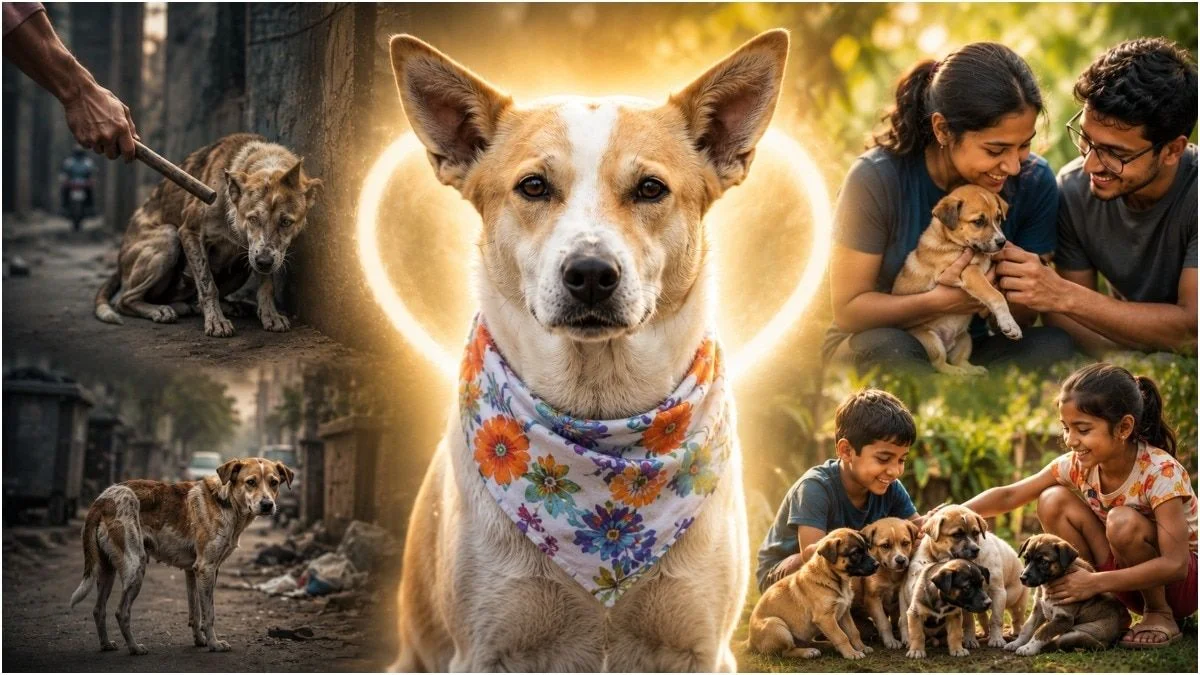
A former stray dog from Kolkata named Aloka has completed a 2,300-mile trek across the United States alongside Buddhist monks. The journey has sparked an emotional campaign among Indian pet owners, accelerating a growing national movement to adopt native street dogs over commercial pedigree breeds.
Key Highlights
- A rescue dog named Aloka completed a 2,300-mile transcontinental walk across America from the coast to Washington, DC.
- The journey has turned into a powerful symbol for India’s native street dogs, colloquially known as Indies or INDogs.
- Advocates are leveraging the narrative to challenge deep-rooted societal biases that prioritize expensive, imported pedigree breeds.
- Pet parents emphasize that native Indian dogs possess high emotional intelligence, strong survival instincts, and optimal climate adaptation.
Every day across India, community dogs face eviction from sidewalks, forced relocation from neighborhoods, and systemic treatment as urban liabilities rather than protected animals.
Aloka was one of the lucky ones. Then he became something else entirely.
The canine possessed no collar, no identity, and no incentive to trust humans. During 2022, on a street in Kolkata, the stray dog made an unremarkable choice to follow a contingent of Buddhist monks and maintained their pace. He survived a vehicular collision, overcame a critical illness, and continued his journey.
The monastics named him Aloka, signifying “light” in the Pali language, and traveled 2,300 miles across American territory from the coastline to the capital. When Aloka reached Washington, DC, millions of spectators had embraced the animal, who features a distinct heart-shaped pattern on his forehead. He evolved into an improbable emblem of peace, endurance, and mutual survival.
However, for the expanding population of native Indian dog owners who choose street rescues over commercial showrooms, Aloka’s cross-country journey delivers a specific and critical message. He represents far more than a traveling animal. He serves as a mirror reflecting a society that has spent generations ignoring its most populous, durable, and marginalized animal population.
The dog at the door we never opened
India contains millions of free-roaming street dogs. They occupy footpaths, forage at refuse sites, traverse complex traffic with practiced caution, and frequently face eviction, fear, or systemic neglect. The public narrative has consistently framed them as urban nuisances or physical threats, representing an inconvenient element of civic life destined for relocation or erasure.
Nevertheless, a quiet social counter-movement has emerged. Within urban centers, a new generation of owners is actively choosing to adopt Indies—the local designation for native street dogs or INDogs—instead of purchasing commercial pedigree bloodlines. Animal rescue shelters report expanding reservation lists.
Digital communities focused on native dogs now command hundreds of thousands of online subscribers. Amid this cultural shift, Aloka emerged not through an orchestrated marketing campaign, but as an animal that simply refused to stop walking.
“I think it’s much bigger than just one dog,” stated Susmita Pakrasi, a public relations specialist and native dog owner. She noted that while Aloka provides a recognizable face, people are connecting with the principle that native dogs deserve equal affection and institutional status. Pakrasi added that public perception is shifting to value these animals for their inherent traits rather than their origins.
What Aloka carries that no pedigree could
The fact that Aloka is a native street dog lends unique significance to his narrative. Had the journey been completed by a Labrador or a Golden Retriever, the account would simply be heartwarming. As an Indian street dog representing millions of uncounted animals, his journey serves as a direct rebuttal to systemic bias.
Richa, an editor who owns a native rescue named Dora, stated that all dogs offer unconditional affection and uncompromised loyalty regardless of background. She explained that Aloka’s sustained journey alongside the monastics proves that native breeds possess identical loyalty, endurance, and intelligence compared to any pedigree.
If Aloka represents possibility, Dora represents proof.
Dora’s background mirrors this narrative of resilience. Extracted from the streets of North Delhi after a vehicular accident killed her entire litter, she survived solely because she had temporarily wandered away to explore. Her rescuer selected the name Dora to reflect that exploratory nature.
Richa noted that her dog displays a powerful instinct for survival alongside a highly independent temperament. She observed that the animal faces experiences without letting fear interfere, a trait she attributes to the majority of native street dogs who develop immense emotional and mental stamina from harsh environments.
This specific durability, forged through survival rather than selective breeding, remains a central theme for native dog owners. Pakrasi defines this asset as high emotional intelligence. She stated that community dogs are deeply intuitive, form profound human connections, and remain highly resilient, arguing they should never be viewed as inferior companions.
The misconception that costs lives
When native dog owners identify the primary myth requiring eradication, their perspectives converge on a single issue. The most destructive misconception is not the allegation of inherent danger, but the belief that these animals do not belong in domestic human spaces.
Richa emphasized that the most damaging assumption is the belief that native dogs are unsuited for human families or domestic life. This deeply embedded cultural perspective continues to depress adoption metrics, alter municipal policy frameworks, and dictate the dismissive attitudes of pedestrians daily.
Tiasa Bhowal, a practicing journalist, stated that the discourse surrounding native dogs reflects a broader societal challenge regarding animal coexistence. She argued that humans must learn to share spaces, noting that assuming animals must completely adapt to human infrastructure represents a fundamental misunderstanding of animal behavior.
Bhowal pointed specifically to the sensationalized media coverage surrounding street dog aggression. While incidents of dog bites receive prominent headlines, the preceding provocations—such as stone-throwing, cornering, or territorial encroachment—are routinely omitted. She called for an analytical approach to animal behavior that mirrors how society evaluates human actions.
The status problem
Beneath India’s complex relationship with domestic animals lies a distinct social motivator identified by Bhowal: socio-economic status.
Bhowal stated that contemporary dog ownership is frequently utilized to demonstrate financial capability, pointing to individuals spending thirty thousand rupees to signal status. This commercial dynamic creates a stark paradox where citizens spend large sums on imported breeds while native puppies die on adjacent streets from malnutrition and trauma.
She critiqued the consumerist approach to pet ownership, comparing animal purchases to buying clothing. Bhowal emphasized that numerous native puppies perish daily from traffic and starvation while buyers choose to spend significant sums rather than rescuing a street animal.
The functional advantages of native dogs remain substantial. Bhowal noted that veteran owners find native dogs to be exceptionally low-maintenance pets that adapt easily to available food and changing environments. Unlike specialized breeds like Huskies, which require continuous air conditioning, native dogs are naturally evolved for the Indian climate.
This reality moves the conversation from romanticism to practical utility: the native dog is evolutionarily tailored for the subcontinent. Yet, it remains the specific animal that domestic households have been slowest to formally adopt.
If every Indie were Aloka
The enduring question raised by Aloka’s journey focuses on systemic potential. The movement questions how Indian society would transform if local street dogs were met with patience and care rather than systemic hostility or apathy.
Pakrasi expressed optimization for a wholesale shift in public perspective. She argued that when community animals receive adequate healthcare and safety, their natural temperaments emerge, allowing the public to recognize them as intelligent, gentle companions rather than objects of fear. She envisions a future where responsible adoption becomes the cultural norm.
Richa suggested that integrating native dogs could foster broader societal healing, noting that animals serve as natural community unifiers. She stated that if citizens extend opportunities to native street dogs, they will be consistently impressed by the animals’ innate cognitive sharpness and intelligence.
Walking towards the light
Aloka did not initiate his journey to serve as a national symbol. He began moving forward because he found a path worth pursuing alongside a group of monastics on a dedicated peace march. His steps gradually accumulated into a larger cultural narrative.
In a homeland where his breed faces far more displacement than celebration, his journey operates simultaneously as an inspiration and a critique. It challenges onlookers to look beyond celebrated success stories and acknowledge the millions of street animals still waiting for intervention.
Millions of identical animals exist across the landscape, having survived trauma, hunger, and societal neglect. They carry the same inherent potential, hidden from those who refuse to look closely. They have been waiting for human integration for generations.
They simply require human empathy.
Future Outlook
As Aloka’s international journey gains sustained traction online, animal welfare organizations in India project an incremental rise in domestic adoption rates for native dogs through 2027. Animal shelters are leveraging this global publicity to lobby municipal corporations for humane population management, focusing on standardized sterilization and local community feeding zones rather than forced displacement. The long-term objective of advocacy groups is to transition the native INDog from a marginalized street animal to a recognized, valued asset in Indian domestic life.
FAQs
What breed of dog is Aloka?
Aloka is a native Indian street dog, commonly referred to as an Indie or INDog. These are naturally evolved, free-roaming dogs indigenous to the Indian subcontinent, known for their resilience and adaptability to the local climate.
How far did Aloka walk during his journey in the United States?
Aloka traveled a total of 2,300 miles across the United States. He began his journey by following a group of Buddhist monks on a peace walk, eventually trekking from the coast all the way to Washington, DC.
Why are native Indian dogs considered practical pets for domestic households?
Native Indian dogs are highly resilient, emotionally intelligent, and naturally adapted to the local subcontinental climate. Unlike imported pedigree breeds such as Huskies, they do not require specialized artificial environments like constant air conditioning and are generally low-maintenance regarding diet and health.


