India and Russia Sign Judicial Cooperation Pact to Enhance Legal Systems
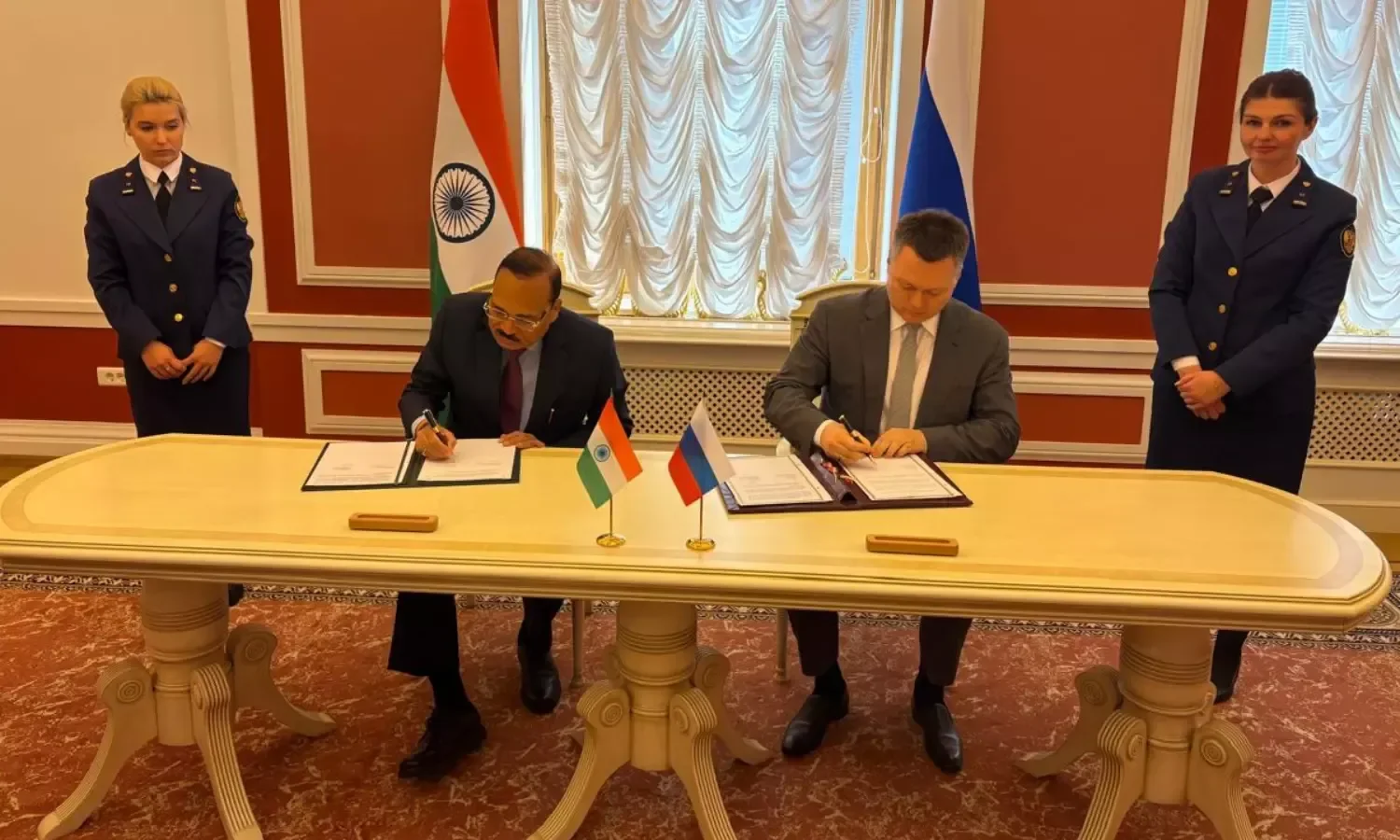
The apex courts of India and Russia have formalized a bilateral partnership to enhance judicial cooperation, addressing digital integration and public trust. Chief Justice of India Surya Kant and Russian Supreme Court Chief Justice Igor Krasnov signed the accord during an official visit to Moscow.
Key Highlights
- India and Russia signed a judicial Memorandum of Understanding in Moscow.
- The pact addresses digital transition challenges while preserving public trust.
- India highlighted its AI tools, SUVAS and Su Sahay, used for legal access.
- Draft regulations ensure human oversight remains paramount over technology.
The Supreme Court of India and the Supreme Court of the Russian Federation finalized a Memorandum of Understanding to establish structured bilateral judicial cooperation.
Chief Justice of India Surya Kant and Chief Justice of the Supreme Court of the Russian Federation Igor Krasnov signed the formal document during a bilateral meeting in Moscow.
Addressing the Supreme Court of the Russian Federation, Chief Justice Surya Kant observed that both judicial systems, despite operating under distinct legal histories, share identical challenges. He noted that both nations must sustain public trust in court systems while managing swift societal and technological transformations.
The Indian jurist maintained that digital infrastructure must function exclusively to broaden access to legal systems. He stressed that automated tools must never replace human adjudication, noting India’s digital initiatives aim for transparent, accessible, and efficient court systems.
Discussing automated intelligence within legal systems, Chief Justice Surya Kant explained that the Indian apex court created advanced software like SUVAS. This platform translates English judgments into 16 distinct regional languages, significantly improving accessibility for citizens nationwide.
He further noted the implementation of “Su Sahay,” a recently deployed digital assistant driven by artificial intelligence. This platform delivers immediate details regarding filing protocols, legal procedures, and ongoing case updates to citizens and legal professionals.
The Chief Justice highlighted the “One Case, One Data” platform, which establishes a uniform electronic history for individual lawsuits across separate court infrastructures. He added that automated platforms are also optimizing mediation and virtual arbitration, which lowers legal expenses and shortens resolution timelines.
However, Chief Justice Surya Kant explicitly maintained that administering justice requires human intellect at its core. He argued that automated platforms can manage transcription, document translation, case administration, and analysis, but cannot assess witness truthfulness, evaluate evidence, or deliver final verdicts.
He drew attention to the newly published framework governing automated systems in Indian courts. These guidelines ensure the secure deployment of advanced technology while preserving independent judicial choice and mandatory human verification.
Concluding his presentation, Chief Justice Surya Kant stated that international judiciaries face comparable hurdles concerning public trust, institutional readiness, and technical evolution. He advocated for expanded partnerships via joint educational initiatives, research ventures, and exchange visits between judicial academies.
The future of global legal administration relies on balancing technical modernization with fundamental human ethics, the Chief Justice stated. He expressed certainty that this alliance would meaningfully reinforce the judicial frameworks of both sovereign states.
Future Outlook
The execution of this bilateral agreement signals an era of structured legal diplomacy between New Delhi and Moscow. Moving forward, both apex courts are expected to launch joint working groups to synchronize digital transformation strategies. This framework will likely influence how developing jurisdictions integrate artificial intelligence without compromising fundamental human rights and judicial sovereignty.
FAQs
What is the primary objective of the India-Russia judicial MoU?
The agreement establishes a formal framework for cooperation between the apex courts of India and Russia. It focuses on sharing best practices, enhancing institutional readiness, and addressing the mutual challenges of technological transformation and public confidence in justice administration.
What digital tools did India showcase during the Moscow address?
India highlighted SUVAS, a software that translates English court rulings into 16 regional languages, and “Su Sahay,” an AI-driven chatbot providing case statuses and filing information. The “One Case, One Data” standard digital record initiative was also emphasized.
How does the Indian judiciary view the role of AI in courtrooms?
The judiciary views artificial intelligence strictly as a supportive administrative tool. Indian draft regulations dictate that AI can assist with translation, information management, and transcription, but cannot replace human discretion, evaluate evidence, or dictate final legal outcomes.