International Day of Yoga 2026 Achieves Global Scale
Millions of individuals worldwide united to celebrate the 12th International Day of Yoga 2026, establishing the ancient practice as a premier global movement for public health. Led by Prime Minister Narendra Modi, the massive demonstrations emphasized wellness and long-term vitality across multiple continents.
Key Highlights
- Over 3 crore individuals across 780 districts registered their participation on the official digital platform.
- The 2026 edition centered on the timely theme of “Yoga for Healthy Ageing” to boost senior wellness.
- Landmark demonstrations stretched from the high-altitude Siachen Glacier to naval ships stationed at sea.
- The Ministry of Ayush secured a new Guinness World Record for its digital broadcast viewership.
The 12th International Day of Yoga (IDY) 2026 generated historic engagement across India and international borders, cementing its status as an essential framework for holistic well-being. Under the guidance of Prime Minister Narendra Modi, massive public demonstrations materialized across the nation, including a central gathering of 35,000 citizens at the Red Road in Kolkata, West Bengal. This year’s specific theme, “Yoga for Healthy Ageing“, focused public attention on mental resilience, physical endurance, and systemic wellness, motivating global populations to permanently adopt the practice.
The Prime Minister expressed his appreciation to international communities for transforming IDY 2026 into an expansive global phenomenon. Organized sessions took place across major nations, including the United States, France, Germany, and Egypt. Mass assemblies extended from the United Nations Headquarters in New York to metropolitan hubs across Europe, West Asia, East Asia, and Africa, proving that the practice serves as a universal nexus for collective harmony.
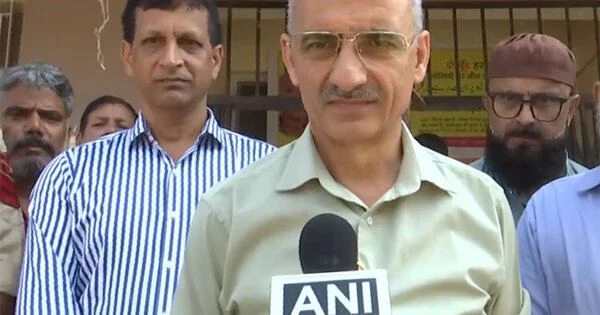
Union Minister of State for Ayush, Shri Prataprao Jadhav, commended the unified efforts of volunteers, citizens, and global wellness organizations in securing this massive success. He emphasized that the immense turnout under the “Yoga for Healthy Ageing” banner validated the practice as an effective tool for preventative health, urging the public to maintain daily practice routines.
Ministry of Ayush Secretary, Vaidya Rajesh Kotecha, lauded the public enthusiasm displayed throughout the 2026 celebrations. He stated that the widespread mobilization across domestic and international territories highlights the deep acceptance of these wellness traditions. Kotecha thanked the collective stakeholders and reiterated that prioritizing “Yoga for Healthy Ageing” will yield long-term public health benefits.
The domestic celebrations drew active participation from top-tier national leaders. President Droupadi Murmu spearheaded a mass assembly in Jabalpur, Madhya Pradesh, while Vice-President C. P. Radhakrishnan traveled to Leh, Ladakh, to join local sessions. Concurrently, Lok Sabha Speaker Om Birla led an administrative session for lawmakers at the Parliament House Complex.
A primary technical highlight of the 2026 itinerary was the expansive “Gangotri to Gangasagar” operational campaign, orchestrated by the Morarji Desai National Institute of Yoga and the National Ayush Mission. Spanning 2,525 kilometers along the historic river corridor, the campaign executed structured protocol sessions across Rishikesh, Haridwar, Prayagraj, Varanasi, Patna, and Hooghly. This strategic initiative successfully fused India’s river heritage with ancient health systems to deliver wellness education directly to riverside populations.
Prior to the primary mobilization at Red Road in Kolkata, West Bengal executed a dense schedule of promotional events designed to maximize public awareness. The “Daud Se Dhyan” initiative managed public marathons across 11 targeted urban locations in Kolkata. The regional programming also featured the “Vande Yogam” series along the Hooghly Riverfront, incorporating competitive art, photography, and cultural exhibitions. A technological display utilizing 3,000 synchronized drones tracked the historical timeline of the practice and paid tribute to historical masters.
The decentralized celebrations successfully reached iconic geographical and heritage markers across the domestic landscape. Organized sessions occurred at the Red Fort in Delhi, Har Ki Pauri in Uttarakhand, the Konark Sun Temple in Odisha, and the Hampi ruins in Karnataka. Additional assemblies converged at Leh Palace, the Mahabalipuram Shore Temple, Sarnath, Kachari Fort, the Charminar precincts, the Gateway of India, Nalanda Mahavihara, and the Sabarmati Riverfront.
Demonstrating the principles of public ownership, the centralized Yoga Sangam Portal, built via the Ayush Grid framework, authenticated the participation of 3.07 crore individuals spanning 36 States and Union Territories. Users uploaded more than 7.46 lakh event images to the repository, which systematically generated over 2.66 lakh official participation certificates.
The administrative platform processed formal registrations from more than 7.64 lakh distinct organizations globally. This pool included 4.24 lakh state entities, 2.46 lakh academic institutions, private corporations, and non-profit groups. West Bengal led institutional metrics with 3.45 lakh organizations, followed by Rajasthan with 1.67 lakh, Madhya Pradesh with 35,742, Assam with 25,285, and Uttar Pradesh with 22,285. The public digital billboard ingested an additional 15,000 citizen images.
The preparatory phase of IDY 2026 established several verified milestones recorded by international tracking agencies. A 75-day countdown gathering in Buldhana, stroke-centered in Maharashtra, featured 5,000 individuals executing the Trikonasana posture simultaneously, securing an entry in the Asia Book of Records. A subsequent 50-day countdown milestone at Kanha Shanti Vanam gathered 6,000 practitioners for a synchronized Bhujangasana performance, earning a secondary regional record. Additionally, on June 14, 2026, the Ministry of Ayush claimed a verified Guinness World Record by drawing 4,35,831 concurrent live viewers to its official YouTube broadcast.
The 2026 execution relied on a comprehensive inter-ministerial strategy, embedding components within the Ministry of Defence, Civil Aviation, Housing and Urban Affairs, Jal Shakti, and Social Justice. Contributions also originated from the CBI, Enforcement Directorate, CISF, National Mission for Clean Ganga, and the Inland Waterways Authority of India to scale public health education.
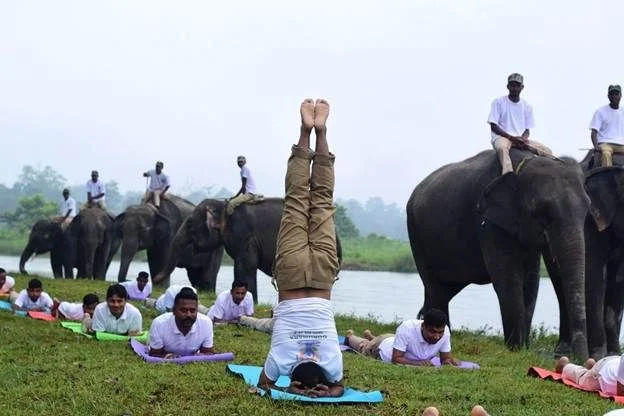
The Ministry of Jal Shakti and its partner water authorities held targeted sessions across the core Ganga basin and deployed specialized river vessels on National Waterway-2 along the Brahmaputra River in Assam. Concurrently, the Ministry of Social Justice managed the “Vayo Yoga Sangam – Yoga for Healthy Ageing” forum at Bharat Mandapam in New Delhi, hosting 1,300 senior citizens to emphasize active aging strategies.
The Ministry of Defence supervised vast deployments spanning from the high-altitude Siachen Glacier to Kanyakumari, the Rann of Kutch, and operational naval vessels out at sea. Defence Minister Rajnath Singh and top military commanders participated alongside thousands of active service personnel. Command-level events occurred across the Army, Navy, Air Force, and Coast Guard, with international defense attaches joining the domestic ranks.
The Indo-Tibetan Border Police organized its custom session at Pangong Tso in Ladakh, operating at an elevation of roughly 14,000 feet to underscore mental endurance and physical conditioning. Meanwhile, the National Cadet Corps deployed 8.30 lakh youth cadets and instructors across 5,000 separate domestic locations to anchor the youth movement.
The conclusion of the 2026 events represents a major step forward in the international expansion of Indian wellness systems. By aligning civil bodies, defense sectors, youth networks, and international partners, IDY 2026 validated the practice as an enduring tool for long-term health and structural aging management.
History of International Day of Yoga
The International Day of Yoga was officially established by the United Nations General Assembly in December 2014 following a proposal introduced by Prime Minister Narendra Modi. The inaugural global celebration occurred on June 21, 2015, drawing millions of practitioners worldwide. Over the past 12 years, the annual event has evolved from a localized cultural initiative into a institutionalized global public health campaign backed by the World Health Organization.
FAQs
What was the official theme for the International Day of Yoga 2026?
The official theme for the 2026 celebrations was Yoga for Healthy Ageing. This theme focused on utilizing regular practice to enhance physical health, cognitive resilience, and overall wellness among aging populations worldwide.
How many people registered on the Yoga Sangam Portal in 2026?
The official Yoga Sangam Portal validated and recorded the participation of more than 3.07 crore individual participants across 780 districts and 36 States and Union Territories in India.
What world records were broken during the IDY 2026 campaign?
The Ministry of Ayush secured a verified Guinness World Record on June 14, 2026, by securing 4,35,831 concurrent live viewers for its YouTube broadcast. Separate mass-participation milestones for synchronized postures were registered in the Asia Book of Records in Buldhana and Kanha Shanti Vanam.