India Mobile Micro Drama Market Booms As Brands Bypass Traditional TV Advertising
India’s traditional 30-second television commercial faces intense competition from vertical, mobile-native micro-dramas. This rapid format transition captured 100 million monthly active users within a single year, disrupting conventional corporate marketing and shifting digital advertising budgets toward hyper-local, episodic mobile content.
Key Highlights
- The Indian micro-drama sector reached a value of Rs 650 crore in 2025 with projected explosive growth ahead.
- Major consumer platforms are replacing standard discount promotions with self-produced episodic application entertainment.
- Regional markets drive the highest engagement, with 60% to 75% of viewers located in Tier-2 and Tier-3 towns.
- Frictionless digital transactions via UPI AutoPay serve as the primary financial foundation for content monetization.
The traditional half-century staple of Indian television advertising is losing ground to a fast-growing mobile rival. Serialized, vertical micro-dramas featuring two-to-three-minute episodes designed for smartphone binging have rapidly scaled into a $300 million business.
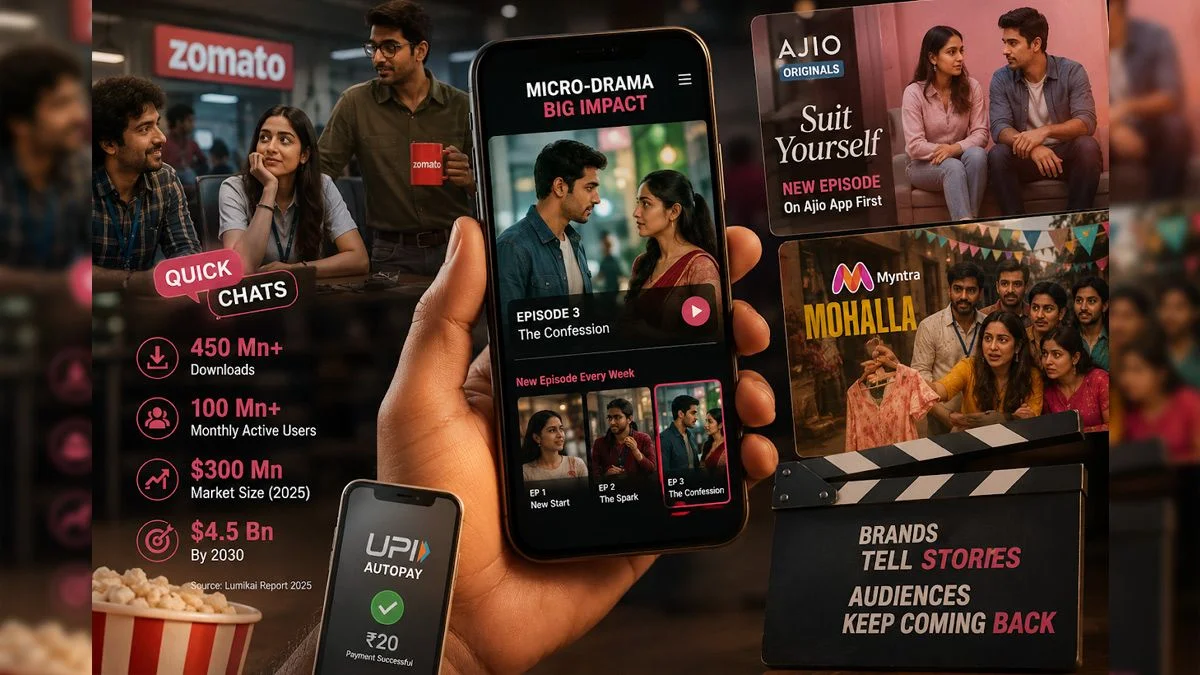
According to Lumikai’s State of India Interactive Media Report 2025, the format secured 450 million downloads and 100 million monthly active users. Industry projections indicate the market will expand to $4.5 billion by 2030, supported by a 91% growth rate expected in 2026 alone.
Three major consumer brands are leading this shifts. Zomato’s Quick Chats, a six-episode workplace mockumentary filmed in a deadpan style, substitutes corporate banter and food debates for promotional discount codes. The application functions as an organic solution to daily office challenges rather than a direct commercial pitch.
Ajio expanded further by establishing a dedicated production branch named Ajio Originals. Its inaugural romance series, Suit Yourself, features recognized actors navigating a relationship storyline during Valentine’s week. To generate a direct traffic funnel, new episodes stream on Ajio’s application hours before debuting on Instagram.
Myntra Mohalla targets regional audiences with an ensemble comedy set in a Tier-2 neighborhood preparing for a wedding. Characters resolve wardrobe dilemmas across traditional ceremonies using items from the platform’s catalog of over 15,000 brands, integrating the retail service directly into the plotline.
While metro areas generate initial buzz, smaller cities drive the highest engagement. The micro-drama sector reached Rs 650 crore in 2025 and will grow at a compound annual rate exceeding 50% through 2028, according to the FICCI-EY 2026 Media & Entertainment Report.
Significantly, Tier-2 and Tier-3 municipalities account for 60% to 75% of the user base. Regional languages serve as a primary commercial driver rather than a basic accessibility feature, as over half of the audience demands native language programming.
Streaming platforms note a substantial increase in consumer willingness to pay when scripts feature colloquial Tamil, Bhojpuri, or local Telugu instead of formal Hindi or English. Narrative themes also divide distinctly along regional preferences across the country.
In the Hindi belt, platforms like Hungama’s FastTV emphasize aspirational narratives focused on rapid wealth accumulation. These stories align directly with the socio-economic mobility desires observed in mid-sized urban centers such as Indore, Patna, and Lucknow.
Conversely, southern states favor accelerated versions of traditional television soap operas. Maran Group’s Kadhaishorts utilizes established family dynamics and household friction, compressing traditional 22-minute television episodes into vertical segments lasting 90 to 180 seconds.
Production formats match the structural conditions of regional consumer environments. Viewers frequently utilize mid-range Android smartphones priced between Rs 8,000 and Rs 15,000, watching during daily commutes or within shared households where text subtitles create reading fatigue.
Production companies prioritize full audio dubbing over on-screen text, utilizing low-cost artificial intelligence tools to translate successful scripts. This localization pipeline converts Hindi assets into synchronized Tamil and Telugu within 21 days, sustaining high monthly release schedules of 150 to 300 episodes.
Monetization relies on localized financial infrastructure via UPI AutoPay. Consumers hesitant to link credit cards to international platforms routinely authorize micro-payments ranging from Rs 20 to Rs 40 through local payment applications to unlock narrative cliffhangers.
This digital transaction trend attracted major entertainment conglomerates. JioStar and Balaji Telefilms are utilizing applications like Kutingg to integrate regional short-form series into broader subscription services, leveraging episodic vertical fiction to capture long-tail consumer demographics.
The underlying operational economics favor corporate marketing departments. Standard high-budget television commercials command production costs between Rs 50 lakh and Rs 2 crore per asset, whereas multi-episode vertical programs require short three-day filming schedules on optimized mobile rigs.
Structurally, these short series integrate commercial products directly into character motivations and plot resolutions, discouraging consumers from skipping media. This targeted formatting improves audience retention and increases organic traffic to brand handles, lowering acquisition expenses.
Technological advancements continue to reshape production systems. A collaborative initiative between Vertigo Global Media and ad-tech firm ADMOTT, supported by the ministry of information and broadcasting WAVES program, introduced real-time virtual product integration for short-form streaming content.
This technology allows corporate brands to insert items into recorded entertainment assets after initial filming and distribution are finalized. The longevity of this marketing mechanism depends heavily on maintaining rigorous script quality.
An over-saturation of forced corporate narratives risks creating swift viewer fatigue. However, the breakdown of structural barriers between consumer brands and entertainment networks marks a durable shift within the competitive domestic mobile-first attention economy.
Future Outlook
The trajectory of the short-form episodic market points toward deeper consolidation and technological integration by 2030. As major media networks bundle independent vertical platforms into comprehensive digital packages, programming budgets will likely mirror traditional television allocations.
Furthermore, the expansion of automated AI localization will allow simultaneous multi-language launches across diverse linguistic zones instantly, cementing micro-payment systems as a primary monetization blueprint for digital entertainment across regional hubs.
FAQs
What is the projected market size of the Indian micro-drama industry?
The Indian micro-drama sector is projected to reach a valuation of $4.5 billion by 2030, expanding from a base value of Rs 650 crore recorded in 2025.
Which demographic segment drives the highest viewership for vertical short-form series?
Tier-2 and Tier-3 towns drive the primary volume of the market, contributing between 60% and 75% of the total viewer base.
How do mobile short-form platforms monetize their content in smaller cities?
Platforms rely on low-cost micro-payments ranging from Rs 20 to Rs 40 managed seamlessly through trusted regional UPI AutoPay transaction channels.


