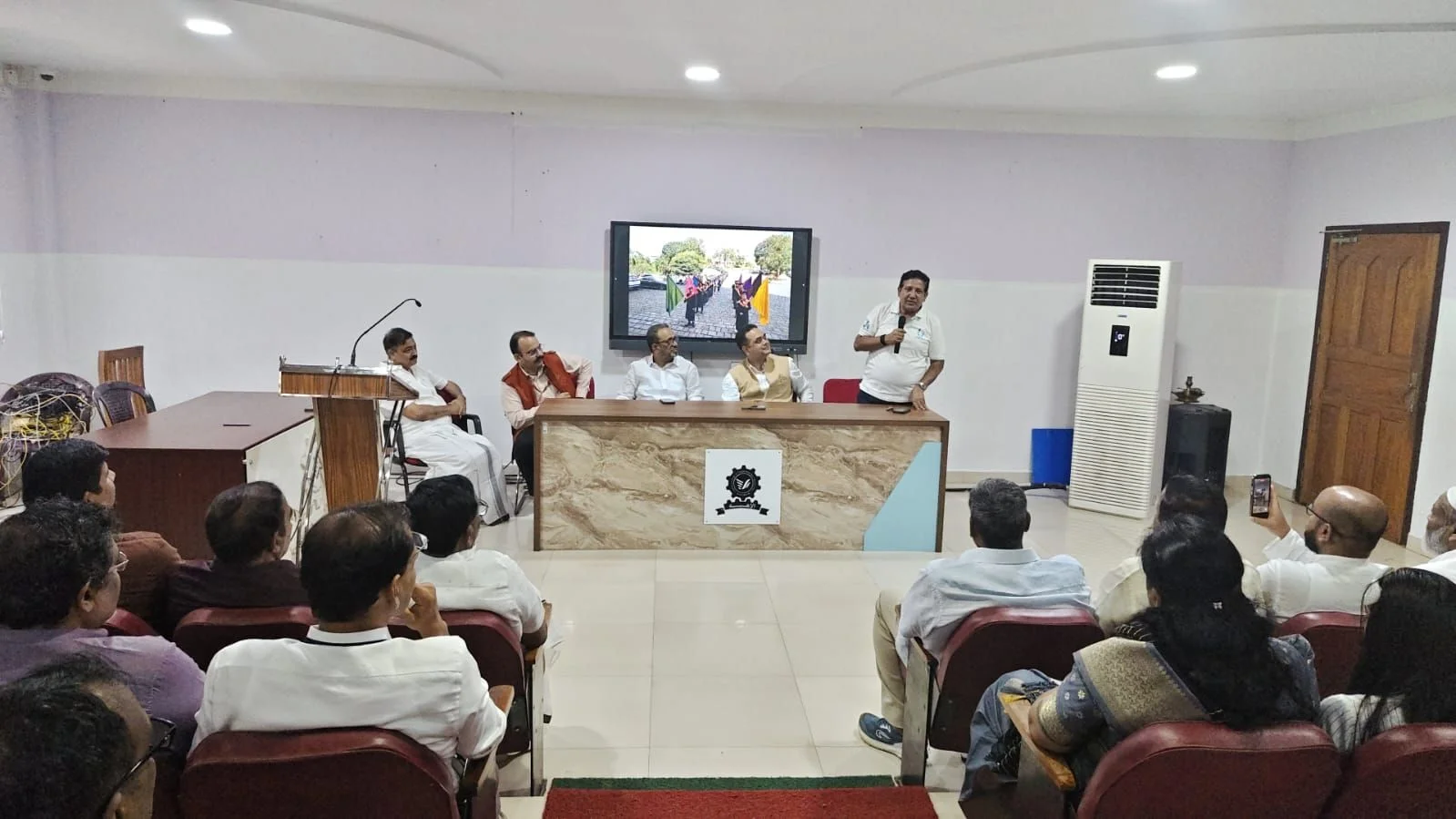
NCMEI Delegation Explores Educational Advancement at Kerala’s Ilahia Trust
A prominent academic delegation led by the National Commission for Minority Educational Institutions evaluated institutional growth during a high-level summit at Kerala’s Ilahia College of Engineering and Technology on June 28, 2026. The leadership conference mapped out strategic modernization initiatives to prepare minority institutions for global competitive challenges.
Key Highlights
- The NCMEI Chairman urged minority institutions to embed artificial intelligence, digital framework architectures, and multi-disciplinary systems into core curricula.
- Institutional specialists identified Ilahia Trust as a strong candidate to pursue official Deemed-to-be University status through structural and governance enhancements.
- Academic leaders synchronized institutional progress goals directly with federal development agendas, including Digital India, Skill India, and Viksit Bharat 2047.
A high-level assembly led by Prof. Dr. Shahid Akhtar, who serves as the Officiating Chairman of the National Commission for Minority Educational Institutions (NCMEI) and National Convener of the Muslim Rashtriya Manch (MRM), executed a critical educational leadership interaction on June 28, 2026.
The strategic session involved K. M. Pareeth, Chairman of the Ilahia Trust, along with members of the organization’s Management Board. The stakeholders convened within the Seminar Hall at the Ilahia College of Engineering and Technology, located in Mulavoor, Kerala.
The academic assembly was presided over by K. M. Pareeth. Adv. T. S. Rasheed, serving as the Vice Chairman of the Ilahia Trust, initiated the proceedings by delivering the welcoming address to the assembled dignitaries and conference participants.
Education is the Strongest Instrument of Nation Building: Prof. Dr. Shahid Akhtar
Delivering the principal keynote address, Prof. Dr. Shahid Akhtar stated that minority educational institutions operate as crucial elements within the broader framework of national development rather than serving merely as academic facilities.
He maintained that modern educational centers must rapidly incorporate cutting-edge instructional methodologies, advanced automation, artificial intelligence, research-driven systems, and industrial innovation to equip students effectively for international employment opportunities and emerging structural transformations.
The Officiating Chairman emphasized that the National Education Policy (NEP) 2020 establishes a comprehensive blueprint to elevate the domestic scholastic framework. This model prioritizes cross-disciplinary studies, systematic investigation, vocational expertise, technical creativity, and superior institutional standards.
Evoking the core philosophical tenant of “Ek Qaum, Ek Watan – Hindustan,” Prof. Akhtar clarified that the phrase represents an active pledge toward collective civic responsibility, constitutional governance, mutual tolerance, social cohesion, and continental integration. He challenged academies to develop competent specialists who function simultaneously as ethical citizens dedicated to state progress.
Ilahia Trust Has Strong Potential to Become a Deemed-to-be University: Col. Tahir Mustafa
Col. Tahir Mustafa, the Registrar of Jamia Hamdard and National In-charge of the Intellectual & Public Relations Wing of the Muslim Rashtriya Manch, analyzed the shifting paradigms of advanced schooling while detailing institutional growth vectors via the federal Deemed-to-be University structure.
The registrar pointed out that the collective network of academic divisions supervised by the Ilahia Trust maintains the structural integrity and pedagogical base required to secure an independent university status. He noted that upgrading instructional quality, scientific research, innovative development, and administrative governance remains vital.
Col. Mustafa linked advanced scholastic development directly with flagship federal campaigns, focusing on Digital India, Startup India, Skill India, Atmanirbhar Bharat, and Viksit Bharat 2047. He stated that modern campuses must cultivate pioneering market visionaries, corporate builders, and responsible managers to generate employment.
Teaching Methodologies Must Evolve with Changing Times: Prof. Bahul Islam
Addressing the assembled academic board, Prof. Bahul Islam, who operates as the Director of IMT Hyderabad, stressed the critical requirement to alter contemporary instructional models in response to rapid global technical updates and heightened institutional competition.
The director supported the systemic integration of experiential learning, target-driven outcomes, scientific inquiry, cross-border academic alliances, corporate-university syndicates, and continuous professional upskilling programs for active faculty members.
He remarked that modern classroom technology must serve to optimize student learning results. He noted that technical systems should properly complement human instructors while actively preserving ethical leadership frameworks, core human values, and objective critical reasoning capabilities among the student body.
Meaningful Deliberations on Educational Excellence and National Development
The bilateral administrative interaction generated extensive debate regarding the optimization of advanced collegiate instruction, the reinforcement of local corporate governance, and the expansion of scientific investigation.
Delegates focused on accelerating digital absorption methods, maximizing localized vocational training systems, expanding corporate alliances, and positioning the student body to capture evolving international employment options.
The panel reached a consensus detailing how minority academic centers carry an essential obligation to build the domestic data economy, preserve community equilibrium, and drive regional economic development through advanced education and industrial breakthrough strategies.
Vote of Thanks
The administrative conference concluded following an official expression of gratitude delivered by Er. P. H. Muneer, the Chairman of the Ilahia College of Engineering and Technology.
The institutional chairman extended formal appreciation to the guest speakers, administrative delegates, and localized participants for providing critical strategic feedback. He noted that the joint conclusions would serve as an analytical template for the campus’s future educational growth targets.
Distinguished Participants
The leadership summit drew a wide array of academic stakeholders, including Samad Mudavana, Co-Convener of MRM Kerala; M. M. Muhammed Kunj, Treasurer of the Ilahia Trust; and M. K. Sayed Muhammed, Secretary of the Ilahia Trust.
Additional high-profile attendees included V. U. Sidhick, Manager of the Ilahia College of Engineering; K. Y. Sadic Muhammed, Chairman of the Ilahia Law College; and V. K. Abdul Salam, Manager of the Ilahia Public School, alongside university administrative leads, professors, and student representatives.
Conference Message
The central directive of the event emphasized that quality education, industrial creativity, institutional ethics, community integration, and sovereign cohesion constitute the primary requirements to achieve the federal Viksit Bharat 2047 developmental threshold.
The delegation concluded that under the unifying guidance of ‘Ek Qaum, Ek Watan – Hindustan,’ domestic collegiate facilities must remain dedicated to graduating ethical professionals, industrial creators, and strategic leaders focused on driving systematic national progress.
Future Outlook
The strategic interaction between the NCMEI leadership and the Ilahia Trust signals an accelerating push toward institutional consolidation among India’s minority education providers. By shifting focus toward the Deemed-to-be University framework, institutions are moving away from isolated technical training toward comprehensive, multi-disciplinary ecosystems. This transformation directly mirrors the structural consolidation goals outlined in the national modernization policies targeting full implementation by the mid-2030s.
FAQs
What was the primary objective of the NCMEI delegation’s visit to the Ilahia Trust?
The high-level interaction aimed to evaluate the institutional potential of the Ilahia Trust network, review modernization goals under NEP 2020, and discuss the long-term roadmap for upgrading the cluster of institutions into a Deemed-to-be University.
Who led the educational leadership interaction in Kerala?
The delegation was led by Prof. Dr. Shahid Akhtar, the Officiating Chairman of the National Commission for Minority Educational Institutions and National Convener of the Muslim Rashtriya Manch, alongside Col. Tahir Mustafa, the Registrar of Jamia Hamdard.
How does the National Education Policy 2020 impact minority institutions according to the summit?
The policy serves as a structural framework to transition traditional colleges into multi-disciplinary hubs that emphasize data science, artificial intelligence, independent research, vocational skill acquisition, and international academic partnerships.