Indian Ambassador Meets Language Students in Beijing
Indian Ambassador to China Vikram K. Doraiswami evaluated the academic progress of Chinese students acquiring proficiency in multiple Indian languages during a visit to Beijing Foreign Studies University on June 6, 2026. The diplomatic engagement emphasized the expanding role of linguistic education in strengthening bilateral connections.
Key Highlights
- Indian Ambassador Vikram K. Doraiswami reviewed language programs at Beijing Foreign Studies University on June 6, 2026.
- Students demonstrated academic proficiency in major languages, including Hindi, Tamil, Bengali, and Sanskrit.
- The diplomatic visit included a bilateral meeting with University President Jia Wenjian to discuss expanded linguistic instruction.
- Ambassador Doraiswami delivered a specialized lecture focusing on over two millennia of historical and cultural exchanges.
Indian Ambassador to China Vikram K. Doraiswami engaged with academic cohorts at Beijing Foreign Studies University on Saturday. The diplomat reviewed student achievements in mastering several critical Indian languages, including Tamil, Hindi, Bengali, and Sanskrit.
During a corporate meeting with University President Jia Wenjian, the ambassador received comprehensive briefings on institutional instruction for Pali, Punjabi, and Urdu. President Jia outlined the university’s expansive educational framework, which manages instruction across more than 100 international languages.
The Indian Embassy in Beijing confirmed the diplomatic exchange through an official statement published on X. The diplomatic mission verified that Ambassador Doraiswami observed language proficiencies and held structural talks regarding the university’s broad academic capabilities.
The ambassador delivered an academic address titled “Bridging Civilisations through Language and Learning.” His remarks emphasized that linguistic studies, societal evaluation, and intellectual discourse have anchored India-China interactions for over 2,000 years.
Tracing historical contacts from the Mauryan epoch to contemporary times, the diplomat detailed how bilateral exchanges enriched both ancient civilizations. These interactions facilitated the systemic transfer of philosophical concepts, artistic frameworks, technologies, and societal innovations.
He noted that historical communication consistently yielded mutual advantages. The ambassador stated that such academic connections remain essential as both modern states experience parallel economic, technological, and social transitions.
The presentation analyzed contemporary developmental shifts occurring across India. The embassy noted that the address emphasized an immediate requirement for advanced scholastic partnerships and direct community exchanges to comprehend current regional realities.
The academic session concluded with an interactive question-and-answer segment. The university students queried the ambassador on diverse geopolitical and cultural subjects.
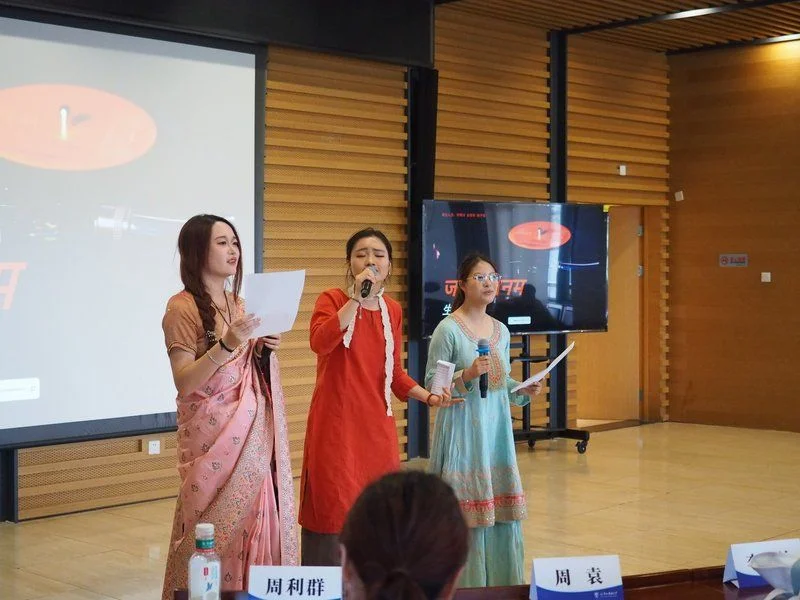
The Indian Embassy shared digital media from the event on X, showcasing various student cultural displays. The embassy noted that the youth group demonstrated advanced communication capabilities through structured regional presentations.
History of India-China Academic Exchanges
Bilateral educational and linguistic interactions between India and China date back to antiquity, driven initially by the transmission of Buddhism along trade routes. Scholars like Xuanzang and Faxian traveled between the nations to translate texts, establishing a precedent for cross-border learning. In the modern era, specialized institutions like Beijing Foreign Studies University have formalized these ancient ties by creating dedicated departments for Indian languages to support trade, diplomacy, and academic research.
FAQs
What languages do Chinese students learn at Beijing Foreign Studies University?
Students at the university study multiple Indian languages, including Hindi, Tamil, Bengali, Sanskrit, Punjabi, Urdu, and the classical language Pali. The institution provides comprehensive instruction across more than 100 international languages.
Who is the current Indian Ambassador to China?
Vikram K. Doraiswami serves as the Indian Ambassador to China and participated in the academic review in Beijing on June 6, 2026.
Why is language learning important for India-China relations?
Linguistic proficiency serves as an essential tool for cultural diplomacy, allowing both nations to improve economic, technological, and social cooperation while sustaining a dialogue that has existed for more than two millennia.