Japan India Summit 2026 Direct Investment Defence Deal
Japanese Prime Minister Sanae Takaichi and Indian Prime Minister Narendra Modi concluded a landmark summit in New Delhi, unlocking billions in capital and pioneering strategic defence pacts. The leaders solidified an expansive economic security roadmap to reshape supply chains, technology sharing, and maritime stability across the Indo-Pacific.
Key Highlights
- Japan and India finalized 129 MoUs and over 100 business agreements, yielding $12.5 billion in immediate fresh investments.
- The nations launched their first-ever joint military hardware project to co-develop a specialized Naval Radio Antenna.
- A new Economic Security Roadmap was adopted to secure supply chain resilience in semiconductors, quantum computing, and advanced materials.
- The India-Japan Bio-gas Initiative will fund the construction of 1,000 sustainable biogas and organic fertilizer plants.
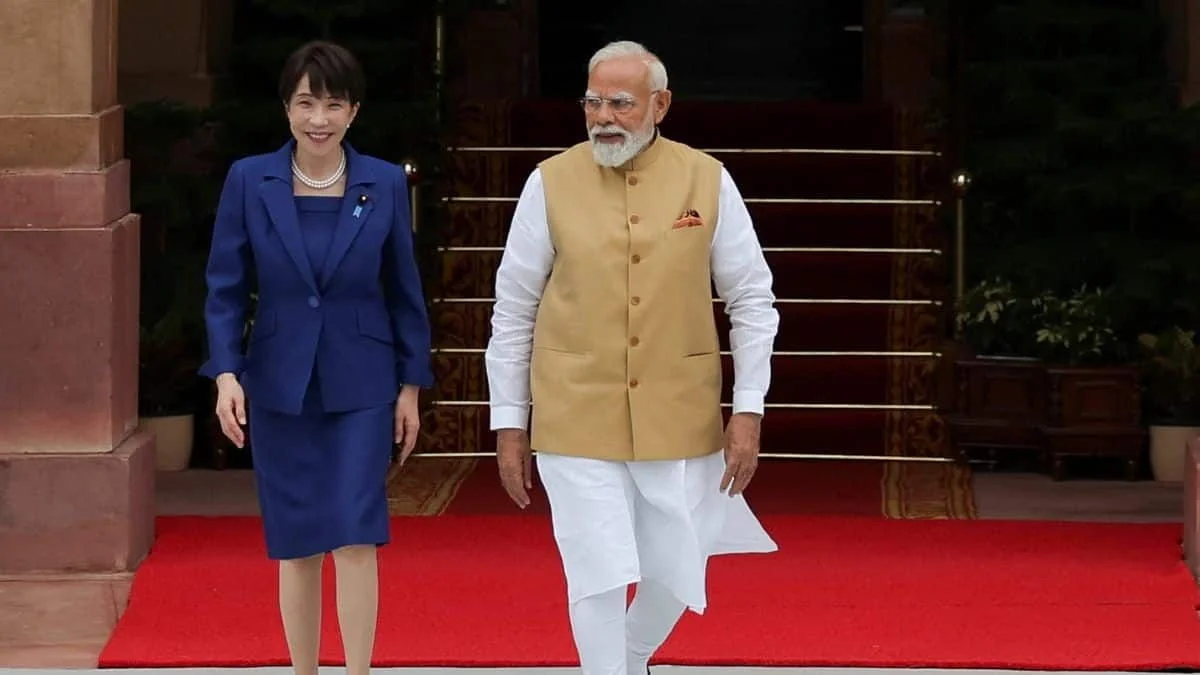
Japanese Prime Minister Sanae Takaichi’s first official visit to India since assuming office witnessed the 16th India-Japan Annual Summit.
The summit took place at a time when governments across the world are reassessing their priorities as supply chains continue to face disruptions.
For both New Delhi and Tokyo, these developments have reinforced the importance of building resilient partnerships while expanding cooperation in emerging technologies and strategic industries.
Against this backdrop, Prime Minister Narendra Modi and his Japanese counterpart used the summit to announce several new initiatives.
Takaichi arrived in New Delhi on the evening of July 1 and was received by Minister of State Jitendra Singh, while the Ministry of External Affairs described the visit as another important step in strengthening the India-Japan Special Strategic and Global Partnership.
New Delhi aims to draw 10 trillion yen in Japanese capital over the coming decade. Prime Minister Narendra Modi confirmed that this push intends to double the operational footprint of Japanese corporations within Indian borders.
More than 100 corporate pacts finalized over the past year are projected to inject upwards of $10 billion into the domestic economy. Fresh regulatory alignments between respective financial services authorities will streamline cross-border capital velocity and elevate local ease-of-doing-business parameters.
Cutting-edge tech integration served as a centerpiece for the diplomatic assembly. The leadership issued an extensive joint mandate detailing artificial intelligence collaboration, pairing Japanese high-precision manufacturing with India’s robust software development ecosystem.
Cooperation in defence
Monolithic strides were registered in sovereign security via a formal manufacturing covenant. The allies authorized their premier military co-development venture centered on a specialized Naval Radio Antenna.
Modi affirmed that the joint engineering of advanced defense systems would directly fortify maritime surveillance, reinforce regional stability, and preserve a rules-based maritime order throughout local waters.
Furthermore, a comprehensive Joint Roadmap on Economic Security was signed to insulate critical supply networks. The bilateral framework mandates synchronized development across semiconductors, quantum information systems, and next-generation metallurgy.
Investments in energy
Ecological infrastructure received an immediate boost via the freshly minted India-Japan Bio-gas Initiative. The environmental framework guarantees Japanese backing to deploy 1,000 decentralized biogas and organic fertilizer facilities across rural zones.
The infrastructure project aligns directly with New Delhi’s overarching GOBARdhan asset-generation program. The strategy aims to elevate agricultural yields, reinforce rural financial autonomy, and provide sustainable local livelihoods.
Complementary agreements expanded green technology development into solid-state batteries, green hydrogen production, and civil nuclear power systems. Additionally, the new India-Japan Next Generation Mobility Partnership Framework will extend industrial coordination into commercial shipbuilding, aerospace engineering, and multi-modal logistics networks.
Bilateral administrative channels will simultaneously enhance high-skilled talent mobility, vocational training initiatives, technical internships, and collaborative startup incubation. The partner nations will mark their 75th anniversary of formal diplomatic engagement in 2027 through wide-ranging cultural and creative economy exchanges.
Modi stressed that complementary economic structures, shared democratic principles, and deep mutual trust will propel India toward its long-term development targets while stabilizing the broader region.
India-Japan trade
Total bilateral trade between the two Asian economies reached $27.5 billion during fiscal year 2026. Official data tracks direct Japanese capital inflows at $3.2 billion between April and December 2025.
Tokyo remains an essential institutional financier for India’s megaprojects, notably anchoring the high-speed rail network linking Mumbai and Ahmedabad. Recent private equity movements also highlight this trend, featuring a massive $1.6 billion acquisition for a 20% equity stake in Yes Bank.
Strategic analysts noted a paradigm shift in Tokyo’s financial commitments, transitioning from risk-mitigated infrastructure loans to direct corporate investments in semiconductors, electronics, and critical minerals. This economic realignment is further strengthened by a new yen-rupee trade settlement mechanism designed to neutralize global macroeconomic shocks.
| Investor / Partner Companies | Project Type / Sector | Investment Value (INR) |
|---|---|---|
| MUFG / Shriram Finance | Financial Services Partnership | Rs 400 billion |
| Itochu Corporation / L&T | Green Ammonia Plant (300,000 tons) | Rs 189 billion |
| SMBC / Yes Bank | Banking Equity Acquisition | Rs 170 billion |
| Sumitomo Corp / Renewable Partner | Clean Energy Infrastructure | Rs 100 billion |
| Suzuki | Automotive Land Acquisition | Rs 50 billion |
| Sumitomo Corp | Comprehensive Industrial Collaboration | Rs 38 billion |
| Daikin | Research & Development Facility | Rs 10 billion |
Future Outlook
The 16th Annual Summit signals a structural evolution from a purely mercantile relationship into an integrated geopolitical alliance. Over the next decade, the focus will pivot toward executing the 10 trillion yen investment target and deploying joint military assets. As global supply corridors face persistent geopolitical pressures, the formalized Economic Security Roadmap will likely accelerate the relocation of critical semiconductor packaging and advanced technology manufacturing hubs from East Asia directly into industrial corridors across India.
FAQs
What is the total investment value announced during the India-Japan Summit?
The summit delivered approximately $12.5 billion in fresh investments, driven by 129 MoUs and over 100 newly signed business agreements targeting technology, clean energy, and manufacturing sectors.
What is the India-Japan Bio-gas Initiative?
It is a joint sustainable energy project where Japan will assist India in setting up 1,000 biogas and organic fertilizer plants. This initiative supports India’s GOBARdhan scheme to advance rural prosperity and environmental sustainability.
What defense project did India and Japan agree to co-develop?
The two nations signed a milestone defense agreement to co-develop a Naval Radio Antenna. This marks their first-ever joint military hardware development project aimed at boosting maritime security.
How much investment does India target from Japan over the next decade?
India aims to attract 10 trillion yen in Japanese investments over the next 10 years while doubling the total number of Japanese corporations operating within the country.