India Trade Strategy Beyond Bilateral Free Trade Agreements
New Delhi’s aggressive push for bilateral trade pacts will only succeed if it triggers deep domestic structural reforms. Relying on isolated market access cannot replace global integration, as real economic expansion requires enhanced industrial efficiency and participation in dense regional manufacturing networks.
Key Highlights
- Bilateral agreements signed since 2022 fail to embed India into major Asian manufacturing networks.
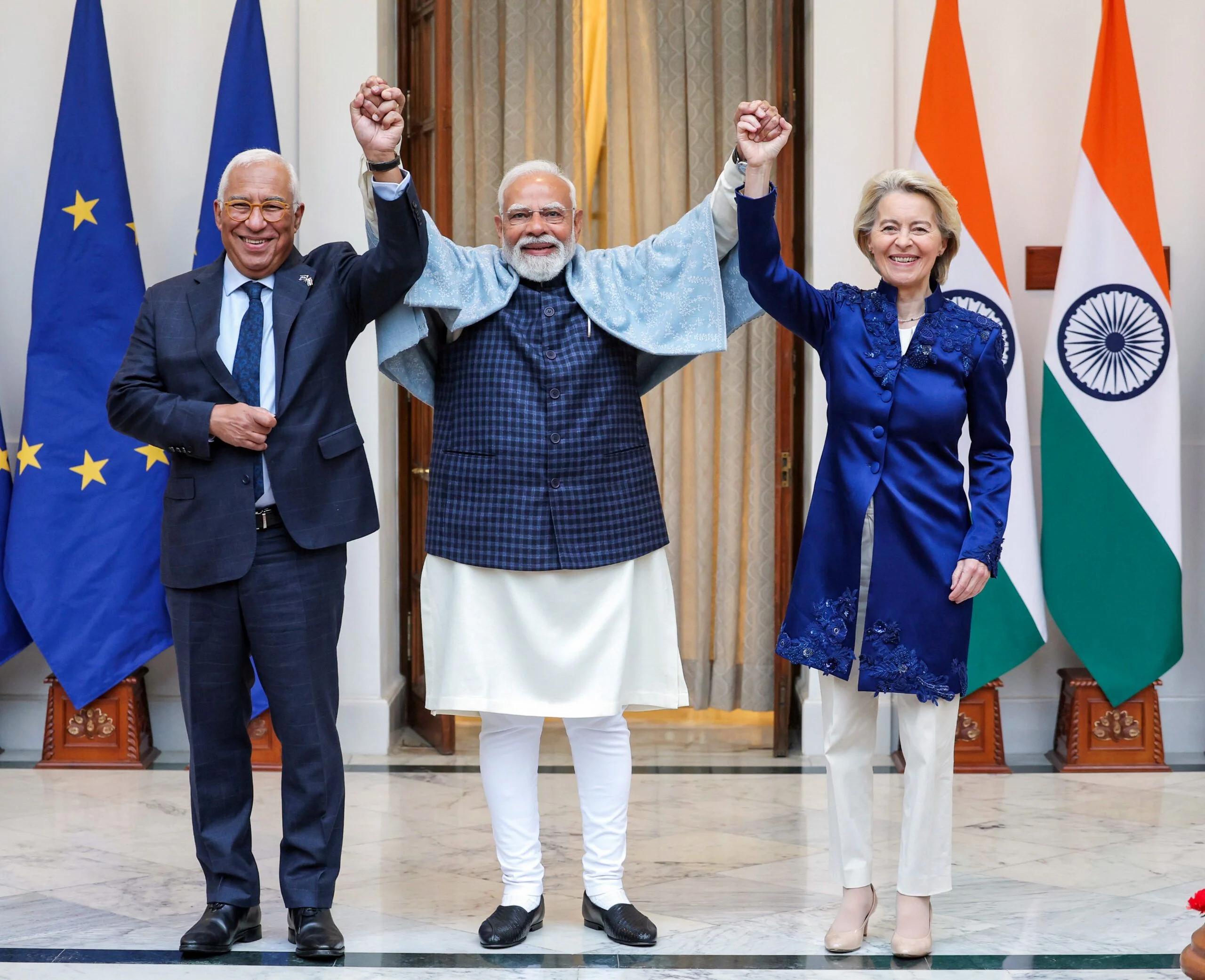
- The landmark India-EU FTA is slated for signature by December 2026, taking effect by early 2027.
- Bilateral rules of origin penalize Indian firms using cost-effective regional components.
- Deep domestic reforms in land, labor, and agriculture are essential to boost manufacturing competitiveness.
India’s wave of bilateral free trade agreements (FTAs) since 2022 — with the United Arab Emirates, Australia, the European Free Trade Association, the United Kingdom, Oman, the European Union and New Zealand — has been read by some as evidence of a turning point in India’s trade policy. But the test will be whether they raise India’s productivity, growth and living standards by entrenching reforms and openness.
Trade agreements should be understood as instruments of trade growth, not policy ends in themselves. Their effectiveness depends on underlying economic capacities and domestic competitiveness — market access alone does not translate into higher exports unless firms are efficient enough to make use of it.
For India, trade agreements can promote manufacturing competitiveness by creating external pressure for, and locking in, difficult domestic reforms. They can also help integrate Indian firms into global value chains, which are highly developed in Asia.
The liberalising content of India’s bilateral agreements has been shallow, with sensitive sectors carved out and long tariff phase-ins. The India–EU FTA, India’s most ambitious agreement, has rightly been characterised as ‘Swiss cheese’. Only 49.6% of Indian tariff lines moved to duty-free on entry — with a further 39.5% to be eliminated over 5–10 years — compared to the European Union’s 70.4%, with an additional 20.3% of tariff lines phased out over 3–5 years. Indian agriculture was excluded entirely, investment protection and geographical indications were deferred to separate negotiations and the services chapters are non-binding.
India’s FTAs focus on selective engagement with economies that are ‘non-competing’ — in the words of External Affairs Minister Subrahmanyam Jaishankar — and do little to bring India closer to regional value chains. The agreements deliver modest market access to wealthier consumer markets while bypassing the production networks into which India’s regional economic peers have been integrating.
Indeed, the bilateral nature of the agreements reinforces this exclusion from regional value chains. Bilateral rules of origin require originating content from India or the bilateral partner, so Indian producers using cheaper regional intermediate parts and components lose preferential access in the markets the FTAs have opened. Network product exports account for approximately 10% of India’s total exports compared to around 50% for China, Japan, South Korea, Malaysia and Vietnam. These countries built their market share under global arrangements or within broader regional agreements, pooling inputs across the regional value chain.
India has chosen to remain outside the broader regional architecture, having withdrawn from Regional Comprehensive Economic Partnership (RCEP) negotiations in 2019 over concerns that RCEP would expose Indian industry to Chinese competition. The Comprehensive and Progressive Agreement for Trans-Pacific Partnership (CPTPP), whose standards are higher than those of RCEP, is even more distant from India’s trade and regulatory settings.
India’s $112 billion trade deficit with China continues to weigh heavily on the minds of Indian policymakers. But while concerns about Chinese trade surges may be partly warranted, deeper protectionism is unlikely to address that challenge. Indian industry already depends on Chinese inputs, with China supplying 43% of India’s electronics imports, 40% of machinery and computer imports and 44% of organic chemicals. Raising tariffs on Chinese imports shelters domestic producers but also raises input costs for Indian exporters who have to compete with Chinese exports in foreign markets regardless.
Other countries have navigated the pressure of Chinese competition through deeper regional engagement. Despite its $65 billion trade deficit with China, Vietnam’s exports rose 18% year-on-year in May 2026 with its manufacturers importing Chinese inputs and adding domestic value for export. Vietnam’s status as a major exporter is driven by integration with China in regional value chains, not avoidance.
Regional engagement facilitates reform by generating external pressure for domestic policy action. RCEP’s services and investment chapters use negative-list scheduling that commits members to liberalisation by default. CPTPP extends that approach further, with binding disciplines on labour, intellectual property, state-owned enterprises and the environment. Many countries have used these regional agreements to advance domestic reforms — Vietnam’s CPTPP commitments helped enable its new Labour Code in 2021 and Intellectual Property Law in 2022 that had been stalling domestically.
India too must undertake difficult but important reforms in land, labour and agriculture if it is to promote manufacturing competitiveness and trade growth. Domestic interests have historically blocked attempts to take on these reforms, and the lobbies that opposed RCEP in 2019 will likely resist again. But India has demonstrated a capacity to push through politically difficult reforms when circumstances have demanded, as it did with the 1991 program of liberalisation.
US President Donald Trump’s use of tariffs as economic leverage has created turbulence in global markets, underlining the importance of rules, predictability and certainty in international trade. His targeting of India with the 2025 ‘Liberation Day’ tariffs showed that New Delhi must take greater agency in defending its interest in reliable access to external markets. Regional agreements in Asia can bring India into the world’s fastest-growing value chains and provide an avenue to pursue exports amid uncertainty elsewhere.
Bilateral agreements will not deliver trade growth on their own. They leave India outside Asian manufacturing networks and without the binding reform commitments that regional integration helps cement. Without commitment to global opening and broader regional engagement, such as through RCEP and CPTPP, India’s bilateral trade strategy is hardly likely to shift the dial on productivity growth and living standards.
Future Outlook
Commerce and Industry Minister Piyush Goyal announced on June 22, 2026, that India and the European Union intend to finalize their milestone FTA by December 2026, with enforcement projected for February or March 2027. This deal promises duty-free access for 93% of Indian exports, scaling up to 99.5% of total export value over time, while granting Europe lower tariffs on luxury automobiles and wine. New Delhi will also open 102 service subsectors compared to the EU’s 144. While this pact represents a notable diplomatic achievement, its long-term transformative impact hinges on whether India uses this momentum to transition toward broader multi-country architecture.
FAQs
Why are bilateral trade agreements considered insufficient for India’s long-term growth?
Bilateral agreements restrict access to integrated regional production networks due to strict rules of origin. These terms prevent Indian manufacturers from sourcing cheaper components across Asia without forfeiting preferential tariff benefits, keeping India isolated from major supply chains.
When is the India-EU Free Trade Agreement expected to take effect?
The India-EU FTA is on track to be signed by December 2026 and is anticipated to enter into full force between February and March 2027.
Which Indian export sectors stand to gain the most from the upcoming EU trade deal?
Labor-intensive industries such as textiles, garments, engineering goods, gems, jewelry, and pharmaceuticals are poised for a significant competitive boost due to the removal of European import tariffs that currently range between 4% and 12%.
Why did India withdraw from the Regional Comprehensive Economic Partnership?
India walked away from RCEP negotiations in 2019 due to deep anxieties that joining the massive trade bloc would flood the domestic market with cheap Chinese manufactured goods, exacerbating an already massive bilateral trade deficit.