India De Licenses 5.9 GHz Spectrum For Connected Vehicles
The Department of Telecommunications waived licensing rules for the 5875–5905 MHz wireless band to deploy Cellular Vehicle-to-Everything systems immediately. Experts state this regulatory shift will eliminate up to 80% of preventable traffic accidents, potentially saving tens of thousands of Indian lives each year.
Key Highlights
- India completely de-licenses the 5.9 GHz radio frequency band to accelerate cellular automotive communication technologies nationwide.
- The twin-pillar policy framework includes short-range radar systems operating across the 77–81 GHz spectrum band.
- Advanced vehicle network warnings communicate hazards in under 10 milliseconds, dramatically outpacing average human reaction times.
- The strategic deployment framework targets nationwide commercial fleets, critical highway blackspots, and regional toll plazas.
The Department of Telecommunications issued Gazette Notification G.S.R. 466(E) on June 10, 2026, exempting Cellular Vehicle-to-Everything (C-V2X) hardware from traditional spectrum licensing. This immediate policy shift under historic telegraphy laws removes major deployment hurdles for intelligent transport networks.
Concurrently, the government published G.S.R. 468(E) to open the 77–81 GHz band for short-range automotive radar systems. Together, these two notifications establish the long-awaited regulatory foundation required to scale up India’s connected vehicle ecosystem.
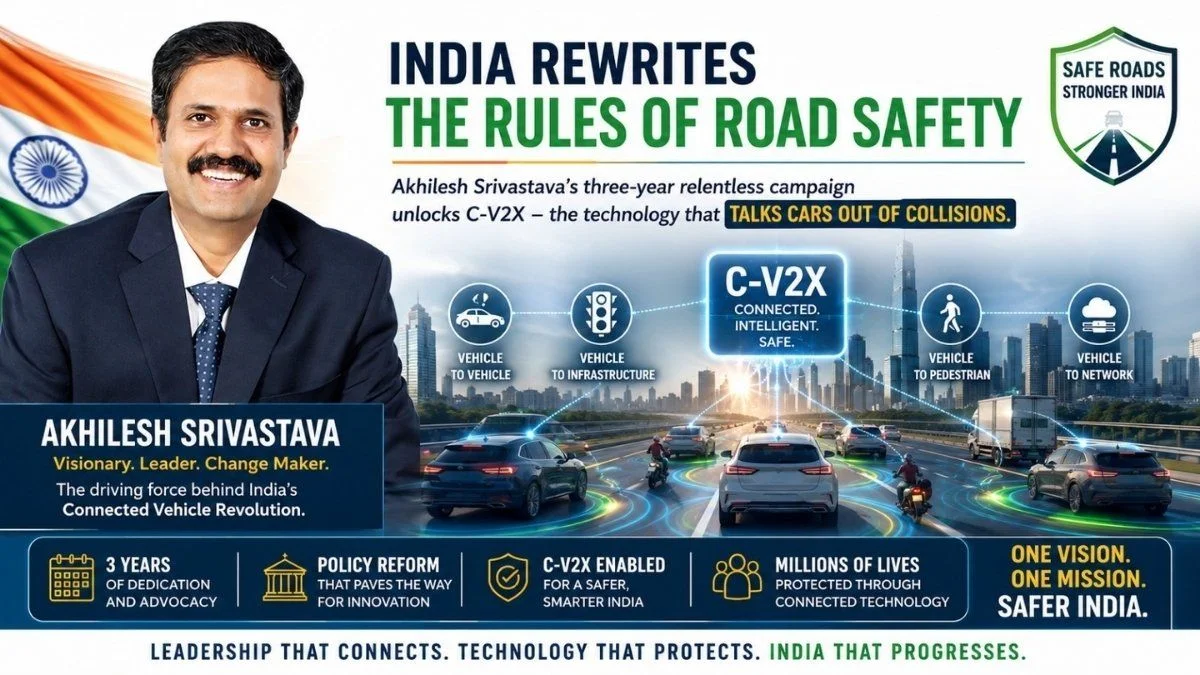
The policy breakthrough stems from years of advocacy by Akhilesh Srivastava, the President of the ITS India Forum. The former national infrastructure executive and World Economic Forum lead spent nearly a decade championing connected vehicle networks.
Srivastava noted that the deployment focuses entirely on protecting human lives by eradicating common driving errors. The technology warns motorists within milliseconds regarding hidden hazards, acting as an invisible safety asset on local roads.
The long road to this notification
India’s policy shift follows years of global progress across key international transportation markets. While Europe deployed similar systems and Japan’s VICS system connected 50 million cars over three decades, domestic frequencies remained restricted.
The United States finalized its own framework through an FCC order in March 2026. Srivastava recognized that India possessed the foundational vehicle tech but lacked the unifying wireless communication infrastructure.
To close this governance gap, he aligned regulatory bodies, technical standard committees, and manufacturing groups. His efforts integrated domestic NavIC positioning systems while adhering strictly to global 3GPP C-V2X standards.
A foundational research paper authored by Srivastava in 2025 urged the immediate liberation of the 5.9 GHz spectrum. That technical blueprint heavily informed the public consultation strategy managed by local telecom authorities.
The regulatory review gathered formal industry feedback from tech corporations and manufacturing associations by May 28, 2026. Following a brief counter-comment window, officials published the finalized gazette notification the next day.
What C-V2X actually does — and why it matters for India
The communication architecture operates via direct device links alongside standard cellular towers within the 5875–5905 MHz spectrum. Networked vehicles transmit critical safety updates to nearby infrastructure with latencies under 10 milliseconds.
This transmission speed registers roughly 50 times faster than typical human sensory perception and physical braking responses. The framework enables direct communication between vehicles, roadside units, pedestrians, and broader cloud traffic management centers.
Local transport data indicates that human error triggers 92% of traffic accidents across the country. High-speed driving, operator fatigue, and mixed traffic conditions aggravate these safety risks on major national thoroughfares.
Network communication protects motorists from hazards hidden around sharp turns or masked by heavy seasonal fog. United States transportation data suggests these safety applications mitigate up to 80% of multi-vehicle collisions.
Applying those safety statistics to India’s 1,77,000 annual traffic fatalities could protect over 100,000 citizens yearly. Industry executives credit the policy shift to reframing automotive tech as a core public health priority.
What comes next — and Srivastava’s larger vision
The new spectrum framework serves as the baseline for a phased national transport rollout. Initial steps require installing wireless communication units inside commercial transport vehicles, public buses, and school vans.
The second phase introduces specialized roadside units across 1,500 national highway toll plazas and known accident zones. The final stage connects the entire automotive fleet into a single automated transport network.
This architecture forms a unified intelligent transport layer powered by an infrastructure foundation model named RoadGPT. The system analyzes real-time sensor information across 63 lakh km of roads to coordinate emergency dispatches.
The global market for these connected vehicle technologies is projected to hit $26.2 billion by 2030. This represents a compound annual growth rate of 43.7% from its initial sub-billion valuation.
With a massive commercial fleet, India is positioned to execute the world’s most consequential safety deployment. Srivastava credited the regulatory success to unified institutional will across various ministries and judicial safety committees.
Automotive groups, telecom operators, and research bodies welcomed the decision, acknowledging the long-term advocacy that secured the order.
FAQs
What is the significance of Gazette Notification G.S.R. 466(E)?
The notification officially de-licenses the 5875–5905 MHz spectrum band in India. This allows Cellular Vehicle-to-Everything (C-V2X) technologies to operate without traditional licensing hurdles, reducing deployment costs and accelerating road safety rollouts.
How does C-V2X technology improve road safety?
C-V2X allows vehicles to communicate with each other, roadside infrastructure, and pedestrians at latencies under 10 milliseconds. This rapid data exchange provides drivers with real-time hazard alerts before the dangers become visible to the human eye.
Which other frequency band was de-licensed alongside the 5.9 GHz spectrum?
The government simultaneously issued notification G.S.R. 468(E), which de-licenses the 77–81 GHz spectrum band. This frequency is specifically reserved for short-range automotive radar systems, completing the regulatory foundation for smart transport.
What are the planned phases for India’s intelligent transport deployment?
Phase 1 integrates communication onboard units into commercial and public transport vehicles. Phase 2 deploys roadside units at over 1,500 toll plazas and accident blackspots. Phase 3 links all vehicles and infrastructure into an AI-powered traffic network.